Main Categories

NaviForum Shanghai 2010

A close brush by a passing typhoon on its opening day aside, NaviForum Shanghai 2010 mustered an impressive slate of senior executives from Chinese companies working in the navigation and telematics/location based services (LBS) field.

Read More >

By Inside GNSS
August 27, 2010

GLONASS-M Satellite Launch Highlights Ambitious Promotion of Russia’s Revitalized GNSS

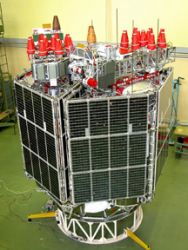
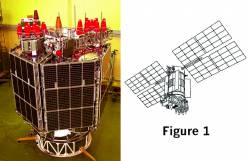
GLONASS-M satellite. Figure/photo, JSC “Academician M.F. Reshetnev “Information Satellite Systems”

A Proton-M carrier rocket successfully launched three GLONASS-M satellites into orbit early this morning (September 2, 2010, Moscow time) from the Baiknour space center in Kazakhstan. Another launch on November 30 will send three more M-type satellites into orbit, and the first GLONASS-K is scheduled to go up on December 25.

The imminent completion of a full constellation by the end of the year is accompanied by a vigorous policy initiative to promote Russia’s revitalized GNSS.

Read More >

By Inside GNSS
[uam_ad id="183541"]

SVN62, the First GPS IIF Satellite, Is Set Healthy

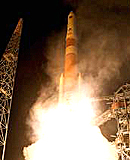
SVN62 launch (ULA)

The U.S. Air Force declared the first GPS Block IIF satellite (SVN62) operational today (August 27, 2010), changing the spacecraft’s navigation signal status to healthy at about 10:10 a.m. (EDT or 4:10 a.m. UTC). 

Launched May 28, the satellite became the responsibility of the USAF 50th Space Wing on August 26,

Read More >

By Inside GNSS
[uam_ad id="183541"]

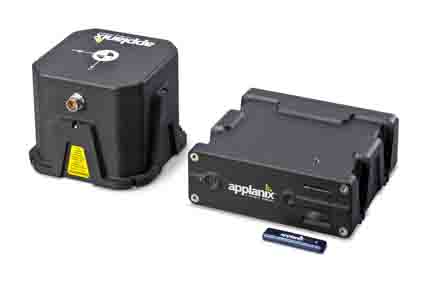
Applanix Releases Updated POS for Land Vehicles

Applanix recently released Version 5 of its Position and Orientation System for Land Vehicles (POS LV).

According to the company, the system uses integrated inertial technology and is designed to generate stable, reliable and repeatable positioning solutions for land-based vehicle applications such as road geometry, pavement inspection, GIS database and asset management, road surveying and vehicle dynamics. The company says the unit is designed to operate under the most difficult GPS conditions in urban and suburban environments.

Read More >

By Inside GNSS

August 24, 2010

CDR Passed: GPS III Ready for Build Phase

Artist’s rendering of GPS III satellite. Lockheed Martin image

More than two years into a multi-billion-dollar contract, the Lockheed Martin team developing the U.S. Air Force’s next-generation GPS Block III satellites continues to defy the physics of large aerospace programs by successfully completing the program’s Critical Design Review (CDR) phase last week — two months ahead of the baseline schedule.

Read More >

By Inside GNSS
August 19, 2010

Air Force Approves 3 GPS Technical Specs

The GPS Wing has authorized publication of three technical documents with updated specifications for the U.S. Global Positioning System, including the next-generation GPS Block IIIA satellites now in development, the L5 radio link, and the new L1 civil signal  (L1C) that will be available with the GPS III spacecraft.

Read More >

By Inside GNSS
August 17, 2010

A Search for Spectrum

In recent years, researchers have explored possible new allocations for Radio Determination Satellite Service (RDSS) and Radio Navigation Satellite Service (RNSS) spectrum from a regulatory point of view. These studies have mainly discussed S-band and C-band in addition to L-band.

The International Telecommunications Union (ITU) Radio Regulations define RNSS as a subset of RDSS. Although the allocations are differentiated — RDSS usually has a paired uplink — both can actually be used for satellite navigation.

Read More >

By Inside GNSS

A Fully Digital Model for Kalman Filters

Q: Is it possible to define a fully digital state model for Kalman filtering?

A: The Kalman filter is a mathematical method, purpose of which is to process noisy measurements in order to obtain an estimate of some relevant parameters of a system. It represents a valuable tool in the GNSS area, with some of its main applications related to the computation of the user position/velocity/time (PVT) solution and to the integration of GNSS receivers with an inertial navigation system (INS) or other sensors.

Read More >

By Inside GNSS
IGM_e-news_subscribe