B: Applications

September 19, 2007

NavCom Tech L1 GPS RTK Receiver

NavCom Technology offers its new SF-2110M and SF-2110R modular L1 StarFire GPS receivers. The SF-2110M has an integrated, compact dual-band antenna capable of receiving GPS and StarFire signals from NavCom’s global satellite-based augmentation system. The SF-2110R includes a separate L-Band antenna for enhanced StarFire signal reception in challenging environments and at high latitudes, according to the company. NavCom Technology Inc., Torrance, California USA.

Read More >

By Glen Gibbons
September 15, 2007

USAF evolves GPS architecture with $800 million upgrade to ground control segment

On September 14, Air Force crews at Schriever AFB, Colorado, completed the initial phase of an $800 million upgrade to the GPS operational control segment.

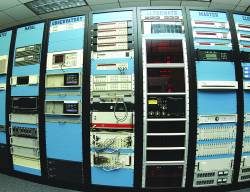
Operators in the 2nd Space Operations Squadron (2SOPS) of the USAF 50th Space Wing migrated control of the GPS satellite constellation and ground monitoring facilities from a 1970s-era mainframe computer to a distributed IT infrastructure with advanced automated features. The 50th Space Wing, through the 2nd SOPS, performs the satellite command and control mission for the Global Positioning System.

Read More >

By Inside GNSS
[uam_ad id="183541"]
September 14, 2007

Symmetricom Launches New Timing Products

San Jose, California–based Symmetricom, Inc., has launched the SyncServer S300/S350, the latest in its line of network time servers using the latest Network Time Protocol (NTP) to synchronize time on servers, workstations, and a variety of network elements for expanding IT enterprises.

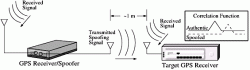
The company also announced that its XLi SAASM Time and Frequency Receiver with a new Ground-Based GPS Receiver Application Module (GB-GRAM) SAASM receiver has been granted security approval by the Global Positioning Systems Wing (GPSW). The GB-GRAM GPS Receiver is integrated into Symmetricom’s XLi SAASM (Selective Availability Anti-Spoofing Module).

Read More >

By Inside GNSS
September 9, 2007

It’s MBOC for common Galileo-GPS civil signal

The United States and the European Union (EU) have agreed to use the multiplexed binary offset carrier (MBOC) for a common GPS-Galileo signal for civilian use. In the future, this will enable combined GNSS receivers to track the GPS and Galileo signals with higher accuracy, even in challenging environments that include multipath, noise, and interference.

These signals will be implemented on the Galileo Open Service and the GPS IIIA new L1 civil signal known as L1C.

Read More >

By Inside GNSS
September 6, 2007

Christopher K. Wilson

Wilson is a leading advocate of positioning and mapping technologies in support of vehicle safety. He was one of the leaders of the Enhanced Digital Map project, a three-year effort by vehicle manufacturers and the government to investigate and demonstrate map-based safety applications. He developed the concept of probe-based mapping, and holds several patents in this area. He has also worked on vehicle positioning systems.

Previously, he served as director of strategic research at Tele Atlas, a major provider of digital map data and other geographic content.

Read More >

By Inside GNSS
August 20, 2007

Trimble Dimensions 2007

Trimble innovations that target the surveying, construction, engineering, and mapping professions, organized into more than 200 educational sessions in multiple specialty tracks. Keynote speakers include Trimble President & CEO Steven Berglund, Dr. Robert Ballard, explorer and discoverer of the wreck of the Titanic, and Peter Hillary, mountaineering explorer.

Read More >

By Inside GNSS
[uam_ad id="183541"]

GNSS Workshop

“Global Navigation Satellite Systems: Problems, Vulnerabilities and Solutions” is the theme of an international workshop jointly organized by the Royal Institute of Navigation (RIN) Croatian Branch and the Institute of Engineering Surveying and Space Geodesy, University of Nottingham, UK. This three day event will focus in particular on developments aiming to improve the accuracy of GNSS, including augmentation systems such as WAAS/EGNOS and networked RTK systems. For more details, contact Dr. Renato Filjar below.

Read More >

By Inside GNSS
July 2, 2007

U.S. Air Force Releases GPS Block IIIA Satellite RFP

After several false starts in the previous months and a multi-year delay in the overall GPS III architecture development, the GPS Wing (formerly the GPS Joint Program Office) announced on July 12 the release of a request for proposal for the development and production of the GPS Block IIIA satellites.

Read More >

By Inside GNSS

GPS + GLONASS for Precision

The SC Geodetic Survey (SCGS) has combined the technologies of the GPS, GLONASS, cellular communications and high-speed server networks to provide centimeter-level accuracy in real-time for surveying, mapping, and engineering applications.

The SC Geodetic Survey (SCGS) has combined the technologies of the GPS, GLONASS, cellular communications and high-speed server networks to provide centimeter-level accuracy in real-time for surveying, mapping, and engineering applications.

Named the SC Virtual Reference Station (VRS*) Network, the system is composed of 45 global navigation satellite system (GNSS) receivers installed statewide and connected by high-speed Internet to servers in the state capital, Columbia. Users connect in the field via cellular digital data communications to access the servers and obtain near real-time custom corrections to position objects or automate vehicle operations.

The South Carolina Department of Transportation has partnered with the SCGS with the intention of using the VRS for machine control to automate highway construction. South Carolina is the only state in the nation to use this technology to include the Russian GLONASS satellites as well as GPS satellites for a more robust solution.

Important to the implementation of the VRS is the provision of a common and consistent connection to the North American Datum NAD83 (2007) via the South Carolina State Plane Coordinate System. All coordinates produced through the use of VRS can be directly tied to NAD83 (2007). Surveyors and engineers will no longer need to be concerned about datum issues and coordinate conversions.

This article will describe how SCGS, which operates within the state Budget & Control Board’s Office of Research and Statistics, designed, implemented, tested, and operates the GNSS VRS network today.

(For the rest of this story, please download the complete article using the PDF link.)

By
July 1, 2007

Galileo’s New PPP: Public-Public Partnership?

GSA Executive Director Pedro Pedreira (left) and Guiseppe Viriglio, ESA director of telecom and navigation, at signing of accord

Having abandoned — for the time being at least — attempts to attract private investment to the creation of Galileo’s infrastructure, European GNSS leaders are working to shape a Plan B that can gain support from the program’s extensive group of stakeholders.

Read More >

By Inside GNSS
June 3, 2007

Speaking with Authority: Galileo’s Lead Agency in a Changing World

Sometimes things don’t go as planned.

That certainly is the situation facing the European GNSS Supervisory Authority (GSA) today as the new lead agency for Galileo affairs.

A meltdown of the public private partnership (PPP) that was supposed to build and operate Europe’s GNSS has thrust an unexpected — and unscripted — role into the hands of the GSA almost at the very moment that the new organization first stepped onto the public stage.

As originally envisioned, the GSA — a European community agency operating under the aegis of the European Commission (EC) — had only to “conclude a concession contract with whichever consortium is selected on completion of the development phase of Galileo.”

Not “negotiate” a contract — that was the task of GSA’s predecessor, the Galileo Joint Undertaking (GJU) — but merely sign off on the deal. And then monitor the contract’s implementation on behalf of its public sponsors while taking up a full suite of other tasks.

Instead, on May 11, the GSA Administrative Board delivered its opinion that progress in negotiations with the consortium of eight companies seeking the 20-year concession contract was not making “relevant progress at the level” needed to ensure a timely completion of the Galileo project.

That conclusion by the GSA board, and a set of alternative courses of action, will now go to the European Union (EU) Transport Ministers Council in early June.

At the center of the storm are the GSA and its executive director, Pedro Pedreira, who took up his responsibilities in July 2005. Before his GSA appointment, Pedreira was serving as director of business development at Portugal Telecom, having spent more than 20 years in the satellite communications field.

Still unfamiliar to many in the GNSS community, the GSA has a €420 million budget for 2007, including €40 million in this year’s R&D allocation from the EC’s 7th Framework Program. An administrative board with representatives from the EU’s 25 member states oversees the authority. Unlike many European Community institutions, however, the board only requires two-thirds majorities for its decisions, which should enable it to act quickly and powerfully.

Although he has been at the GSA nearly two years, it was only upon the “liquidation” of the GJU in January that Pedreira and his organization became truly visible. During the interim, his focus was on building a staff with “critical mass” — now numbering about 50 — and preparing for the authority’s role as the lead agent for supervising implementation of Galileo and monitoring compliance of a Galileo Operating Company (GOC) with the concession contract.

In a series of exclusive conversations with Pedreira and key GSA staff members in March and May, Inside GNSS explored the agency’s mission and the implications of a potentially strategic change of direction for the Galileo program and the authority’s role.

European sources close to the concession negotiations have told Inside GNSS that the leading alternate approach to a PPP is an outright public takeover of the project now and issuance of a new tender for a private operator once most or all of the Galileo space and ground infrastructure is built.

Pedreira would not discuss the specifics of any of the proposed alternatives before they are presented to the transport ministers in June. However, he acknowledged that “the original mandate [to the GSA] was based on a certain model – PPP.” Depending on the decision reached by the transport ministers, “The Council may look at the governance of the program and adjust the mandate of the GSA.”

More, and Then Less

As laid out in a July 12, 2004, EU Council regulation establishing the GSA, the first order of business for the authority was to “conclude a concession contract with whichever consortium is selected on completion of the development phase of Galileo and take steps to ensure compliance by that consortium with the obligations — in particular the public service obligations — arising from the concession contract.”

Because at the time it went out of business the GJU had only managed to thrash out a “head of terms” agreement — essentially, the chapter headings and outline of points for an eventual contract — it initially appeared that GSA would be saddled with a lengthy negotiation with the private consortium. Instead, by the time of the Munich Satellite Navigation Summit in early March, Pedreira and EC Director-General for Transport and Energy Matthias Ruete were decrying the failure of the consortium to incorporate, appoint a CEO, and finish talks on the concession contract.

At a March 22 meeting, the transport ministers gave the consortium until May 10 to meet a series of milestones, leaving it to the EC, “assisted by GSA and ESA [the European Space Agency], to assess progress in the concession negotiations and to submit alternative scenarios, also assessed for costs, risk, and affordability,” in time for their June council meeting.
“The council in March noted its previous decision to implement the project with PPP,” says Pedreira. “But we could have a different geometry of partnership [with the private sector]. It could have a different shape.”

So, what happens to GSA if the transport council (and probably the Ministers Council — heads of state of the 25 EU members) drops or delays implementation of the PPP concept and goes for an public sector–only plan?

“It’s too soon to see how to adjust forms of the current organization,” says Pedreira. “The concession has taken a considerable amount of our resources. We have been giving a priority to the concession [since GSA was established].”
Indeed, supporting the GSA concession effort, headed by Carlo des Dorides who had served as chief negotiator with the GJU, was at the top of several other GSA administrators’ agendas.

In a March interview, Gian Gherado Calini, head of market development, told Inside GNSS that his group had two main tasks: first, the concession and working with des Dorides to identify size and growth of those markets supported by services operated by the concession. Second came downstream markets and creating conditions for them to succeed.

At that time, Hermann Ebner, head of the largest GSA unit, the Technical Department, put support for the concession process at the top of his list as well. A GSA technical task force had completed an assessment of design risks, and the department handled design revisions proposed by the consortium and kept a running tab on the changing cost figures associated with the program.

Even the security section had a role through the PACIFIC project to size the potential markets for the publicly regulated service (PRS), an encrypted signal designed for public safety, law enforcement, and possibly military applications.

Still Plenty to Do

Although the concession headed the list of GSA responsibilities, it is far from the only task given the agency by the 2004 regulation.

“Many aspects of GSA role are independent of the procurement model,” Pedreira says, ticking off some of the others that are top of mind: Galileo security, frequency coordination, management of R&D programs, and integration of the European Geostationary Navigation Overlay Service (EGNOS, essentially a satellite-based augmentation system) into the Galileo infrastructure and operations.

In the matter of market development, for instance, Pedreira points out, “The business plan of the concession internalized only a fraction of the public activity [in application markets].” The Open Service, from which an overwhelming portion of Galileo market revenues will come, was not part of the concession’s mandate. That represents, in Calini’s words, “a gold mine” of potential new services and products.

Getting Technical
. Meanwhile, the EC 7th Framework Program has allocated a total of €350 million over the next seven years for R&D projects under the GSA’s control, plus any still-uncompleted FP6 projects taken over from the GJU. The first calls for tenders on FP7 projects this year will target applications, receiver development, and Galileo implementation, says Ebner.

Another large item on Ebner’s agenda, regardless of GSA’s partner in moving Galileo forward, is system definition and development. On May 11, the agency published announcements for a system definition and performance head, a space segment implementation officer, and a ground mission segment implementation officer.

Other major tasks for the GSA Technical Department include managing the Galileo signal Interface Control Documents (ICDs) and frequency coordination. At its March 21 meeting, the GSA Administrative Board issued notice of an intention to proceed with implementing the multiplexed BOC waveform that will serve as the basis not only for Galileo Open Service signals but the new GPS civil signal at the L1 frequency (L1C).

Unlike the GJU, GSA can sign contracts and handle international agreements previously overseen by other EC departments. It has taken over from the GJU the responsibility for keeping track of projects by the People’s Republic of China, Israel, and other co-investors in Galileo.

Keeping Galileo Safe.
Nearly untouched by the success or failure of the concession is the GSA’s role regarding security for the Galileo system — including space, ground, and user segments. “Galileo is the first EU space program for which security was needed,” says Olivier Crop, the agency’s PRS officer.

The GSA has created a System, Safety, and Security Committee (3SC), which will be a key player in EU decisions on Galileo. The authority also will be responsible for establishing a Galileo Security Center charged with helping protect the system’s critical infrastructure, controlled signals, and PRS-capable user equipment.

EC policy on PRS, which was only approved for inclusion in Galileo in 2004, lets every member nation decide whether they want to allow use of PRS within their own “sovereignty domain.” Each country controls access to its own receivers, but operations in other countries or throughout the EU generally requires approval of the European Council.

EGNOS.
The 2004 council regulation also entrusted the GSA with “managing the agreement with the economic operator charged with operating EGNOS and of presenting a framework on the future policy options concerning EGNOS,” which is largely complete and in provisional operation.

In 2004, with the incorporation of EGNOS into the concession, Pedreira says, came the recognition “that the consortium could not tackle [operating EGNOS] as soon as hoped. There was a need to go for an open tender on EGNOS economic operation.”

EGNOS, in fact, was a subject of discussion at the GSA board’s May 11 meeting. “There are many aspects to settle,” says Pedreira — issues involving ESA and the aviation organizations that are co-owners of EGNOS with the EU. “We will need to transfer assets to GSA to proceed with an open tender” for a service provider to implement early operation of EGNOS.
“At the working level, GSA has very good, very intense relations with ESA, especially on EGNOS and IOV,” he adds.

The GSA is also charged with responsibilities during the in-orbit validation (IOV) phase of Galileo’s development, although ESA is in charge of the technical side of things. “It would be surprising if the council went for a solution without taking note of the progress on the IOV phase and making best use of the assets and investment made to date.”

Perhaps most significantly, under the 2004 council regulation the GSA owns the tangible and intangible assets created during the development and implementation phases of the program. In other words, the agency is the legal guardian of the public interest in Galileo.

Overhanging that role, of course, is what the GSA’s political masters — initially, the transport ministers and, ultimately, the member states — decide to do about Galileo as a whole.

By Inside GNSS
May 1, 2007

Ruth Neilan: The Global Grid Master

Ruth Neilan outside the history library at the GeoForschungsZentrum in Potsdam, Germany.

When Ruth Neilan was named director of what is now known as the Central Bureau of the International GNSS Service (IGS), she had an immense undertaking before her.

A voluntary civilian federation, the IGS compiles and analyzes GPS (and more recently, GLONASS) satellite data. From these, the IGS creates highly accurate products —such as precise satellite orbit and clock files — and makes them freely available to engineers, scientists, and researchers all over the world.

When Ruth Neilan was named director of what is now known as the Central Bureau of the International GNSS Service (IGS), she had an immense undertaking before her.

A voluntary civilian federation, the IGS compiles and analyzes GPS (and more recently, GLONASS) satellite data. From these, the IGS creates highly accurate products —such as precise satellite orbit and clock files — and makes them freely available to engineers, scientists, and researchers all over the world.

The latter folks use the IGS data to improve the accuracy of their own GNSS positioning and timing results based on observations from the same set of satellites, using IGS products in place of the broadcast data.

Originally known as the International GPS Service for Geodyanmics, the standardized global tracking network was initiated by NASA and NOAA in the late 1980s. Today, the IGS Central Bureau is managed by NASA’s Jet Propulsion Laboratory (JPL) at Caltech in Pasadena, California, where Neilan has worked for nearly 25 years. IGS has 200 participating organizations —mostly public, government, and research agencies — with upwards of 400 permanent ground stations and data and analysis centers in more than 80 countries.

But in the early 1990s, all of that was far in the future. Neilan and the IGS had to create the building blocks themselves: setting standards, agreeing upon specific formats for data collection and processing, deciding how much to log to guarantee the precise results they needed. They succeeded in great part because of Neilan’s passion and optimism that GNSS technologies could — and do — bridge geopolitical boundaries.

“Through IGS, developing countries can join an international effort. People are very enthusiastic about contributing,” she said. “Off-the-shelf products have developed to such a point that they can leapfrog into the highest technology that’s available. The difficulty we have is getting enough resources to put their efforts on solid ground and ensure sustainability.”

Never Say “Never”

Neilan’s internationalist bent was established early in life.

She recalls crawling beneath the drafting tables in her father’s engineering firm in Somerset, a small Appalachian town in southwest Pennsylvania, and losing herself in books. She especially like the one with fascinating photographs of Asia and, in fact, went on to study Mandarin Chinese for five years.

As a child, she was convinced that she would “never” be an engineer. But blessed with a surefire sense of direction that she calls “Zen navigation,” Neilan loved reading maps and making precise measurements.

At college, she gravitated to The Pennsylvania State University’s engineering technology program, earned an associate’s degree, and became a surveyor. But she still wasn’t convinced that engineering should be her life’s work, so she took a detour.

A two-year globe-spanning tour started her on the path that combined her passion — Asia and the world — with what turned out to be her calling: engineering and the development of GNSS.

On her sojourn Neilan crossed Turkey and Afghanistan, worked as English editor for a Taipei magazine, climbed to the Mount Everest base camp, and attained an altitude of 19,200 feet— without oxygen — while crossing into the Rowalling Valley along the Tibetan border. Along the way, Neilan realized she was good at engineering.

She returned to the United States to earn a bachelor’s degree in civil and environmental engineering plus a minor in Asian studies, graduating with distinction from the University of Wisconsin at Madison in 1983.

Although the buzz about GPS began perking in the early 1980s, nothing was taught at the university level. After graduating, Neilan visited a friend at the Jet Propulsion Laboratory at California Institute of Technology in Pasadena, California. Hoping for nothing more than ideas for a thesis topic, Neilan arrived wearing flip-flops and shorts. She met with several people working on GPS and, by the end of the day, she had a job.

She put herself on what she laughingly refers to as the first in a series of “five-year plans,” working for JPL while pursuing her master’s degree. She finished her thesis, “An Experimental Investigation of the Effect of GPS Satellite Multipath,” in 1986.

Growing the Global Grid

Neilan’s first major project out of graduate school put her at the hub of the emerging GPS infrastructure. JPL assigned her to get the Deep Space Network’s first GPS receivers and meteorological instrumentation up and running. As that project unfolded, she also managed seminal projects measuring crustal deformation, tectonic motion, and earthquake fault monitoring using GPS techniques.

Starting in 1990, a planning group of five leaders — including Neilan and her mentor at JPL, Bill Melbourne — began meeting to plan the way forward for a global network. Neilan led implementation and operation of ground data systems for the GPS Ground Tracking Network. At about the same time, she also took on the separate task of coordinating the sub-network of six GPS tracking stations required for mission support of the GPS precise orbit determination experiment flown on the satellite TOPEX/Poseidon.

In 1992, she became GPS Operations Manager for the NASA/JPL global network and for scientific support of regional experiments, overseeing project management and technical direction of field engineering for NASA scientists and geodetic tasks at the University NAVSTAR Consortium (UNAVCO) in Boulder, Colorado.

One year later, she was named director of IGS.

The Global Grid and Beyond

Neilan’s serves on the advisory board of the U.S. Positioning, Navigation and Timing Executive Committee, which addresses such issues as policy, planning, management, services, capabilities, and funding.

“This board provides an additional assurance that there is a voice for users,” Neilan says. “The board includes international people, which emphasizes the global nature of GPS.” It also underscores the value that the executive committee places on the international community as part of the process, she adds

Since 2005 she also has served as vice chair of the Global Geodetic Observing System, which provides continuous, precise observations of the three fundamental geodetic observables and their variations: the Earth’s shape, gravity field, and rotational motion. She says a stable, sustainable global reference frame is crucial for all Earth observation and for practical applications ranging from agriculture to the dynamics of atmosphere and the oceans.

The system is beginning to help scientists get their arms around the complexities of seismic activity and climate variation. “Natural hazard detection and mitigation is a really important use of GPS and continuous networking,” Neilan says. “Less than a day after the earthquake that triggered the tsunamis in the Indian Ocean in 2004, we could see that our IGS station in Singapore had moved almost an inch. Our IGS stations in India also had moved.”

Neilan’s zest for travel makes her an ideal fit for her job, which requires frequent trips to developing countries. She lights up when talking about bringing Africa’s 50-plus nations into the grid. This effort, known as AFREF (which stands for unification of African Reference Frames) includes vertical data as well as gravity observations. However, she emphasizes that planning on a continental scale does not have to be “top down or all at once.” Instead, she focuses on assisting newcomers put in GPS systems that meet standards and follow conventions used by the rest of the world.

If Neilan had just one magic GNSS wish, it would that everyone understood the importance of tying into the global grid, known officially as the International Terrestrial Reference Frame. “It’s easy to remotely sense an area, but often contractors or consultants set up their own little local reference system,” she explains. “Then, when they try to link up or extend their project, it has no relationship to the country’s grid, much less the international grid. It’s been very hard to get this across to the mapping and GIS people.”

NASA’s return to space exploration opens up the possibility of extending GPS-like constellations to the Moon and to Mars. “We need to have a way of commonly and seamlessly referencing all the vehicles,” Neilan says. “An extended coordinate timing system would reduce errors.”

Neilan’s daily contacts with colleagues around the globe reinforce her optimism that GNSS technologies can bridge geopolitical boundaries.

“Open availability [of data] is seeding so much innovation and fostering better understanding of our world,” she says. “IGS is the global sandbox. Everybody can have fun and play.”

Neilan’s coordinates:
34° 12′ 5.7" N
118° 10′ 27.47" W
h = 372 meters

Ruth Neilan’s Many GNSS Hats

  • Vice Chair, Global Geodetic Observing System (GGOS) since 2005
  • Director, Central Bureau of the International GNSS Service (IGS), since 1993
  • Advisory board, US Positioning, Navigation and Timing (PNT) Executive Committee
  • Ad Hoc Strategic Committee on Information and Data (SCID), International Council for Science (ICSU)
  • International Committee on GNSS (ICG), representing the International Association of Geodesy (IAG)
  • Executive Committee, International Association of Geodesy
  • IGS website http://igscb.jpl.nasa.gov

COMPASS POINTS

Engineering Specialties
Surveyor, geodetic surveying, and civil and environmental engineering.

GNSS Mentor
Bill Melbourne at the Jet Propulsion Laboratory, a visionary who’s many accomplishments included leading GPS technology developments at JPL. “His support in shaping the GPS global network and working with our international partners laid the foundation for the IGS.”

Favorite Equation
Geoid Separation H=h-N

Heights that are given from GPS (h) are relative to the GPS ellipsoid WGS84. “To get the vertical position of a point, the separation between the geoid and the ellipsoid (N) must be known — with care. You can think of the geoid as the surface of the earth approximated by the mean sea level.”

Her Compass Points
Neilan credits her family first – her “brilliant” jazz pianist husband, “terrific” kids, and parents who “are always there, even for GPS observations in American Samoa, Easter Island, and remote areas of Mexico.” Her other compass points are “the wonderful IGS/GNSS community of colleagues and friends,” and “The great game — soccer!”

Fell in love with GPS when . . .
. . . she realized that this revolutionary technology could provide precise position and navigation aids for anyone, anywhere, anytime. “(This) levels the playing field to an extent — especially in the developing countries.”

Knew GNSS had arrived when. . .
. . .
CASA UNO ’88 deployed the first civilian global tracking network for orbit improvements to monitor crustal deformation at many stations in Central and South America. “This was the first large-scale study of crustal deformation. Now it is done continuously for hundreds of stations around the globe.”

Influences of Engineering on her Private Life
“Time motion studies in the kitchen!”

Popular Notions about GNSS that Most Annoy
“That GPS will operate according to specifications when actually it is far, far better than that. We need to develop the notion of performance-based capabilities and delivery of services.”

What’s next?
For Neilan and IGS, this includes integrating the upcoming signals from GALILEO, COMPASS and other new GNSSes into the mix. They are aiming for seamless incorporation to take advantage of the signals “so that we can use this technology over several decades in order to better understand our changing world.” And, as always, IGS’s on-going effort to promote dialog and a forum for the international use of GNSS.

Human Engineering is a regular feature that highlights some of the personalities behind the technologies, products, and programs of the GNSS community. We welcome readers’ recommendations for future profiles. Contact Glen Gibbons, gl**@********ss.com.

By
IGM_e-news_subscribe