GNSS World

March 28, 2016

Up in the AIRR

Anyone who has sat through several iterations of a slide presentation by the Federal Aviation Administration (FAA) can’t help but wonder if there isn’t a better way to do things.

As speakers flip through an exhaustively vetted series of PowerPoint slides, squeezing out a new bullet point or two from one version to the next six months later, watching paint dry seems like a more productive — and briefer — use of one’s time. The agency sometimes brings a whole new meaning to the concept of geological time.

Read More >

By Dee Ann Divis

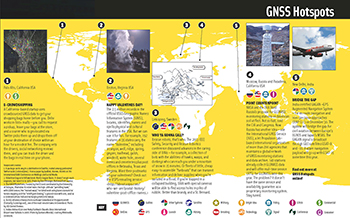
GNSS Hotspots | March 2016

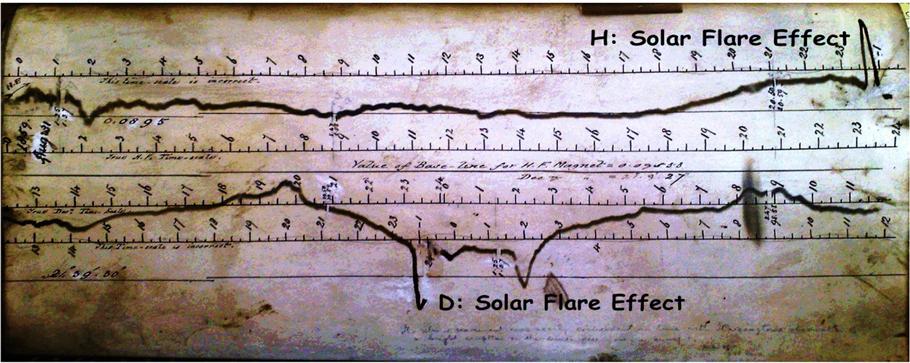
One of 12 magnetograms recorded at Greenwich Observatory during the Great Geomagnetic Storm of 1859
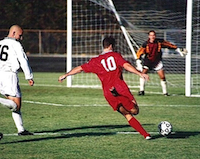
1996 soccer game in the Midwest, (Rick Dikeman image)
Nouméa ground station after the flood
A pencil and a coffee cup show the size of NASA’s teeny tiny PhoneSat
Bonus Hotspot: Naro Tartaruga AUV
Pacific lamprey spawning (photo by Jeremy Monroe, Fresh Waters Illustrated)
“Return of the Bucentaurn to the Molo on Ascension Day”, by (Giovanni Antonio Canal) Canaletto
The U.S. Naval Observatory Alternate Master Clock at 2nd Space Operations Squadron, Schriever AFB in Colorado. This photo was taken in January, 2006 during the addition of a leap second. The USNO master clocks control GPS timing. They are accurate to within one second every 20 million years (Satellites are so picky! Humans, on the other hand, just want to know if we’re too late for lunch) USAF photo by A1C Jason Ridder.
Detail of Compass/ BeiDou2 system diagram
Hotspot 6: Beluga A300 600ST

Dangerous Games in Rio, Animal Trackers, Chinese Logistics and The Radiation Club

Read More >

By Inside GNSS
March 27, 2016

Sandy Kennedy’s Compass Points

Return to main article: Sandy Kennedy: Here to Stay

COMPASS POINTS

Engineering specialties

Algorithm development, Kalman filtering, GNSS/INS integration, digital signal processing, embedded software, system integration

Favorite equation

Kennedy really likes the foundational differential equation, the basis of Kalman filtering, because it can become so many different things:

Read More >

By Inside GNSS
[uam_ad id="183541"]
March 18, 2016

Sandy Kennedy: Here to Stay

Sandy Kennedy and her husband Arlin Amundrud

>>Sandy Kennedy’s Compass Points

Sandy Kennedy grew up in Miami. Miami, Manitoba, Canada, that is — a town of 150 people with a school, a café, a defunct railroad station, and an ice skating rink.

Now she’s director and chief engineer in charge of receiver core cards at NovAtel Inc., a developer and manufacturer of high-precision GNSS products headquartered in Calgary, Alberta. It’s a long way from where she started, but then again, maybe not.

Read More >

By Inside GNSS

GLONASS and PNT in Russia

The legal and regulatory framework of the Russian Federation covers not only the GLONASS system, but the country’s overall positioning, navigation and timing (PNT) system as well.

The term PNT is a synonym for navigation activities as defined in the Federal Law on Navigation Activities. The PNT system in the Russian Federation is defined as the combination of administrative and technical means that provide spatial and time data to all user groups, with GLONASS as a key element.

Read More >

By Ingo Baumann

What are the fundamentals of an effective GNSS test plan?

Q. What are the fundamentals of an effective GNSS test plan?  

A. One aspect of GNSS development that engineers often find challenging is the lack of common testing standards and procedures. This can make life difficult for the engineer tasked with constructing a test plan for a new GNSS-enabled system. How much testing is proportionate, at which stages of development? What are the key performance parameters to measure? What apparatus is best suited to the application, and what are the appropriate pass/fail criteria?

Read More >

By Inside GNSS
[uam_ad id="183541"]

How Privatizing Air Traffic Control Could Affect Satellite Navigation’s Role in Aviation

The satellite-based NextGen program is in trouble — no question about it.

The Federal Aviation Administration (FAA) air traffic modernization effort will likely cost triple its original $40-billion program budget and need an extra decade — until 2035 or beyond — to reach completion, according to 2014 testimony by Department of Transportation (DoT) Inspector General Calvin Scovel.

Read More >

By Dee Ann Divis
January 27, 2016

Making Good Better

SBAS and RNSS: The Unsung Heroes of GNSS

Okay, if I had wanted to pander to GNSS fans, I might have called this, “Making Great Greater.”

But there are only so many superlatives that can be lathered on this remarkable technology before simple praise turns into hagiography.

So, it’s time once more to give a little love to those unsung heroes of GNSS: the augmentations and regional navigation satellite systems.

Read More >

By Inside GNSS

GNSS Hotspots | January 2016

One of 12 magnetograms recorded at Greenwich Observatory during the Great Geomagnetic Storm of 1859
1996 soccer game in the Midwest, (Rick Dikeman image)
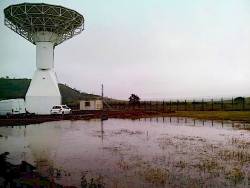
Nouméa ground station after the flood
A pencil and a coffee cup show the size of NASA’s teeny tiny PhoneSat
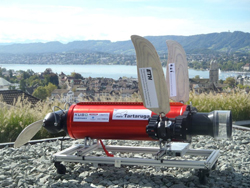
Bonus Hotspot: Naro Tartaruga AUV
Pacific lamprey spawning (photo by Jeremy Monroe, Fresh Waters Illustrated)
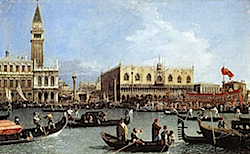
“Return of the Bucentaurn to the Molo on Ascension Day”, by (Giovanni Antonio Canal) Canaletto
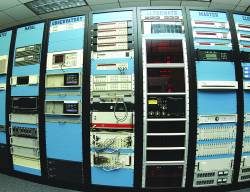
The U.S. Naval Observatory Alternate Master Clock at 2nd Space Operations Squadron, Schriever AFB in Colorado. This photo was taken in January, 2006 during the addition of a leap second. The USNO master clocks control GPS timing. They are accurate to within one second every 20 million years (Satellites are so picky! Humans, on the other hand, just want to know if we’re too late for lunch) USAF photo by A1C Jason Ridder.
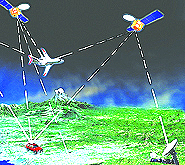
Detail of Compass/ BeiDou2 system diagram

Hotspot 6: Beluga A300 600ST

Catching thieves in California, Galileo satellites test Einstein, Russian space agency remodel, and 911 training for operators who can’t read maps.

Read More >

By Inside GNSS
January 19, 2016

Galileo Themes, Threads and Visions

Europe’s space community rang in the New Year with two of its brightest annual fixtures: the European Union (EU) Space Policy conference in Brussels and the European Space Agency (ESA) media briefing in Paris.

The events brought out all of the relevant voices and served to illustrate not only the disposition of materiel and troops but also their intent and even the level of morale. 

Read More >

By Peter Gutierrez
January 18, 2016

GNSS Satellite-Based Augmentation Systems

Working Papers explore the technical and scientific themes that underpin GNSS programs and applications. This regular column is coordinated by Prof. Dr.-Ing. Günter Hein, head of Europe’s Galileo Operations and Evolution.

With the support of the European Space Agency (ESA), a European team designed a frequency- and time-transfer process and validated its performance in a complex navigation test bed. This two-way time-transfer technology took advantage of the following:

Read More >

By Günter W. Hein

What is Doppler collision and is it a problem in GNSS?

Figure 1, 3, 4 & 5

Q: What is Doppler collision and is it a problem in GNSS?

A: Doppler collision is a physical effect in code-division multiple access (CDMA) systems where code measurement errors are observed due to cross-correlation effects. Doppler collision may occur when the Doppler frequency between signals from two different transmitters is smaller than the code lock loop bandwidth.

Read More >

By Inside GNSS
1 18 19 20 21 22 39
IGM_e-news_subscribe