Main Categories

NavtechGPS Takes on Raven GPS-Related Product Distribution

Raven Industries Electronic Systems Division has announced a new distributor relationship that will offer the company’s differential GPS (DGPS) products through NavtechGPS, of Springfield, Virginia.

Effective December 15, 2011, NavtechGPS began receiving and processing U.S. orders for Raven StarLink DGPS products, including line amplifiers, Raven Link timing & synchronization system, down/up converters, splitters, and antennas.

Read More >

By Inside GNSS
December 26, 2011

Spirent Launches Data Sets of World City Environments to Aid GNSS Receiver Testing

Spirent Communications has launched of a subscription service for live GNSS (GPS, GLONASS, and QZSS) environmental-capture data set samples, recorded at major locations worldwide, in challenging urban and suburban conditions.

The data sets are designed for use with the company’s GSS6400 GNSS Record and Playback test System. They encompass a variety of recorded scenarios ranging from drive-through multi-level roads, tunnels, and car parks to drive-throughs in downtown areas with high-rise buildings.

Read More >

By Inside GNSS
[uam_ad id="183541"]

ESA Report: Galileo IOV Transmitting on all 3 Frequencies

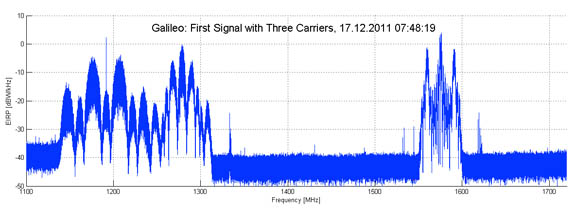
The European Space Agency (ESA) has reported its first successful reception of triple-frequency signals from a Galileo in-orbit validation (IOV) spacecraft.

The weekend of December 17 all Galileo signals were activated simultaneously for the first time across the European GNSS system’s three spectral bands, known as E1 (1559–1592 MHz), E5 (1164–1215 MHz), and E6 (1.215–1.300 MHz). The accompanying graphic displays the signals spectral profile.

Read More >

By Inside GNSS
[uam_ad id="183541"]
December 12, 2011

Galileo IOV Satellites Begin Transmitting E1 Signal

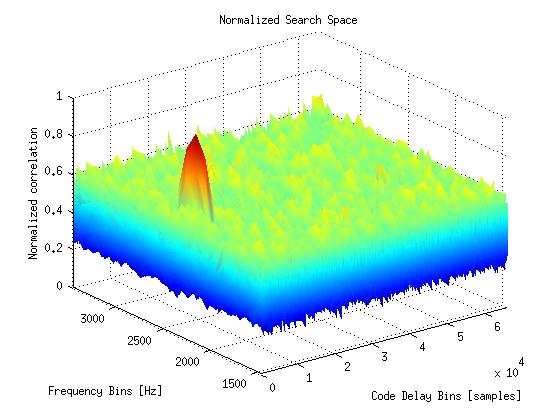
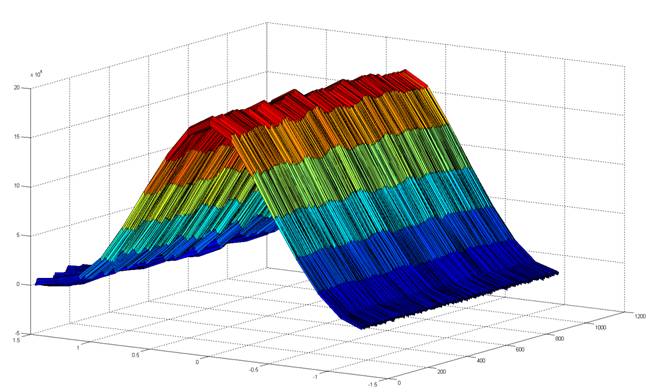
The PRN 11E5b autocorrelation function as monitored by TAS-I receiver (x axis represents chip spacing y, time in seconds).

[Updated December 14, 2011] Today (December 12, 2011), the first of two Galileo IOV satellites launched October 21 began transmitting its payload signals.

Researchers at several European organizations have reported initial acquisition and tracking results of the E1 signals from the Galileo-ProtoFlight Model (PFM) satellite (previously incorrectly identified as Flight Model-2), also identified by its pseudorandom noise code (PRN 11).

Read More >

By Inside GNSS
December 5, 2011

Conference Survey Reflects North American Leadership in GNSS Innovation, Delays in Galileo Program

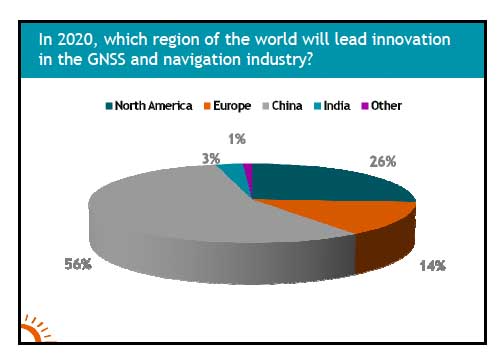
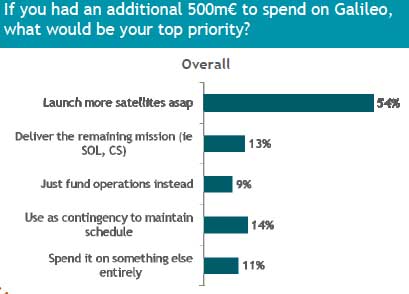
A survey of 140 attendees at last week’s European Navigation Conference (ENC 2011) in London, England, produced a fascinating assessment of GNSS expectations in the coming years — and how that assessment has changed since 2007.

Sponsored by Helios, a UK business and technology consultancy working in the transportation and technology domains, the survey asked delegates eight questions with multiple choice answers, and recorded their responses using handheld keypads and live electronic voting.

Read More >

By Inside GNSS
December 1, 2011

European Commission Rolls Out Free Software for EGNOS Developers

The European Commission has introduced free, downloadable and ready-to-use software tools to help anyone develop enhanced location and timing applications that harness the power of Europe’s European Geostationary Navigation Overlay Service (EGNOS).

EGNOS, which began operations earlier this year, provides real-time satellite-based corrections and integrity monitoring for GPS satellite signals.

Read More >

By Inside GNSS

Galileo Regains Momentum with Financial, Management Framework Proposals

Paul Weissenberg of the European Commission’s Enterprise and Industry directorate

After years of arduous political navigation filled with delays and disappointments, Europe’s GNSS programs appear to have found firmer ground as it heads into a crucial deployment phase.

Today (November 30, 2011), the European Commission (EC) proposed a €7 billion (US$9.41 billion) allocation for Galileo and EGNOS in the European Union’s next budget cycle (2014–2020) and delegation of the programs “exploitation” to the European GNSS Agency (GSA) and the systems’ deployment, to the European Space Agency (ESA).

Read More >

By Inside GNSS
November 30, 2011

LightSquared Postpones International Expansion Effort

A GPS app on a Japanese smartphone. The GPS Council there told the FCC that any signal degradation could jeopardize the Global Positioning System’s standing as a global standard.

LightSquared has dropped, for now, efforts to expand its wireless broadband plans to markets in other countries, Inside GNSS has learned.

The Virginia firm was working this summer on proposals to the International Telecommunication Union, including one aimed at addressing compatibility issues between ground stations or “complementary ground components” of mobile satellite services and other frequency-using services.

Read More >

By Inside GNSS

Spirent Launches TestDrive-GNSS Automation Software

Spirent Communications has announced the launch of its new automation and reporting tool, TestDrive-GNSS for SimGEN- and SimREPLAYplus-controlled GNSS test systems. TestDrive-GNSS automates the testing process to significantly reduce overhead costs and testing times associated with characterization of GNSS devices.

Read More >

By Inside GNSS
IGM_e-news_subscribe