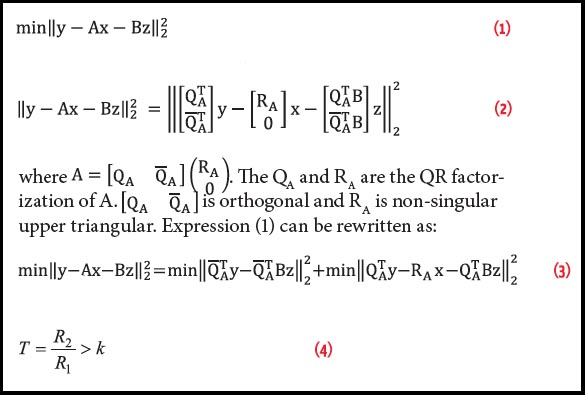
How do you trust centimeter level accuracy positioning?
Q: How do you trust centimeter level accuracy positioning?
By Inside GNSS
Global Navigation Satellite Systems Engineering, Policy, and Design
Q: How do you trust centimeter level accuracy positioning?
By Inside GNSS
The first Satellite Masters Conference will cover space-based business applications for Copernicus and Galileo in Europe. It will take place on October 23 and 24 at the German Federal Ministry of Transport and Digital Infrastructure (BMVI).
The event is free, but registration before October 10 is required.
By Inside GNSS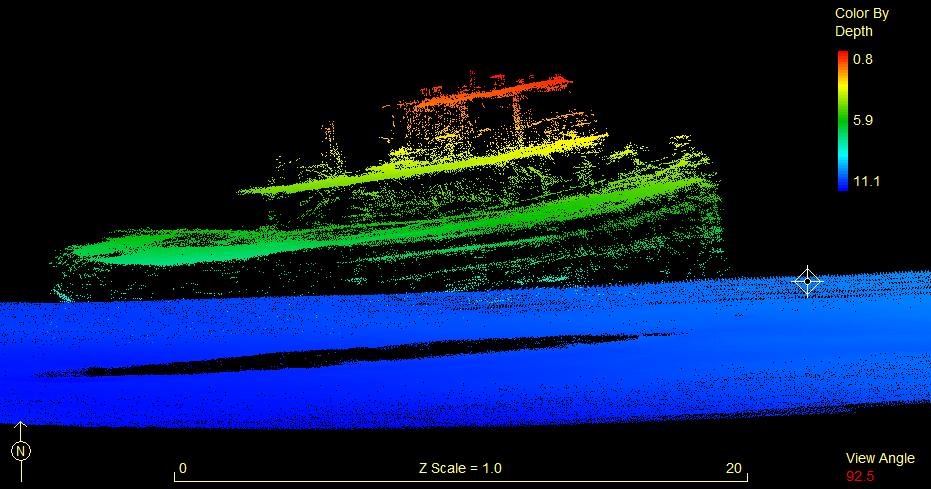 Sidescan image of Norbit Seahorse
Sensonor has announced new features for its STIM300, a small, lightweight micro-electro-mechanical system (MEMS) inertial measurement unit (IMU) that provides non-GPS–aided positioning in multiple domains.
The STIM300 — which can be used underwater, on land and sea, and in aeronautic and astronautic applications — now has real-time g-compensation in al axes and supports rates of up to 2000 degrees/second.
By Inside GNSS Graham Purves, new Veripos CEO
In his role as president of Hexagon Positioning Intelligence, Michael Ritter has announced the appointment Graham Purves as president & CEO of Veripos, effective September 9.
“Graham has amassed a tremendous level of experience in all aspects of our industry during his over 25 years at NovAtel,” said Ritter, who also serves as president and CEO of the Calgary, Canada–based NovAtel Inc. “This experience and especially his dexterity for sales, marketing, and business development are ideal prerequisites for this next step in his career.”
By Inside GNSS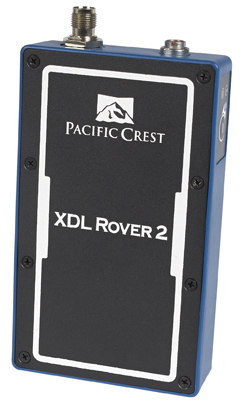
Available now, the XDL Rover 2 is equipped with Bluetooth wireless communication for ease in configuration and operation, including use with Android devices in the field. UHF data can be transmitted via Bluetooth to a paired host device for operational efficiency.
By Inside GNSS
The high-precision GNSS industry should expect to see industry consolidation and a scramble for new markets and innovations as prices for high-end chips and modules continue to slide, experts told attendees at a ION GNSS+ panel discussion in Tampa, Florida, last week (September 11, 2014).
The falling prices could strain R&D budgets, they noted, but could also create opportunity as high-end receivers come within reach of emerging industries like self-driving cars, unmanned aerial vehicles, and are even incorporated into consumer products.
By Inside GNSS

Working Papers explore the technical and scientific themes that underpin GNSS programs and applications. This regular column is coordinated by Prof. Dr.-Ing. Günter Hein, head of Europe’s Galileo Operations and Evolution.
By Inside GNSS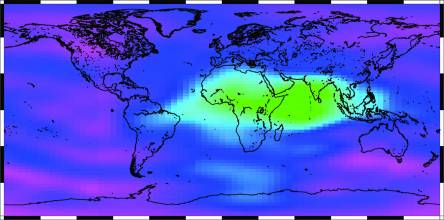
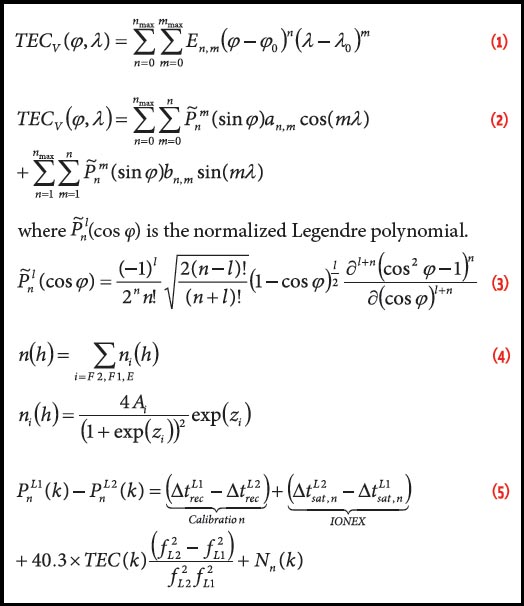
Scintillation — rapid RF signal frequency and amplitude changes due to signal propagation path changes and phase shifting caused by solar turbulence in the ionosphere — is well known in the GNSS community. However, conclusive scientific studies that cover the whole extent of the question are hard to find. Galileo In-Orbit Validation Experiment (GIOVE) data processing confirmed the effects of scintillation on GNSS receivers, as described in the paper by J. Giraud listed in the Additional Resources section near the end of this article.
By Inside GNSS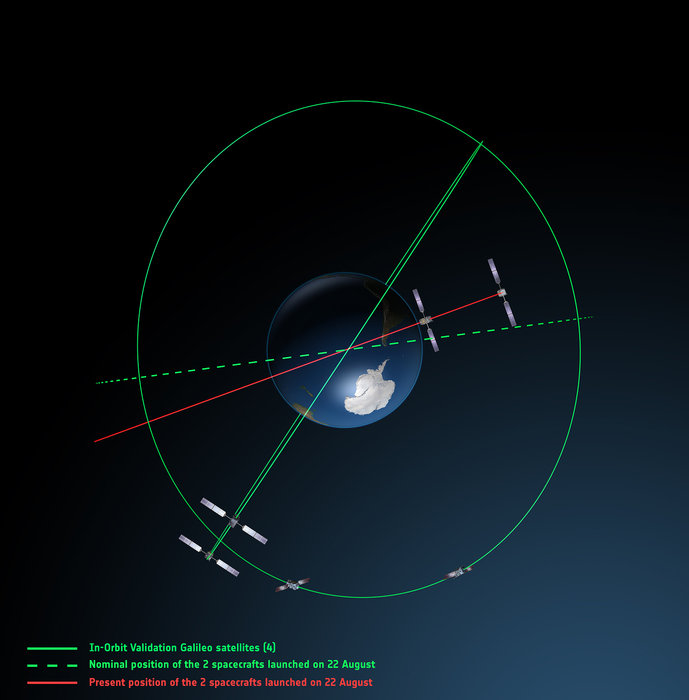 Orbits of the fifth and sixth Galileo satellites launched together on August 22, 2014, in red, compared to their intended position, in dashed green, and the position of the four IOV satellites launched in 2011 and 2012 in solid green. This view looks down over Earth’s South Pole, helping to illustrate how the two satellites’ orbital inclination relative to the equator is less than was intended ESA illustration.
The European Space Agency (ESA) released dramatic illustrations today (September 16, 2014) of the orbital locations of the two errant Galileo spacecraft launched on August 22, the intended orbit, and the locations of four In-Orbit Validation (IOV) satellites.
By Inside GNSS
Two European proposals to allow pseudolites in the protected frequencies used by GPS and Galileo could soon be adopted, creating a potential interference risk to GNSS receivers and hampering efforts to protect satellite navigation spectrum, experts say.
By Inside GNSS
The European GNSS Agency (GSA) and Eurocontrol have signed a new cooperation agreement to jointly contribute to the implementation of European Union GNSS policies as they apply to the field of aviation.
By Inside GNSS The Antiquarium in the Residenz München
The Munich Satellite Navigation Summit will take place at the Residenz Muenchen in Munich, Germany on March 24 – 26, 2015.
The theme for this year’s summit is “Future of PNT – A Glance into the Crystal Ball”.
The technical program includes plenary discussions and updates on the main activities in worldwide satellite navigation systems, including:
By Inside GNSS
 The Capitole of ToulouseToulouse, France
The 2014 International Technical Symposium on Navigation and Timing will be held at the ENAC premises (Bellonte Amphitheater) in Toulouse, France on November 17 – 18, 2014. The objective of the symposium is to gather experts and innovators that will present their views/work on specific navigation- and/or timing-related topics, with an emphasis on technical aspects.
Online registration is open.
By Inside GNSS