
Septentrio unveils AsteRx-m2 Sx, a GPS/GNSS receiver offering always-on sub-decimeter accuracy without the need for additional correction service subscriptions.
By Inside GNSSThe U.S. Department of Defense awarded a $1.7 million contract to Orolia Defense and Security for multiple BroadSim advanced GPS simulator systems for testing facilities and field test assets.
By Inside GNSSThe fourth GNSS Raw Measurements Task Force Workshop gathered more than 200 participants from 32 countries in an online experience in late May. A keynote presentation by Frank van Diggelen from Google led the charge, unveiling recently updated Google tools for logging and analyzing GNSS measurements on the Android platform. The European GNSS Agency (GSA) hosted.
By Inside GNSSThe China Satellite Navigation Office (CSNO) announced completion of two years of testing of BeiDou inter-satellite links, an innovative feature of the GNSS that will reportedly produce greater accuracy for users on Earth. The test campaign encompassed 29 satellites of the third generation (BDS-3) of the now global system.
By Inside GNSSThe Institute of Navigation premier conference, ION GNSS+ 2020, held annually in September, will this year have a virtual option for attendance. It will mirror the technical program presented live, September 21-25 in St. Louis, Missouri, and will give global attendees access to the latest GNSS developments and content. Virtual meeting attendance will be free for all first-time ION GNSS+ attendees.
By Inside GNSSA new magnetic anomaly navigation technique (MAGNAV), researched by the Air Force Institute of Technology (AFIT), will get its wings tested aboard F-16 fightercraft this September. In an effort seeking alternatives to GPS and GNSS, MAGNAV sensors and software will be flown on Air Force Test Pilots School (AFTPS) F-16s over a test range adjacent to Edwards Air Force Base in Nevada.
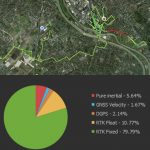
By Inside GNSSSwift Navigation has completed a 6,600-mile cross-country drive test measuring the efficacy of its Skylark cloud corrections service and demonstrating nationwide lane-level GNSS correction coverage at the accuracy, reliability and availability levels required by its customers.
By Inside GNSSTersus GNSS has released the BX40C RTK Board to support its series of GNSS boards and provide high-accuracy, fast positioning services. Powered by new Tersus ExtremeRTK GNSS technology, the BX40C Board can support multi-constellation and multi-frequency all-in-view satellite tracking.
By Inside GNSSWe cannot simply test-drive our way to safety. Instead, innovative methods of demonstrating safety and reliability must come into play immediately.
A free three-hour professional training over two days in June aims to show how.
By Inside GNSSA group of Stanford Ph.D. and Masters graduates, with work experience among them at SpaceX, Ford Motor Systems, Blue Origin, Booz Allen Hamilton and other firms, has launched a start-up to start up a low-Earth orbit successor to GPS and other GNSS. The existing services, they say, are not up to the challenges of autonomy. They founded Xona Space Systems to supplant the venerable satnav systems.
By Inside GNSSThe Position Authenticated Tachograph foR OSNMA Launch (PATROL) project is developing the first external GNSS facility for smart tachographs, using Galileo’s new Open Service Authentication (OS-NMA). The tachograph, a device fitted to a vehicle that automatically records its speed and distance, together with the driver’s activity selected from a choice of modes, uses Galileo authentication to verify that the navigation data received from satellites is genuine.
By Inside GNSSThe U.S. Air Force updated the GPS Standard Positioning System (SPS) Performance Standard (PS) in mid-April, 2020, the first new Performance Standard document since 2008. It includes mention of and pre-Initial Operating Capability (IOC) performance standards for the new civil GPS signals L2C and L5 for the first time. In another new feature, the document mentions “expanded capabilities which allow the total size of operational constellation to grow beyond the previous maximum of 32 Navstar satellites” for “more robust constellation availability to enhance the overall SPS SIS performance.”
By Inside GNSS