agriculture

August 8, 2014

Test Sites: The Select Six

ALASKA
Remote Sensing

1. The Team
The Pan-Pacific UAS Test Range complex is likely the largest of the FAA test ranges both in terms of its number of participants and its geographic coverage. The University of Alaska Fairbanks manages the team, which comprises some 59 contributors including Oregon and Hawaii as well as the countries of Norway, Ireland and Canada.

Read More >

By Inside GNSS
[uam_ad id="183541"]

Special Report: UAS in the NAS

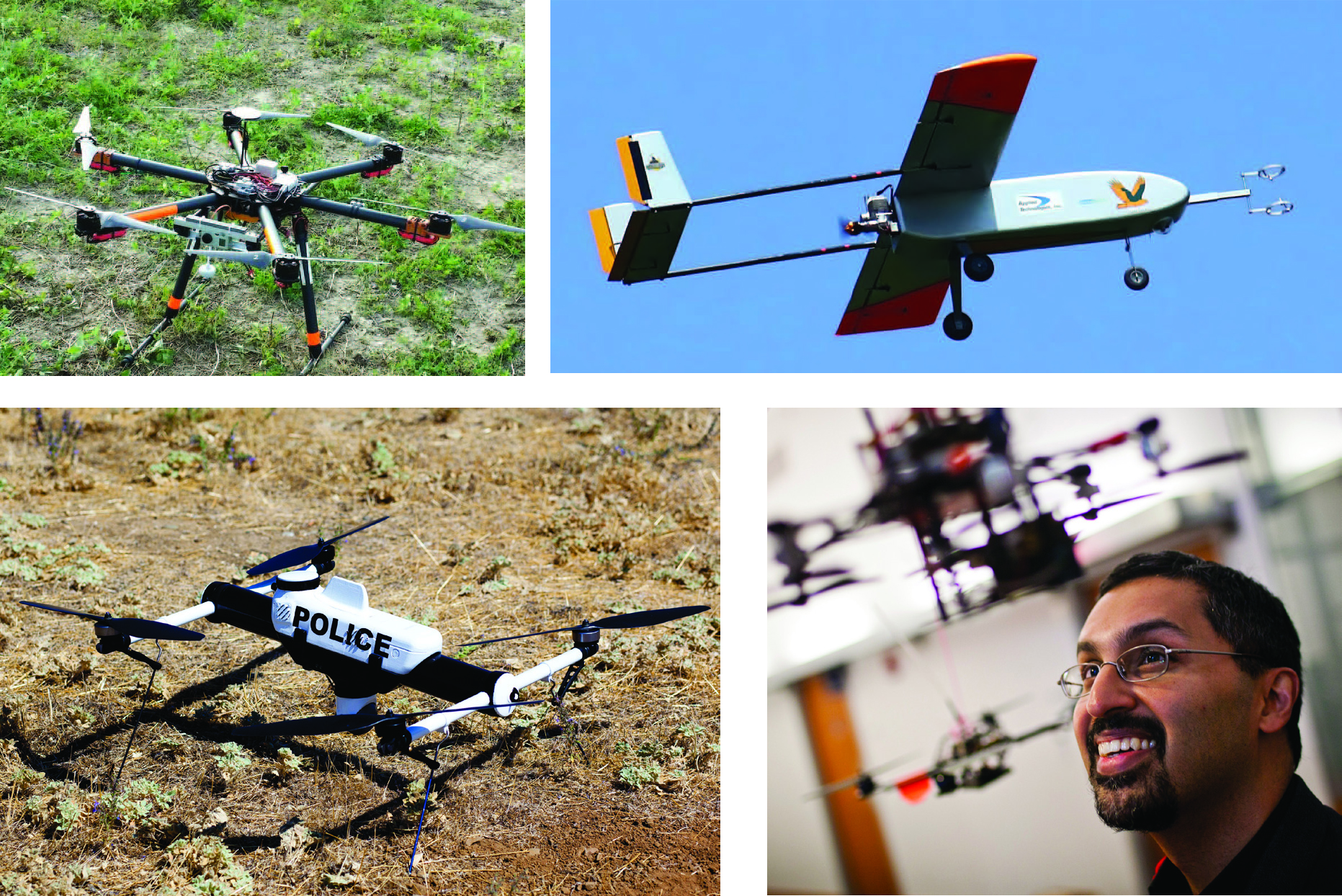
Clockwise from top left: A small drone rests on the ground during a demonstration in Florida, The Golden Eagle, a UAV developed at Clarkson University, takes wing, Nick Roy smiles at a drone in a lab at MIT, The Qube unmanned aerial vehicle by AeroVironment.

BY THE NUMBERS

Read More >

By Inside GNSS

Driverless Cars

Stanley, an autonomous car developed by the Stanford University Racing Team, won the 2005 DARPA Grand Challenge after successfully traversing a 132-mile course.

Interest in automated vehicles is surging, fueled by visions of computer-directed cars able to independently thread their way through a traffic jam before safely dropping off their otherwise-occupied passengers and finding their own parking place.

Read More >

By Inside GNSS

Publisher’s Letter

Transformative.

My first encounter with an unmanned aerial vehicle, or UAV, was at the German Aerospace Center (DLR) in Oberpfaffenhofen Germany. Here, I watched in awe as a small quadrotor operated in an indoor flight testing “holodeck,” complete with an array of high-frequency strobe/camera units designed to log, stream and visualize precise position and attitude for rapid 3D mapping.

Read More >

By Inside GNSS
July 21, 2014

New Leaders at the GPS Helm

Washington, D.C., has a peculiarity of seasons. While most of the world marks the shifts between winter and spring, summer and autumn, the politicos on the streets of the U.S. capital count the passage of time in two-year increments.

New operatives and appointees flock to the centers of power in the early days of each administration and the opening of each Congress, then migrate to friendlier climes as congressional elections loom and the administration winds down — as it is now.

Read More >

By Dee Ann Divis
[uam_ad id="183541"]
July 16, 2014

Communications Act Rewrite Could Adversely Affect GPS Community

Two powerful lawmakers are weighing rewriting the rules for the way frequencies are allocated as part of an overhaul of the nation’s telecommunications laws. The effort, which is likely to see legislation drafted next year, is considering options such as flexible licensing and receiver standards that could directly affect the GPS community.

Read More >

By Inside GNSS
July 11, 2014

UN/ ICG Workshop: GNSS for Scientific Applications

Aerial view of ICTP

A weeklong workshop on GNSS and its scientific applications in low-latitude regions of the world will be held in Trieste, Italy at the Abdus Salam International Centre for Theoretical Physics (ICTP) on December 1-5, 2014.

The five-day event will be held in English. It is sponsored by the United Nations Office for Outer Space Affairs (UNOOSA) and organized by the USA and European Commission through the UN’s International Committee on GNSS (ICG).

Read More >

By Inside GNSS
June 30, 2014

FAA Seeks Comment on Groundbreaking UAS Application, Model Aircraft Rules

Federal aviation officials appear to be moving quickly to defuse mounting pressure for the commercial use of unmanned aircraft, clarifying their authority over such aircraft and starting the public process for licensing small firms for limited operations.

The Federal Aviation Administration (FAA) has taken a tough stance in its interpretation of the legal uses for model aircraft published on June 23 in the Federal Register. The issue surged into the national spotlight when the agency failed to win a legal challenge over its authority to regulate such devices.

Read More >

By Inside GNSS
May 18, 2014

FAA UAV Exemption Process Is in Place, Though Perhaps Imperfect

Jim Williams, FAA UAS Integration Office. AUVSI photo

Companies hungry to offer commercial services in the United States with unmanned aircraft finally have something to chew on.

The Federal Aviation Administration (FAA) has laid out a process whereby a carefully selected set of unmanned aerial systems (UAS) may be granted an exemption to do for-pay flights before the first broad rules for U.S. flying unmanned aircraft are finalized.

Read More >

By Inside GNSS
1 7 8 9 10 11 14
IGM_e-news_subscribe