Main Categories

March 13, 2009

Broadcom, SiRF Top GPS IC Vendor Ranking

A sophisticated vendor matrix that measures qualitative as well as quantitative factors ranks Broadcom as the leading supplier of GPS chips worldwide.

SiRF Technology and Texas Instruments came in second and third in the GPS Integrated Circuit Manufacturer Vendor Matrix, developed by ABI Research based in Oyster Bay, New York, with results announced today (March 12, 2009).

Read More >

By Inside GNSS
March 6, 2009

Munich Summit Highlights Satellite Navigation Plans, GNSS Program Struggles

Paul Verhoef, European Commission (left), and Yin Jun, China Ministry of Science and Technology


Highlights of the 2009 Munich Satellite Navigation Summit (March 3- 5):
Russia will place its first CDMA signal on the GLONASS L3 frequency that overlaps the European Galileo E5b spectrum; China plans to launch three Compass satellites this year and seven more next year to provide a regional capability for Compass/Beidou, followed by completion of the full 30-MEO, 5-GEO constellation after 2015 and before 2020; Galileo program discussions revealed tensions around negotiations with China about a frequency overlay of Compass signals on the security-oriented Public Regulated Service as well as the question of whether the costs to build Galileo can be kept within the €3.4-billion limit agreed by the European Council and the European Parliament; the GPS Block IIR-20(M) satellite with an L5 demonstration payload will be launched later this month in what may be the program’s last chance to secure primary GPS access to the frequency.

Read More >

By Inside GNSS
February 28, 2009

FY 2010 Budget Outline Proposes to End Loran

Ready for another round?

President Obama appears to have weighed in on the long-running Loran/eLoran debate — on the side of terminating the terrestrial radionavigation system and, apparently, its enhanced version that had been proposed as a backup to GPS.

In a February 26 message to U.S. Coast Guard (USCG) members, Vice-Admiral V. S. Crea, USCG Vice Commandant and Chief Operating Officer, said the Fiscal Year 2010 (FY10) budget outlined in a document sent to Congress calls for termination of Loran-C in the coming year.

Read More >

By Glen Gibbons
[uam_ad id="183541"]
February 26, 2009

Federal Commission Backs Mileage Fees over Gas Taxes, Champions GPS Technology

Maybe it was just poor timing.

U.S. Transportation Secretary Ray LaHood’s passing comment that systems for assessing fees based on vehicle miles traveled (VMT) rather than gasoline taxes was quickly shot down by White House press secretary Robert Gibbs in a February 20 news conference.

On February 26, however, the congressionally mandated National Surface Transportation Infrastructure Financing Commission (NSTIFC) came out with a recommendation the United States should do exactly that — and pointed firmly to GNSS systems as a key enabling technology for accomplishing such a transition.

Read More >

By Glen Gibbons
February 24, 2009

GNSS Vulnerabilities and Solutions Conference 2009

The 2009 GNSS conference will focus on problems and vulnerabilities, and in particular, on developments aiming to improve the accuracy and reliability of the various GNSSes. It will take place on the resort island of Krk during the Adriatic high season.

Two special sessions will be organised in order to address particular causes of GNSS vulnerabilities: Space Weather and Ionospheric Effects on GNSS, and Safety Critical Applications (concerning primarily the ITS).

Read More >

By Inside GNSS

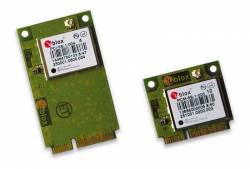
u-blox Launches Mobile Computer Cards

u-blox PCI-5S and PCM-5S

u-blox has announced the immediate availability of a GPS “PCI Express Mini” card. The card enables laptops, netbooks, mobile Internet devices, and “Ultra Mobile” PC OEMs to provide GPS and location-based services such as personal navigation, services/people finder, and geo-tagging.

Sales of mobile PCs with integrated GPS are projected to grow from 3 million units in 2007 to 45 million units in 2011, according to the company.

Read More >

By Glen Gibbons
February 23, 2009

CellGuide Announces the RAMON GPS Module

CellGuide, a Rehovot, Israel–based fables semiconductor manufacturer of highly integrated host-based GPS/GNSS receivers, has introduced the RAMON GPS module.

Measuring 5.4 x 4.6 x 1.1 millimeters, the RAMON module includes both active and passive components in a single fully integrated package, meeting the demanding design and cost requirements of device manufacturers.

Read More >

By Glen Gibbons
[uam_ad id="183541"]
February 22, 2009

GPS-Monitored Vehicle Fees: Change You Can’t Believe In

Transportation Secretary Ray LaHood

One change that apparently won’t happen under the Obama administration is replacing the federal gasoline tax with a GPS-monitored mileage fee.

In an interview with the Associated Press last week, U.S. Department of Transportation (DoT) Secretary Ray LaHood had suggested that his agency should look at a “vehicular miles program where people are actually clocked on the number of miles that they traveled.”

It was one of the shortest flights of a trial balloon so far this year.

Read More >

By Glen Gibbons
February 17, 2009

Rx Networks Launches SUPL Data Service, Announces Infineon Chipset Role

Rx Networks, Inc., a Vancouver, B.C., Canada–based provider of assisted-GPS (AGPS) technology has announced the availability of its GPStream Secure User Plane 1.0 Light Edition (SUPL 1.0 LE) data service. The company has also announced that Infineon Technologies AG uses an optimized version of the company’s GPStream Mobile Suite to work with Infineon’s next-generation XPOSYS GPS chipset technology.

Read More >

By Glen Gibbons

CSR-SiRF Merger Pairs Struggling Bluetooth and GPS Powerhouses – and Shows Handset Platform Dominance

CSR image

Merger plans recently announced by CSR (Cambridge Silicon Radio) plc and SiRF Technology Inc. connote more than the evolving fortunes and common future of a Cambridge, UK–based Bluetooth and WiFi provider and a San Jose, California GPS manufacturer.

It reaffirms the emergence of mobile phone handsets as a dominant location platform, the convergence of wireless communications and positioning at the chip level, and the trend toward absorption by semiconductor manufacturers of independent GPS technology providers who offer only single-frequency solutions.

Read More >

By Glen Gibbons
February 13, 2009

Satellite Collision Raises Issue of Similar GNSS Risks

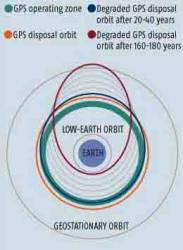
GPS Orbital Decay. Aerospace Corporation

The February 10 collision of an active Iridium satellite and a defunct Russian military communications satellite underlines a concern raised recently at the International Committee on GNSS (ICG) about the need to include coordination of space vehicle (SV) operations.

In comments during a session of Working Group A (compatibility and interoperability) during the ICG’s recent meeting in Pasadena, California, Professor Grigory Stupak of the Russian Institute for Space Device Engineering (RISDE), noted that Russia’s “position is that compatibility includes more than just signals,” among other things, “the sharing of orbits and disposal of satellites.”

Similar concerns have been expressed in recent years by organizations that have studied the possibility of GNSS satellites, particularly those that have been “parked” in disposal or graveyard orbits, to drift and possibly collide with one another.

Read More >

By Glen Gibbons

New Russian GLONASS Satellites in Operation

The last of three GLONASS satellites launched December 25 began broadcasting a healthy navigation signal today (February 12), according to the Russian Space Agency’s Information-Analytical Center, bringing Russia’s operational GNSS constellation to 20 spacecraft.

One satellite, space vehicle number (SVN) 701 launched more than five years ago, has been off-line and in “maintenance” status for the last month. Another spacecraft, SVN 722, is transmitting only in the GLONASS L1 band.

Read More >

By Glen Gibbons
IGM_e-news_subscribe