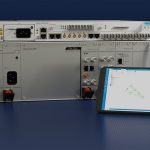

Jericho Receivers, a subsidiary of All 6G, has announced commercial availability of its Software-Defined Atomic Clock (SDAC), a timing device designed to maintain atomic-clock-grade accuracy by fusing multiple independent references rather than relying on a single source.
The system draws on GNSS for primary high-precision timing, ATSC 3.0 terrestrial broadcast signals — including the Broadcast Positioning System (BPS) — as a GPS-independent complement, and network-based precision time protocols for integration with IP infrastructure.
The company positions the approach as an alternative to conventional holdover mode, in which a device runs on its own internal clock during a GNSS outage and gradually drifts from true time. By continuously cross-referencing GNSS, terrestrial ATSC 3.0/BPS signals and network timing protocols, the SDAC is intended to maintain synchronization through jamming, spoofing or satellite signal loss rather than degrading over an outage.
Madeleine Noland, president of ATSC, said in the announcement that ATSC 3.0 was built to support applications beyond video delivery, including time transfer and positioning through BPS, and called the deployment evidence of broadcasting’s role in resilient national timing infrastructure. Dean Goodman, CEO of All 6G, said the product responds to a longstanding need for a true complement to satellite timing, combining satellite, broadcast, terrestrial and network sources into a single system, and linked the effort to FCC Chairman Brendan Carr’s public emphasis on resilient PNT infrastructure.
All 6G said the SDAC is designed and manufactured in the U.S. under the company’s no-Chinese-chip policy, targeting 5G/6G networks, data centers, power grids, financial systems, defense applications and other critical infrastructure requiring assured PNT. The device is available now for evaluation and deployment.