B: Applications

What about GPS jamming and maritime safety, and linear carrier phase combinations?

Q: What is the effect of GPS jamming on maritime safety?

A: Although GPS jamming incidents are relatively rare they can occur; and when they do, their impact can be severe.

The General Lighthouse Authorities of the United Kingdom and Ireland (GLAs) comprise the Commissioners of Irish Lights, the Commissioners of Northern Lighthouses and Trinity House, who between them provide aids to navigation (AtoNs) for the benefit of all mariners in British and Irish waters.

Q: What is the effect of GPS jamming on maritime safety?

A: Although GPS jamming incidents are relatively rare they can occur; and when they do, their impact can be severe.

The General Lighthouse Authorities of the United Kingdom and Ireland (GLAs) comprise the Commissioners of Irish Lights, the Commissioners of Northern Lighthouses and Trinity House, who between them provide aids to navigation (AtoNs) for the benefit of all mariners in British and Irish waters.

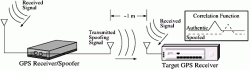
In order to investigate the effects of GPS jamming, whether by intentional or accidental means, the GLAs conducted a trial in 2008 on the effect of GPS denial on marine aids-to-navigation, and ship-borne and shore-based navigation and information systems.

Today’s mariners commonly use GPS enabled devices to navigate their vessels, however large, from port to port and berth to berth.  The International Maritime Organization (IMO) mandates the carriage of electronic position-fixing systems by all vessels over 300 gross tons and those carrying passengers on an international voyage in accordance with the Safety of Life at Sea (SOLAS) convention.

The GPS position is often fed into other vessel systems, for example an electronic chart display and information system (ECDIS), the vessel’s automatic identification system (AIS), or a plotter.

The use of differential GPS (DGPS) is preferred; mariners improve their positioning accuracy and ensure integrity of their GPS derived position by using the large number of DGPS radiobeacons located around the world.

Although GPS receivers for navigation are commonplace and very conspicuous on the bridge, the use of GPS is often more inconspicuous in other AtoN and positioning devices. Examples include its use for providing position input to the onboard AIS transponder, as well as the digital selective calling (DSC) system, which has the capability to include the vessel’s position as part of a distress signal.

In addition to vessel-based systems, marine aids-to-navigation use GPS. AIS timeslots may be synchronized using GPS as a source of accurate time. AIS also provides AtoN position information based on GPS input. Synchronized lights use GPS as a common timing source, and differential GPS services provide accuracy and integrity to the mariner.

Therefore, GPS denial, whether intentional from malicious jamming or unintentional due to malfunctioning equipment such as television antennas, may affect safety both on the bridge and on-shore.

(For the rest of Alan Grant and Paul Williams’ answer to this question, please download the complete article using the pdf link above.)

Q: What are linear carrier phase combinations and what are the relevant considerations?

A: Linear carrier phase combinations are formed by adding or subtracting carrier phase measurements on two or more frequencies. Such combinations are used to improve the resulting measurement in some manner relative to the original measurements.

In this context, “improvement” usually implies removing/reducing certain errors so as to facilitate the ambiguity resolution process or increase the measurement (and, therefore, position) precision. We must note, however, that improvement in both areas is not possible and thus a design trade-off is required.

In this “solution,” we will discuss how linear carrier phase combinations are formed and the key considerations associated with this process. A discussion of some of the common GPS combinations is also provided.

Topics in the full article include Linear Combinations, Integer Nature of the Ambiguities, Magnitude of Errors in Units of Cycles, Magnitude of Errors in Units of Length.

Summary and Outlook
The analysis focuses on dual-frequency combinations. However, with the modernization of GPS and the upcoming launches of Galileo and Compass, multiple frequency combinations will be possible. Despite this, the considerations discussed in this article will still hold and can be used as a stepping stone for more advanced combinations and subsequent data processing.

(For the rest of Mark Petovello’s answer to this question, please download the complete article using the pdf link above.)

By Inside GNSS

Critical Infrastructure: The United States and GPS

So, President Obama wants to spend some money on infrastructure, eh? Well, here’s an idea: send some of it GPS’s way.

Infrastructure isn’t just concrete and rebar. We can also build highways to the stars and — pardon the clichés — bridges to the future rather than bridges to nowhere.

And talk about bang for the buck. The billion dollars or so that the United States spends on GPS each year produces many tens of billions of dollars in products and services.

So, President Obama wants to spend some money on infrastructure, eh? Well, here’s an idea: send some of it GPS’s way.

Infrastructure isn’t just concrete and rebar. We can also build highways to the stars and — pardon the clichés — bridges to the future rather than bridges to nowhere.

And talk about bang for the buck. The billion dollars or so that the United States spends on GPS each year produces many tens of billions of dollars in products and services.

Of course, a big chunk of that GPS market is outside of this country. But after our recent lamentable contribution to global financial troubles, perhaps its time to remind the world about the unprecedented U.S. generosity in creating an entirely new public utility and making it available everywhere.

Not only that, but U.S. policy forced other GNSS providers to be generous, too. As the would-be Galileo public-private partnership discovered, you can’t compete with free.

Anyway, back to Obama and infrastructure.

The Global Positioning System has many unusual, novel, perhaps even unique features. But the one that relates to the current topic is that GPS is both a critical infrastructure in itself — notably its ground control and space segments and the pervasive, strategic installation of high-performance receivers  — and a contributor to other critical infrastructures, such as communications networks or transportation.

That should earn GPS double the attention, if not twice the budget.

But there’s more. GPS not only allows us to do things that we couldn’t do before; it allows us to do them more efficiently — greater productivity at less cost, whether surveying forest boundaries or guiding a thousand airplanes at once.

And though those efficiencies may reduce the job opportunities at individual enterprises, they stimulate a far greater amount of job creation overall — design and engineering, manufacturing, professional fieldwork — most of it high-skilled and higher-paying than the positions that were lost.

The United States really hasn’t had an industrial policy since just before and during World War II, when the Roosevelt administration converted much of the nation’s jobless into public employees (Works Progress Administration, Civilian Conservation Corps), its manufacturing sector into an armament assembly line, and gasoline and foodstuffs into ration coupons.

After that, we saw occasional, isolated initiatives — the interstate highway system, the lunar missions of the 1960s, SEMATECH — large-scale infrastructure and technology programs that could have served as potential components of an industrial policy, if one had existed.

GPS can help thread the new infrastructure efforts together, and expand the role that it already plays.  Many commercial GPS manufacturers are looking forward to the opportunities that building or restoring highways, bridges, and (imagine!) maybe even railroads will bring.

But the United States is still running the GPS program as though we had all the time in the world. Well, no offense to those atomic clocks on board the GPS satellites (another first of its kind), but the world is quickly catching up with us in matters of GNSS. And, if we take a close look at the world’s four GNSS program schedules, over the next few years just about every other GNSS system is going to pass GPS by in terms of signal availability, modernity, and diversity.

The United States risks seeing its GPS brand decline amid the growing choices in the GNSS marketplace.

It’s time that the GPS leadership, civil and military, revisited its prevailing philosophy and began launching for scheduled capability, rather than as needed to sustain an aging constellation.

And, while they’re at it, they should take another look at the size of the constellation. Every other GNSS system is committed to a true 30 satellite/30 slot configuration. If the advent of the biggest infrastructure investment in American history isn’t the right time to do the same with GPS, when is?

As American poet Edwin Markham asked on behalf of the man with the hoe gazing at the ground, “Give back the upward looking and the light/ Rebuild in it the music and the dream”

By

Thales Alenia Space Italia Wins Two Galileo Receiver Development Contracts

The European Space Agency (ESA) has awarded Thales Alenia Space Italia (TAS-Italia) two contracts for development of Galileo ground station receiver equipment.

One contract is for Galileo In-Orbit Validation Element (GIOVE) phase A/B ground station receivers capable of tracking the multiplex binary offset carrier (MBOC) signal that is common to both the Galileo Open Service (OS) and the new GPS L1 civil signal, which will be transmitted beginning with the GPS III generation of satellites.

Read More >

By Glen Gibbons
[uam_ad id="183541"]
January 12, 2009

Dual-Frequency RTK GPS Receiver

Hemisphere GPS offers the dual-frequency R220 GPS receiver, a 39-channel that offers real-time kinematic (RTK) operation with 12 channels of L1 C/A code, 12 channels of L1 P-code, and 12 channels of L2 P-code tracking. The other three channels can be used for tracking satellite-based augmentation systems including OmniSTAR’s commercial HP and XP differential correction services or three additional channels of L1 C/A-code tracking.

Read More >

By Glen Gibbons
January 11, 2009

Former U.S. Space Commerce Official Joins ITT

Edward M. Morris

Edward M. Morris, formerly executive director for the U.S. Office of Space Commercialization, Department of Commerce, has joined ITT Space Systems Division (SSD) as executive director of strategic business development.

In his new position, Morris will be responsible for strategic program and business development of GPS navigation systems and additional space-related capabilities.

Read More >

By Glen Gibbons
January 9, 2009

Gates Backs Lynn for Key Defense Post

William J. Lynn III

(Updated Jan.26) President Barack Obama’s nomination of William J. Lynn III, a senior vice-president at Raytheon Corporation, for deputy secretary of defense and his granting Lynn a waiver from the new administration’s own rules on former lobbyists has provoked considerable criticism from some quarters.

As the number two official in the Department of Defense (DoD), Lynn would report directly to Robert Gates, the current secretary of defense who has continued in that position in the new administration, the only holdover from ex-President Bush’s cabinet. Gates has come out strongly in support of Lynn, saying that he requested the waiver from the president.

Among other responsibilities, the deputy secretary serves as the co-chair of
the Space-Based Positioning, Navigation, and Timing (PNT) Executive
Committee (ExCom). Lynn would succeed Gordon England, who has paid a lot of attention to GPS during his term in office and enhanced the role of the PNT ExCom as an arbiter and advocate for the GPS program throughout the federal government.

Read More >

By Glen Gibbons
January 8, 2009

AUVSI Unmanned Systems Program Review 2009

AUVSI sponsors a three-day review of government unmanned system programs at the Mandarin Oriental Hotel in Washington DC on February 3-5 2009.

The event features 30 sessions covering air, ground and maritime systems. Topics include Next Generation UAS, Civil Use of UAS, DARPA Programs, NIST Search and Rescue, Irregular Warfare use for Maritime Systems, and many more.

AUVSI is the Association for Unmanned Vehicle Systems International, an industry group.

Register online at the website below.

Read More >

By Inside GNSS

[uam_ad id="183541"]
January 6, 2009

PCTEL Acquires Wi-Sys

PCTEL, Inc., announced today (January 5) that it has acquired Wi-Sys Communications Inc., an Ottawa, Ontario, Canada–based company that specializes in GPS antenna and receiver technology. PCTEL will pay $2.1 million for Wi-Sys and plans to fully integrate the latter company’s operations into its Antenna Products Group (APG).

Read More >

By Glen Gibbons
December 26, 2008

GNSS Postprocessing Software

OnPOZ Precision Positioning (a division of VGI Solutions) offers a new EZSurv GNSS Post-Processing version that offers full compatibility with GLONASS satellite signals. According to the company, EZSurv is compatible with most of the raw GNSS data formats on the market. The software computes high-accuracy geodetic results, enabling seamless data postprocessing among different brands of GNSS receivers using the following surveying modes: static, rapid static, stop and go, kinematic, semi-kinematic, and on-the-fly (OTF) for single and dual frequency receivers.

Read More >

By Glen Gibbons
December 7, 2008

NovAtel Announces GNSS Smart Antenna for Machine Guidance

NovAtel has announced its new SMART-AG antenna, an L1 GPS + GLONASS receiver plus antenna system housed in a single, low profile, rugged enclosure, designed for manual guidance and auto steer installations.

SMART-AG features 14 GPS L1 channels, 12 GLONASS L1 channels, and two additional channels for satellite-based augmentation systems (SBAS) as well as two NMEA 0183 compatible RS-232 serial ports, an NMEA2000 compatible CAN port, plus built-in mounting magnets.

Read More >

By Inside GNSS
November 25, 2008

GPS 21st Century Milestones (2001-2008)

(Back to GPS Focus page)
2001

December 1. Deputy Secretary of Defense Paul Wolfowitz expresses resistance to Galileo in a letter to European defense ministers.
December 1. Russia’s system rebuilding project begins with the launch of a modernized GLONASS satellite prototype (GLONASS-M)
2002
November 25. The U.S. Coast Guard moves from Transportation to the newly established Department of Homeland Security.
2004

Read More >

By Inside GNSS
November 24, 2008

Trimble Dimensions 2009

The Trimble Dimensions 2009 conference and exhibition takes place at The Mirage in Las Vegas, Nevada. Learn how to get the most from your positioning equipment. Listen to industry leaders discuss the future of positioning. Connect with peers from around the world at the exhibition.

Keynote speakers include Steve Bergland, Trimble president and CEO; Robert Kriegel, author of If It Ain’t Broke…Break It! and Steve Squyres, principal investigator for the Mars Exploration Rover Project

Read More >

By Inside GNSS

IGM_e-news_subscribe