
B: Applications

The GPS Dot and its Discontents

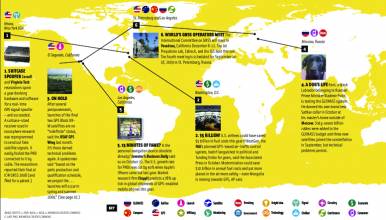
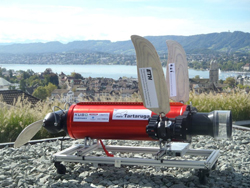
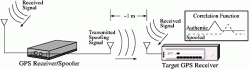
In-home construction of the first civilian-owned civil GPS spoofer.

Over the last few years, several of us in the GNSS community have done our best to convince our colleagues, policymakers, and the general public that unsavory characters with GNSS jammers or spoofers are a genuine threat to GNSS and an orderly society.

"But who would want to use a jammer or spoofer?” people ask.

My response? Hackers, because they can. Thieves planning to snatch expensive cargo. A moonlighting employee in the company car. Worse yet, state actors or terrorists targeting our national infrastructure.

Read More >

By Inside GNSS
One-Centimeter Accuracy with PPP

The navigation message has always been considered an inherent and essential feature of a global satellite navigation system. Its primary objective is to provide receivers with information on the errors of satellite clocks and parameters to compute the positions of satellites, as well as other parameters that help generate more accurate measurements.  

Read More >

By Inside GNSS

[uam_ad id="183541"]
February 29, 2012

GPS Program Budget: A Lot, But Is It Enough?

The details of President Obama’s 2013 budget have been gradually filtering out and, in general, the GPS system and those programs closely linked to satellite navigation, have escaped deep cuts.

On the hardware side the White House has requested $58.2 for GPS IIF satellite procurement. According to Air Force budget documents, the plan is to then wrap up the total IIF procurement of 12 satellites with a request for $77.6 million in FY14 and $7.3 million in FY15.

Read More >

By Inside GNSS
February 23, 2012

IFEN and WORK Microwave Introduce Enhanced NavX-NCS GNSS Simulator

IFEN, the Poing, Germany–based manufacturer of GNSS navigation products and services, working in partnership with WORK Microwave, have announced an enhanced version of IFEN’s NavX-NCS Professional, a multi-frequency GNSS simulator.

Optimized for research and development of GNSS safety and professional applications, the enhanced version of the NavX-NCS Professional incorporate the following key features:

Read More >

By Inside GNSS
February 11, 2012

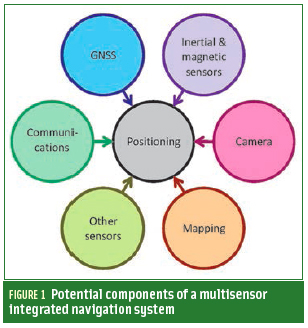
Challenges in GNSS /INS Integration

Dr. Andrey Soloviev, Qunav

GNSS and inertial technologies have a complicated mutual history.

Once competitors for navigation and positioning applications, they now appear ever more frequently in complementary roles — often within the same solution or system design.

Read More >

By Inside GNSS

[uam_ad id="183541"]
January 24, 2012

SIDEBAR: GNSS Attitude Determination on the Fly

Return to main article: "Winging It"

GNSS technology is used in various ways to find attitude or tra­jectory. The simplest method relies on measuring the velocity of a single receiver and interpreting the direction of that vector as the vehicle’s heading.

This works for applications where a vehicle’s motion is con­strained to only one axis – either absolutely, as with a train, or in the typical case of a car — when being driven responsibly!

Read More >

By Inside GNSS

SIDEBAR: In-Office Data Processing and Analysis

Return to main article: "Winging It"

With high-quality data sets obtained in the foot-to-foot configu­ration, we set about on postprocessing the data to extract more information about the NovAtel wingsuit system’s performance in the free-fall environment.

This was a multi-step process involving several NovAtel utilities and techniques, which we will describe here.

Read More >

By Inside GNSS
January 16, 2012

FIG /IAG Technical Seminar: Reference Frame in Practice

Monte Mario, the highest hill in Rome

A special seminar for geodesists will take place in Rome, Italy on May 4 and 5, just before the 35th FIG general assembly and working week.

The conference venue is the Cavalieri hotel on Monte Mario near the Vatican.

It is organized by the International Association of Geodesy (IAG), the surveyors’ international association (FIG) and the UN’s International Committee on GNSS (ICG).

Read More >

By Inside GNSS

Code Tracking and Pseudoranges

FIGURE 2: Pseudorange computation based on transmission. On the left side, the satellites are transmitting mes¬sages synchronously. On the right side, the four subframes are received asynchronously, due to the different propagation time. The TLM word is taken as a referene. The time differences ?i are computed on the basis of the relative arrival times of the front of the first bit of the TLM word.

Q: How can pseudorange measurements be generated from code tracking?

A: Every GNSS receiver processes the received signals to obtain an estimate of the propagation time of the signal from the satellites to the receiver. These propagation times are then expressed in meters to solve for the user position using trilateration.

Read More >

By Inside GNSS

New Austerity Squeezes GPS as DoD Tightens Its Belt

Embracing the need for debt-driven discipline, the White House has revised its strategy for the nation’s defense, taking a more fiscally constrained approach that reduces the number of troops and future spending on defense systems.

The new plan, formally announced January 5, was already being put into effect last summer. “The strategic guid­ance was the compass by which we steered the budget review leading to the president’s budget for fiscal year ‘13 and the years thereafter,” Deputy Secretary of Defense Ashton B. Carter told reporters.

Read More >

By Dee Ann Divis
IGM_e-news_subscribe