Shift to the Cloud at the Core of Restaged OCX Program

Key details are emerging about how Air Force managers are working to pull into line the substantially delayed and over budget program to build a new GPS ground system.
By Inside GNSS
Key details are emerging about how Air Force managers are working to pull into line the substantially delayed and over budget program to build a new GPS ground system.
By Inside GNSS
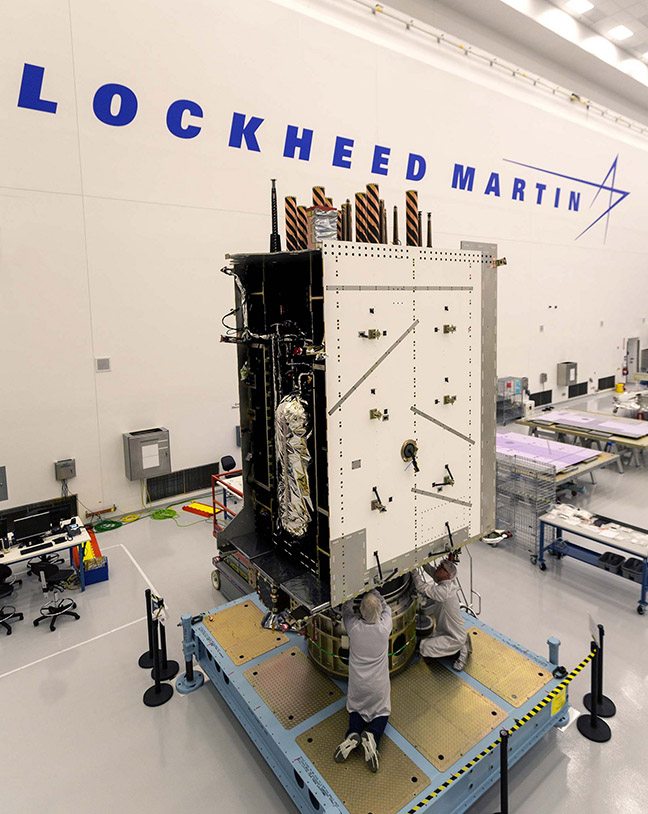
GPS III SV01 now awaits a call up to begin pre-launch preparations. Photo: Lockheed Martin.Ushering in a new era of advanced Global Positioning System technology, the U.S. Air Force this week declared the first Lockheed Martin-built GPS III satellite “Available for Launch.”
The Air Force’s “AFL” declaration is the final acceptance of Lockheed Martin’s first GPS III Space Vehicle (GPS III SV01) prior to its expected 2018 launch. GPS III SV01 will bring new capabilities to U.S. and allied military forces, and a new civil signal that will improve future connectivity worldwide for commercial and civilian users.
By Inside GNSSIf all goes as planned the world’s satellite navigation providers will be launching dozens of satellites between now and the end of the decade.
The activity just this year and next is remarkable, said John Betz of the MITRE Corp., who co-chaired the panel with José- Ángel Ávila-Rodriguez of the European Space Agency.
By Inside GNSS
General John (Jay) Raymond The ground was already shifting when Gen. John (Jay) Raymond took charge of Air Force Space Command (AFSPC) in October 2016. Just six months before, his predecessor Gen. John Hyten had announced the Space Enterprise Vision, a new way of approaching space asset development, management and protection now that space had become both contested and far more crowded. There were issues across the space, ground and user segments of the GPS program; sequestration was still looming and Congress was looking closely at how to reorganize the way the Air Force managed its space programs.
By Inside GNSS
Martin Faga, a former assistant secretary of the Air Force for space. GPS.gov photo.The battle lines over restructuring the management of military space were drawn sharply Sept. 18 when the Senate passed its version of the National Defense Authorization Act for Fiscal Year 2018.
By Inside GNSSLockheed Martin announced that its second-generation satellite-based augmentation system (2nd Gen SBAS) testbed started broadcasting in dual frequency, multi-constellation (DFMC) during testing this week that was moved up from originally scheduled dates.
By Inside GNSSDenver, Colorado-based Lockheed Martin announced that the U.S. Air Force awarded the company a $45.5 million contract to provide Military Code (M-Code) Early Use (MCEU) capability to the Global Positioning System (GPS). Part of the Air Force’s overall modernization plan for the GPS, M-Code is an advanced, new signal designed to improve anti-jamming and protection from spoofing, as well as to increase secure access, to military GPS signals for U.S. and allied armed forces.
By Inside GNSSAfter several years of shifting plans the competition to build the next tranche of GPS III satellites is poised to start, though the context in which that contest will take place has changed markedly from when planning first began.
By Dee Ann DivisThe old quip about limitations refers to cramming 10 pounds of stuff into a five-pound sack. Congressional lawmakers must be wishing for something that easy as they get ready to return to work Sept. 5.
By Dee Ann DivisThe U. S. Air Force is weighing shortening the design life of the GPS satellites it buys after it finishes filling out the constellation with the final tranche of GPS III spacecraft.
Space Command reached out to the industry late last month asking for feedback on the ramifications of scaling back on the elements that make the GPS space vehicles (SVs) the “Energizer Bunnies” of space — the satellites that just go and go and go.
By Dee Ann Divis
Bernhard Richter, Leica Geosystems GNSS business director
Enrico Salvatori, Qualcomm Europe
Carlo Bagnoli, STMicroelectronicsCarlo Bagnoli is Director of Infotainment BU System and Applications at STMicroelectronics. The company is a global semiconductor leader focusing on smart driving and the internet of things, creating intelligent and energy-efficient products that enable intelligent transport as well as smarter factories, cities and homes.
Within the infotainment business unit, Bagnoli and his team work to develop positioning receivers, broadcast receivers and communication processors for the automotive market. Doing so means gathering GNSS signals from far and wide.
By Inside GNSS
The MDU performs the primary mission of the GPS satellite, which is generation of the navigation signals and data that provide precise time information to users on a continuous basis. Photo: Harris Corp.Harris Corporation has delivered the third of 10 advanced navigation payloads to Lockheed Martin, which will increase accuracy, signal power and jamming resistance for U.S. Air Force GPS III satellites.
By Inside GNSS
Lockheed Martin’s planned satellite integration facility, the Gateway Center, is slated for completion in 2020. Photo: Lockheed Martin. Preliminary construction is underway on a new, $350 million Lockheed Martin facility that will produce next-generation satellites. The new facility, located on the company’s Waterton Canyon campus near Denver, Colorado is the latest step in an ongoing transformation, infused with innovation to provide future missions at reduced cost and cycle time.
By Inside GNSS