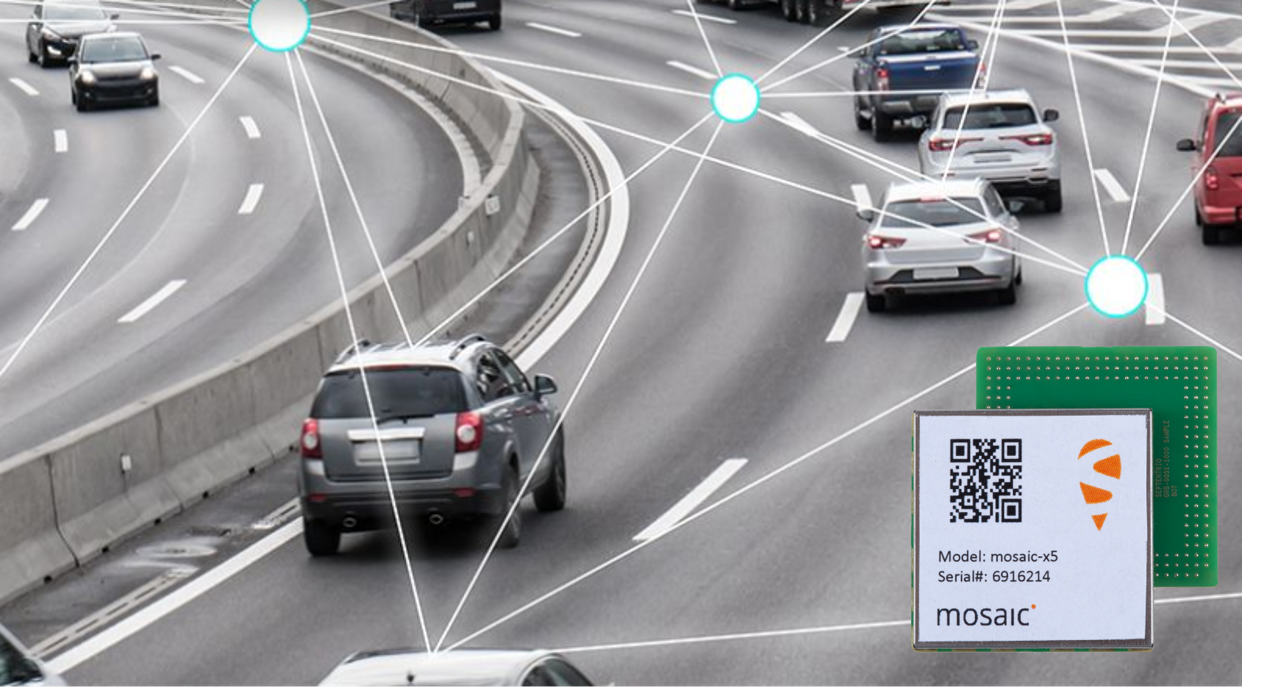
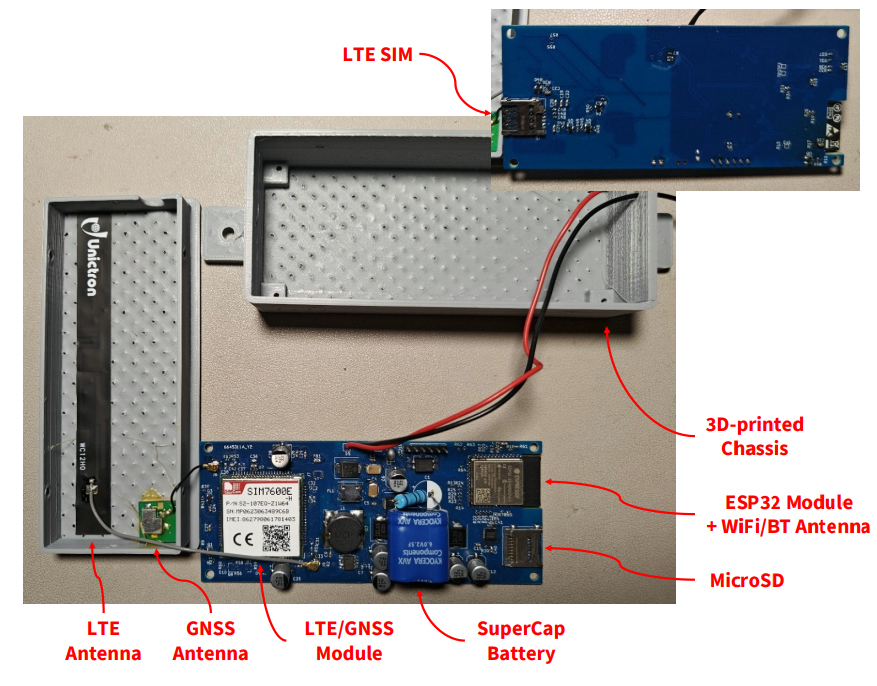
With funding from the European Space Agency (ESA), Space for Life (S4L), formerly Safe Structures Company (SSC), has developed the PONTI Box, a compact, automotive-grade sensor unit that collects high-frequency accelerometer data and precise GNSS timing as vehicles cross bridges and overpasses.
Across Europe and the United States, thousands of bridges and other elevated roadways are ageing, with many approaching or exceeding their design lifespans. In Italy alone, over 3,600 such structures span the 5,700 km Autostrade network, many in urgent need of inspection and maintenance, but traditional structural health assessment remains expensive and logistically complex.
PONTI builds on S4L’s GAMBE project, which used data from drivers’ smartphones to detect bridge vibrations. PONTI furthers this concept with dedicated hardware and cloud-based analytics to create a low-cost, scalable monitoring system.
Data are transmitted, either directly or via the PONTI app, to a cloud-based storage and processing centre, which integrates acquisition, filtering, and analytic functions. The system architecture, built around virtualized modules (firewall, broker, server, storage, and web server), supports secure data flows and web-based dashboards for users, operators, and administrators.
Affordable and scalable
At a recent ESA-hosted event, S4L’s Fabio Gerace presented the results of the PONTI research program, which involved laboratory validation and field demonstrations. During one testing campaign, 21 buses equipped with PONTI Boxes recorded over 62,000 crossings on Italian overpasses.
Multi-level processing transformed raw accelerometer and GNSS data into frequency spectra and spectrograms that reveal each structure’s dynamic response. While the system correctly acquired and processed data, results showed that the 1 kHz sampling rate limited frequency resolution; modal frequencies below 15 Hz could not be reliably detected. GNSS connection losses in tunnels and on certain types of overpasses also affected data quality.
Despite these challenges, the demonstrations confirmed the feasibility of vehicle-based, satellite-referenced structural monitoring. Gerace said results point towards a PONTI Box Plus, which would involve 15 kHz sampling and deployment on a dedicated, AI-assisted mobile laboratory van. The team also intend to extend the technology to assessment of road surface conditions.
Tragic overpass collapses like that which occurred at Genoa’s Ponte Morandi have made clear the human and economic cost of delayed monitoring. Gerace said PONTI exemplifies how space-derived position, navigation and timing (PNT) technologies can transform civil infrastructure management, offering road authorities and concessionaires an affordable, continuous, and scalable solution to safeguard public safety and optimize maintenance investments.
Ponti (Position Navigation Timing for Viaducts Monitoring) was co-funded under ESA’s NAVISP Element 2, which aims to increase European competitiveness in PNT.