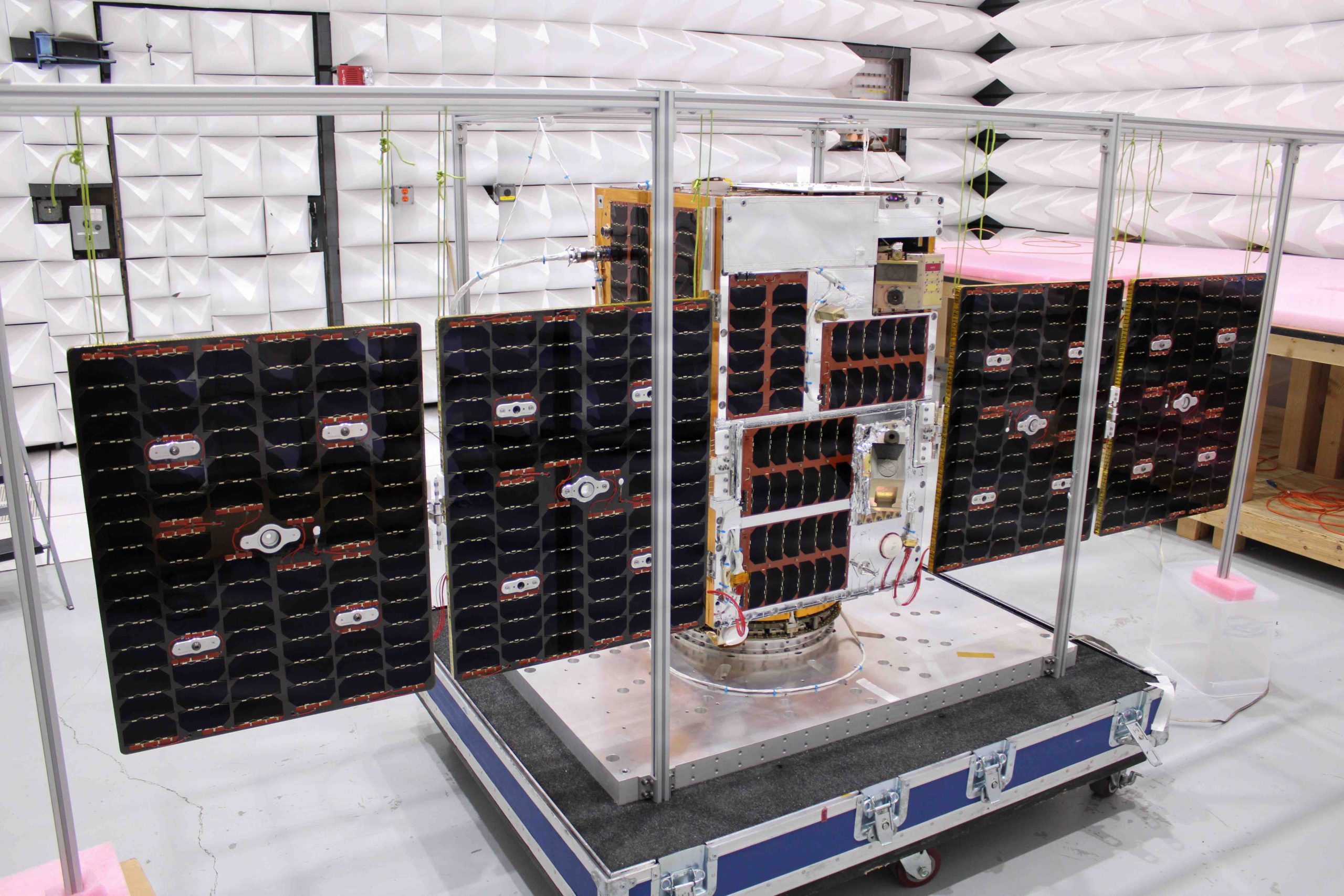
The U.S. Naval Research Laboratory successfully launched three experimental payloads aboard the Space Test Program’s STPSat-7 mission on April 7, including a new sensor designed to characterize the orbital GNSS environment and generate ionospheric space weather products directly relevant to GPS accuracy and integrity.
GOSAS: From Accidental Discovery to Dedicated Mission
The GNSS Orbiting Situational Awareness Sensor, or GOSAS, is a CubeSat-compatible, programmable dual GPS receiver that will operate from orbit to monitor conditions affecting space-based GNSS signals. “Understanding and predicting space weather is critical for ensuring the accuracy of GPS and the integrity of military communications,” said Scott Budzien, NRL research physicist and GOSAS principal investigator.
GOSAS is a direct follow-on to NRL’s GROUP-C experiment, which operated aboard the International Space Station from 2017 to 2023. GROUP-C’s primary mission was GPS radio occultation and ultraviolet photometry, but the experiment serendipitously detected GPS ground interference from orbit — a finding with significant implications for counterspace situational awareness. GOSAS was conceived in 2020 specifically to build on that capability, formalizing orbital GNSS environment characterization as a dedicated mission objective rather than an incidental one. The timing is notable: as documented in assessments including the Secure World Foundation’s newly released Global Counterspace Capabilities 2026, GPS jamming over conflict zones has now been shown to affect LEO satellites carrying onboard GPS receivers, creating measurable gaps in orbital PNT coverage. A purpose-built sensor for detecting and characterizing that interference environment addresses a documented and growing operational gap.
The STPSat-7 spacecraft launched at approximately 4:33 a.m. PDT from Vandenberg Space Force Base, California, aboard a Northrop Grumman Minotaur IV launch vehicle as part of the STP-S29A mission.
Companion Payloads Address Debris and Radiation Detection
The two additional NRL payloads round out a broad space environment characterization effort. LARADO — the Lasersheet Anomaly Resolution and Debris Observation instrument — will detect and characterize small orbital debris that cannot be tracked from the ground, providing data to update debris models used by spacecraft engineers, satellite operators, and policymakers. The LARADO concept dates to 2012 and has been funded since FY22 through NASA’s Heliophysics Division. GARI-1C, the third payload, will space-qualify new gamma-ray detector technology using commercial off-the-shelf components, with an eye toward future defense applications including detection of weapons of mass destruction from orbit.
The Space Test Program, operating under U.S. Space Systems Command, was established in 1966 to provide flight opportunities for research and development payloads with potential military utility. “The success of this mission highlights how cutting-edge research and development are fundamental to preserving America’s strategic edge in space,” said USSF Lt. Col. Brian Shimek, system program manager and director for STP.