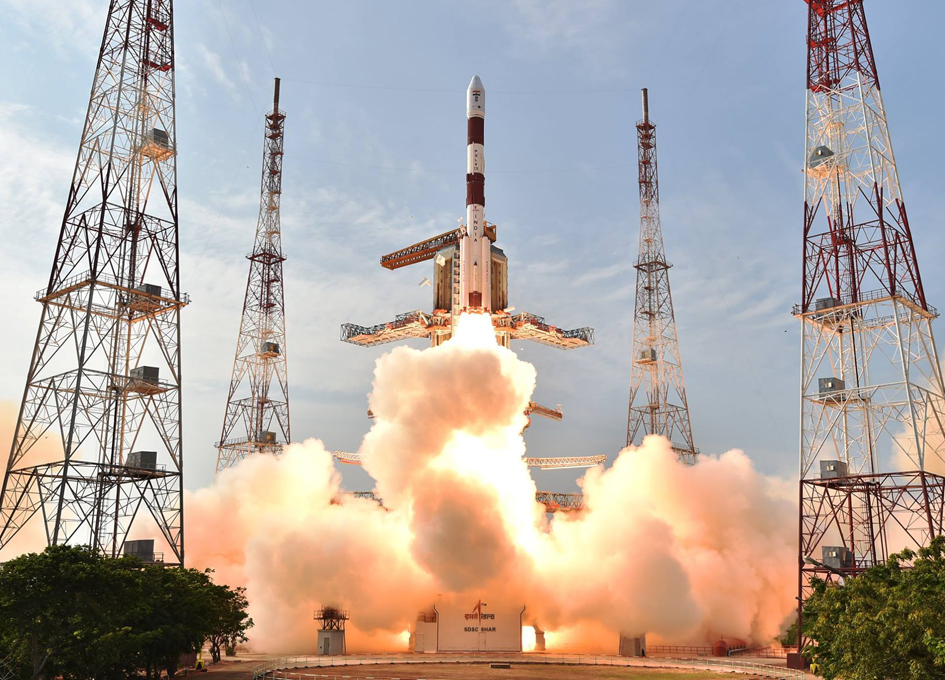
India’s regional navigation system, NavIC, has lost another source of precise timing after the onboard atomic clock aboard IRNSS-1F stopped functioning on March 13, according to the India Space Research Organisation (ISRO).
The satellite had reached its 10-year design life on March 10. ISRO indicated the spacecraft will remain operational for limited services, including one-way messaging, but it will no longer support standard navigation functions that depend on precise onboard timing.
Timing loss directly impacts PNT performance
Atomic clocks are the foundational element of any GNSS or regional PNT system. Navigation signals rely on nanosecond-level synchronization between satellites and user receivers; without a stable onboard clock, a satellite cannot provide accurate ranging. In practical terms, the loss of IRNSS-1F as a timing node reduces usable signal geometry and degrades overall system robustness rather than simply removing a satellite from inventory.
IRNSS-1F was launched in March 2016 as part of the original IRNSS constellation, now branded as NavIC. Its loss for navigation further compresses a system already operating with limited redundancy. Public disclosures and recent reporting indicate that only a subset of NavIC satellites are currently fully usable for positioning services, leaving less margin for fault tolerance across the regional coverage area.
Persistent clock reliability challenges
The latest failure reinforces a long-standing issue within the NavIC program: the reliability of space-qualified rubidium atomic clocks. Earlier IRNSS satellites experienced similar failures, forcing ISRO to operate the constellation conservatively and accelerate plans for replacement spacecraft. Across GNSS architectures, clock reliability is a critical determinant of system availability—satellites can remain on orbit yet become functionally irrelevant for navigation if timing degrades.
ISRO has been pursuing second-generation NavIC satellites to restore and expand capability, but progress has been uneven. The NVS-02 satellite, part of this next-generation effort, encountered issues following launch despite successful orbital insertion. At the same time, ISRO continues to invest in the broader timing infrastructure supporting NavIC, including international metrology collaborations aimed at strengthening reference time systems.
Strategic implications for sovereign PNT
The immediate effect is not a loss of NavIC service, but a reduction in resilience at a time when sovereign PNT capability is increasingly treated as critical infrastructure. NavIC was designed to reduce India’s reliance on foreign GNSS for both civilian and government applications. As jamming, spoofing and geopolitical risk reshape the PNT landscape, constellation health—particularly onboard timing integrity—becomes a primary measure of operational capability.
Timing integrity remains the system’s linchpin
The IRNSS-1F failure underscores a fundamental point: end-to-end resilience begins with stable space-segment timing. Advances in signal structure, augmentation and receiver design cannot compensate for degraded clocks in orbit. Restoring NavIC’s full capability will depend not only on replenishment launches, but on achieving durable, next-generation clock performance across the constellation.