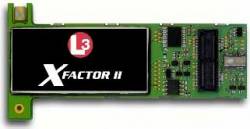

L3Harris Technologies has delivered more than 100,000 next-generation Military Code (M-Code) GPS receivers to U.S. and allied forces.
The receivers were delivered under the Modernized GPS User Equipment (MGUE) Increment 1 program, a Department of Defense initiative designed to replace legacy GPS receivers with systems capable of accessing encrypted M-Code signals and operating in contested electromagnetic environments.
The milestone reflects the large-scale fielding of M-Code-enabled PNT hardware across multiple operational domains, including air, land and maritime platforms.
Scaling Secure Military PNT
M-Code is the latest generation of encrypted military GPS signals designed to improve resistance to jamming, spoofing and other forms of interference. The signal is intended to provide more robust navigation and timing services for military users as electronic warfare and GPS denial capabilities proliferate.
Under the MGUE program, the Department of Defense is transitioning platforms across the joint force to receivers capable of processing M-Code signals transmitted by modernized GPS satellites.
L3Harris stated that the delivery milestone reflects the growing deployment of secure PNT hardware as operations become more distributed and reliant on reliable navigation and timing data. The company has been involved in GPS modernization efforts for more than four decades, supplying receivers and related technologies for defense platforms and weapons systems.
The 100,000-unit threshold highlights the scale at which M-Code receivers are now being integrated into operational systems across U.S. and allied forces.
Supporting the MGUE Transition
MGUE Increment 1 focuses on integrating M-Code receivers into existing military platforms, including aircraft, ground vehicles and precision-guided systems.
The transition is part of a broader GPS modernization architecture that includes new satellite generations, upgraded control systems and updated user equipment capable of securely receiving the modernized signals.
Within this architecture, receiver modules such as L3Harris’ TruTrak-M Type II are designed to meet MGUE technical requirements while addressing size, weight, power and cost constraints associated with integration into operational platforms.
Improving receiver performance and resilience is considered critical as adversaries increasingly deploy electronic warfare capabilities designed to disrupt satellite navigation signals.
Next Phase of GPS Receiver Development
L3Harris said it is continuing development efforts for MGUE Increment 2, which aims to further improve receiver performance and integration flexibility.
The next phase of the program includes development of a new M-Code-capable application-specific integrated circuit (ASIC) and next-generation receiver modules intended to reduce size, weight and power requirements while maintaining security and performance.
These advances are expected to enable broader integration of secure GPS capability across additional platforms and mission systems.