
GNSS jamming and spoofing usually comes from the ground with signals traveling line-of-sight. This means they are most likely to be detected by and impact aircraft. But what about maritime and shore infrastructure?
GPSPatron and Gdynia Maritime University (GMU) established a partnership in 2024 to examine GNSS interference at ground level. Krasimir Hristov, GPSPatron’s head of business development and partnerships, said the two organizations share research interests in maritime navigation security, GNSS vulnerability, and advanced interference-detection technologies—especially as they impact maritime.
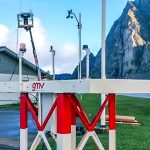
Their first project involved GPSPatron mounting a GNSS interference detector about 15 meters above sea level on GMU’s Faculty of Navigation building facing the Gulf of Gdansk. After monitoring the area for nine months they published their results in early 2025. Findings include:
-More than 84 hours of interference, most of which was jamming.
-Some interference events were more than 7 hours long.
-There was no correlation between events detected on the ground and those detected by aviation ADS-B.
-Strong indications that some sources of interference were mobile.
Building on this work, the team took to the high seas with their interference detection equipment from June to October. Their new report, “GNSS Interference Monitoring in the Baltic Sea: Shipborne Observations near the Kaliningrad Enclave Marine Border,” reveals some interesting changes in interference activity over the previous year and impacts on maritime traffic.
Jamming to Spoofing
In the 2024 study, the team only detected jamming. This year, every event was a combination of multi-constellation jamming and spoofing. False GPS L1 signals were transmitted while other GNSS signals were jammed.
More Disruptions
Interference was active a higher percentage of the time this year compared to the previous study, and persistent events were longer. In one 48 hour window, interference was active for 30 hours.
Coordinated Interference, Four Types and Locations
The study found four types of transmitters operating in four different locations that all activated and ceased at the same time, indicating a centralized tactical coordination. The sources were:
-GPS spoofing transmitter generating forged GPS L1 signals.
-Lower-band chirp jammer targeting GPS, Galileo and BeiDou.
-Upper-band chirp jammer targeting GLONASS exclusively.
-Full-band analog-like jammer flooding the entire 60 MHz GNSS L1 band.
Stronger Offshore than Dockside
When the vessel was offshore, the interference detected was as much as 15dB stronger than when it was moored dockside. As the ship approached the waters off Kaliningrad, the interference signal strength steadily increased to its highest level.
Interference within Port of Gdańsk
While shore infrastructure seemed to often be shielded from interference by terrain and other obstacles, the project detected repeated instances of jamming coming from within the port itself. Jammers in passenger vehicles were a repeat problem as RF noise.
“Industrial RF noise, appearing in multi-hour intervals on 3, 5 and 10 September, produced broadband emissions consistent with malfunctioning electrical or RF equipment,” according to the report.
While not part of the study, Hristov said other impacts to shore infrastructure have been observed.
“We’ve seen multiple cases where operations were slowed, paused or temporarily shut down due to degraded positioning reliability. For example, offshore wind construction activities have been halted on several occasions when GNSS accuracy dropped below operational thresholds, and there have been instances where container ports were forced to idle equipment until signals stabilized. These disruptions tend to be shorter and more contained compared to offshore incidents, but the operational and financial consequences are for sure significant.”
In many of these cases, the impacted parties have reasons to not formally report or publicize the disruptions.
As is the case with most studies of interference in aviation, the authors of this report urge mariners to exercise caution over being alarmed. Numerous maritime systems, such as the Automatic Identification System (AIS, which is analogous to aviation’s ADS-B) are degraded or made inoperable by interference with GPS and other GNSS.
Continued Joint Efforts
The PNT and maritime community can expect to see further joint work from the two organizations.
“Our collaboration includes knowledge exchange, joint exploration of real-world GNSS disruption scenarios, and discussions on potential research initiatives that connect academic expertise with GPSPatron’s field-tested technology,” Hristov said. “Marine University of Gdynia values the opportunity to integrate practical commercial insights into its curriculum and research programs, while GPSPatron benefits from the university’s academic depth, testing environments, and access to domain specialists.”