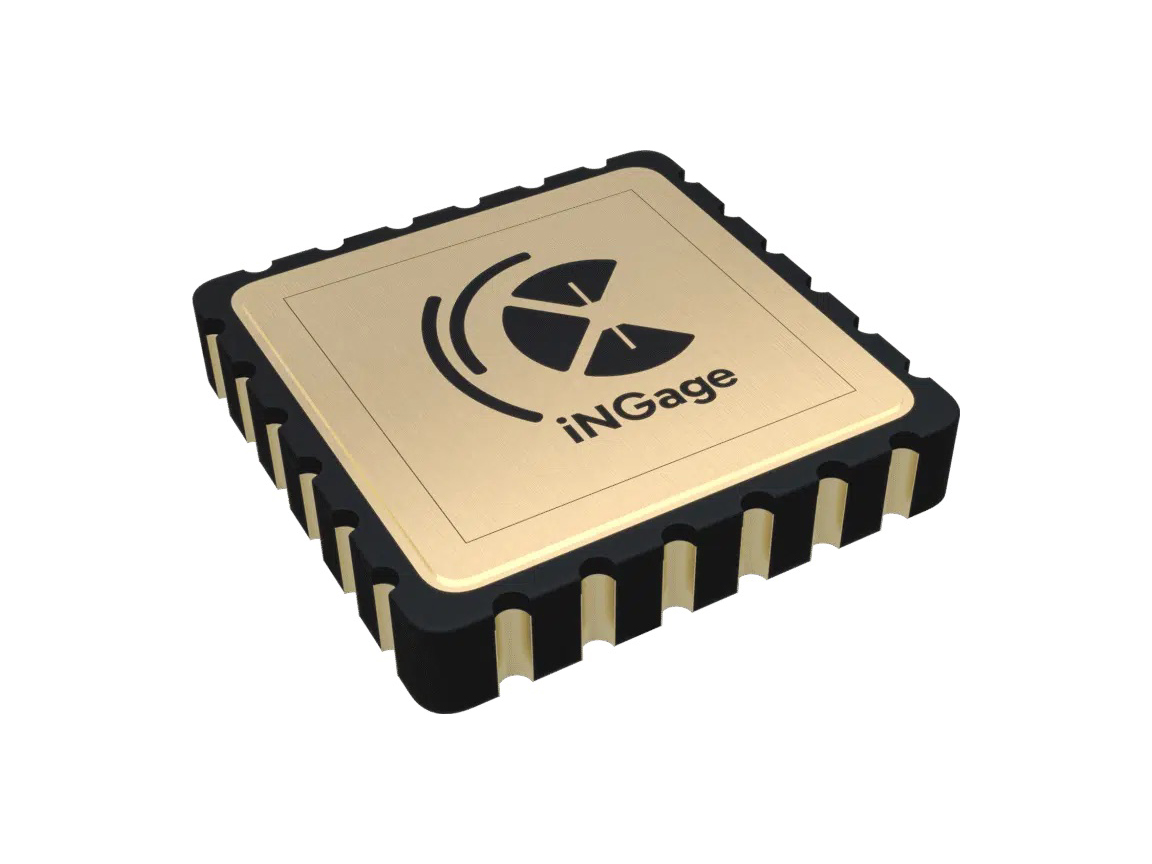
Europe has found an intriguing new player in the contest to strengthen resilience in positioning, navigation, and timing (PNT). iNGage is a Franco-Italian startup formed in early 2025 to commercialize a novel class of micro- and nano-electro-mechanical systems (M&NEMS)-based inertial sensors.
With a €6 million seed round announced at the end of September 2025, the company is now accelerating plans to industrialize its multi-axis units and push them into markets hungry for robust alternative-PNT options.
iNGage’s technology centers on piezoresistive nano-gauge detection, a departure from the capacitive approaches that dominate today’s MEMS inertial sensors. The company claims order-of-magnitude improvements in sensitivity, enabling short-term stability approaching tactical grade.
For GNSS-dependent systems, this means brief outages caused by jamming or spoofing can be bridged by inertial sensors with far less drift, preserving navigation integrity for autonomous vehicles, drones, and industrial robots. If validated in production devices, the new sensors could narrow the long-standing gap between MEMS, with their advantages in terms of size, weight, power, and cost (SWaP-C), and high-end, high-cost fiber-optic gyros (FOGs), which are more precise and stable.
Looking good
Sourcing regionally, iNGage is positioning itself squarely within EU’s broader PNT-sovereignty agenda, which affirms the essential nature of domestically scalable inertial technology as Europe explores fused-PNT architectures and potential LEO-PNT augmentation.
While the company remains early-stage, its profile is growing. CEO Philippe Robert and other iNGage personnel have spoken at several industry gatherings, outlining the company’s views on precision sensing, navigation resilience, and the performance envelope of emerging M&NEMS technologies. The company has highlighted drift-over-time behavior and projected error growth during simulated GNSS interruptions, topics that resonate with semiconductor and autonomy stakeholders, and integrators seeking practical alternative-PNT solutions.
Newly secured funding is earmarked for industrialization of the company’s multi-axis navigation sensors, maturing the manufacturing flow, expanding test and calibration infrastructure, and initiating the qualification processes required for automotive, aerospace, and defense markets
As wider evaluation of prototypes moves forward, potential customers will gain a clearer understanding of how the technology performs under real-world conditions. If iNGage is successful, Europe will have gained a homegrown inertial technology capable of reinforcing GNSS robustness without the cost and size penalties associated with traditional tactical-grade systems.
For now, there is a fresh and potentially important entrant in the alternative-PNT landscape, one readers may want to watch closely as more data emerges and integrators across Europe start probing the technology in the new year.