Previous administrations have put PNT investment on layaway. That bill has come due.
Passive, outdated approaches to PNT are endangering our nation.
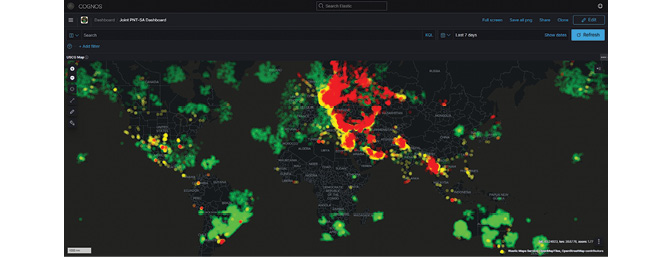
GPS denial and manipulation are a growing threat, and have been for more than 25 years. A plot of interference incidents (Figure 1) shows terrestrial-based GPS disruptions spreading across the globe like a cancer. And on top of that, there isn’t a place on the planet that’s beyond the reach of recently discovered space-based disruption weapons.
Yet, America has no widely adopted backup service to deter interference and protect users. This is because the U.S. has been pursuing an unsuccessful,15-year-old strategy that has gone unchallenged through two Democratic and two Republican administrations.
It is past time for a change. Subject matter experts have been talking about the nation’s over-dependence on GPS for decades. It’s been:
- 26 years since the Clinton administration identified the problem.
- 22 years since President George W. Bush mandated a GPS backup.
- 18 years since the government announced a solution.
- 15 years since the Office of Management and Budget (OMB) persuaded the president to reject the interagency solution.
- 8 years since Congress passed and President Trump signed an act into law mandating a terrestrial timing system to backup GPS.
- 6 years since President Trump signed an executive order designed to “fix” the problem.
Yet, America’s over-dependence on GPS is greater than ever, with no alternatives that could “get the bullseye off GPS” in sight.
In the years since the first Trump administration addressed PNT, the risk to the U.S. from this vulnerability has increased dramatically. The signs include:
- Recent revelations that Russia has been periodically exercising a space-based weapon since 2019 that interferes with GPS across continental size areas. (They have been doing the same to China’s BeiDou since 2020).
- Russia’s 2021 threat to destroy all GPS satellites if NATO interfered with its invasion of Ukraine.
- The use of wide area jamming and spoofing by numerous nations in the Mediterranean, Middle East and Asia.
- China’s completion of an integrated and resilient PNT architecture that includes signals from space, eLoran and fiber ensuring it can withstand GNSS disruption. This gives it significant tactical and strategic advantages over the U.S. and the West.
Past Time for a New Approach
Trump administration PNT policies and approaches were established before these concerning dangers came to light. Equally concerning, these still in-force documents are based heavily on decades-old policies that, even then, many thought inadequate.
The first Trump administration addressed PNT in two documents:
- Executive Order 13905, “Strengthening National Resilience Through Responsible Use of Positioning, Navigation, and Timing Services,” February 12, 2020.
- Space Policy Directive (SPD) 7, “The United States Space-Based Positioning, Navigation, and Timing Policy,” January 15, 2021.
In both, the administration adopted its predecessors’ passive, laissez faire approach, leaving our critical national security interests to the whims of fate.
The provisions of the executive order were, as attorneys are fond of saying, “necessary but not sufficient.” The order only addressed critical infrastructure, focused on educating users and fell far short of taking or compelling any actions to make the nation safer.
In SPD 7, the Trump administration’s discussion of protecting GPS with a backup is almost a word-for word repeat of a document from 11 years before:
2010 National Space Policy:
“…identify and implement, as necessary and appropriate, redundant and back-up systems or approaches for critical infrastructure, key resources, and mission-essential functions.”
2021 Space Policy Directive 7:
“…identify and implement, as appropriate, alternative sources of PNT for critical infrastructure, key resources, and mission-essential functions.”
Contrasting sharply with the passive “maybe someday” approaches is the assertive and proactive direction in President George W. Bush’s 2004 mandate. With the attacks of 9/11 still fresh, he was determined to make America able to withstand any future assault, regardless of the vector.
According to the NSPD-39 Fact Sheet, Bush’s National Security Presidential Directive 39 “U.S. Space-Based Position, Navigation, and Timing Policy” in December 2004 required the U.S. Department of Transportation (DOT) to:
“In coordination with the Secretary of Homeland Security, develop, acquire, operate, and maintain backup position, navigation, and timing capabilities that can support critical transportation, homeland security, and other critical civil and commercial infrastructure applications within the United States, in the event of a disruption of the Global Positioning System or other space-based positioning, navigation, and timing services.”
A Flawed “Action Plan”
Officials in this Trump administration have not promulgated any new or updated PNT policy. Instead, they are operating with two government documents published just before they took office. These are:
- Department of Transportation PNT Strategic Plan, December 2024.
- Complementary PNT Action Plan, DOT Actions to Drive CPNT Adoption, March 2024.
Both documents expand upon previous commitments to do things on the periphery of resilient PNT without actually ensuring any national capability is deployed.Yet, initially, the Complementary PNT Action Plan did seem to hold out a ray of hope officials have cited as a pathway to success: the promise of “government as first adopter.”
This is the idea that the federal government would lead the way in adopting complementary and alternate PNT services, setting an example for the nation by showing the government is serious about the need to use such systems. Also, by establishing long-term contracts, the market would be reassured such services would be around for the long haul and worth investing in.
Yet, two years after the action plan was published, there seems to have been very little to no government adoption.
Why? It’s undoubtedly because, as outlined in the plan, “government as first adopter” is fatally flawed in two ways.
First, it contemplates the DOT and other federal departments acquiring PNT services to support assets in the privately owned critical infrastructure sectors they supervise. While the DOT has the legal authority to do that, other departments do not. That puts everyone but DOT out of the picture.
It also doesn’t help that DOT attempts to acquire services to support transportation systems have been continually rebuffed by OMB. If the department responsible for leading civil PNT policy isn’t getting anywhere, it is difficult to imagine others without specific legal authority succeeding.
The second problem is funding. While the cost of alternative PNT services is expected to be minimal compared to the overall federal budget, it will cost something. And as big as the federal budget has grown, every penny is already spoken for.
Even positing other federal departments were (1) willing to act without legal authority, and (2) act on a plan promulgated by a technical center at another department with no authority to direct their actions, they would still have to find funds for something that was not their idea. Either new funds would have to be requested from Congress (which requires OMB approval), or other program would have to be decremented or sacrificed (again, requiring OMB approval). Both scenarios are exceptionally unlikely. Consequently, “government as first adopter” is not a conceivable action or a plan. Rather, it seems an empty promise designed to mislead the public and senior officials.
Breaking From the Ineffective Past
As Rita Mae Brown put it in her 1983 novel “Sudden Death,” “Insanity is doing the same thing over and over again but expecting different results.”
For more than two decades, the United States has been talking about GPS vulnerability and the need for complementary, alternative and backup capability. All that while diligent but unempowered government officials have been prevented from acting to make America safer.
Every U.S. national PNT policy and action after 2004 has been ineffectual when it comes to protecting GPS services with a complementary and backup capability.
Nations across the globe are establishing or already have resilient core national PNT architectures that have, at their center, GPS and other space-based PNT, but also include terrestrial broadcast PNT and fiber-based precise timing systems. These provide security for critical infrastructure, small and big companies, and individual citizens alike. They protect economies in the event of severe solar weather and ensure defense industries can keep producing even if space-based signals are denied. All while America is becoming one of the least protected and most vulnerable nations.
It is past time for the Trump administration to break from the failed past and take an active role in ensuring American PNT safety and security.