Atheros Names Former TI Manager to Head Mobile Wireless Efforts
Atheros Communications, Inc., has announced the appointment of Amir Faintuch as vice-president and general manager of the company’s Mobile Wireless Business Unit.
By Glen GibbonsAtheros Communications, Inc., has announced the appointment of Amir Faintuch as vice-president and general manager of the company’s Mobile Wireless Business Unit.

By Glen GibbonsApplanix has introduced a major new release of POSPac MMS (Mobile Mapping Suite), its GNSS-aided inertial postprocessing software for mobile mapping and surveying applications.
The new release adds features and functionality for land-based mapping and surveying to the existing suite, making it fully equipped for processing mobile mapping data from the air, sea, and land platforms.
By Glen Gibbons
Abstracts for the Institute of Navigation’s 2009 International Technical Meeting (ITM) are due on October 3, 2008. Final manuscripts are due by January 5, 2009. Find out more online at the ION website, or email ab*******@*on.org.
The theme of this winter’s meeting is "GNSS Technology: A Path to Sustainable Economic and Social Benefits for Developing Countries."
By Inside GNSS
One is tempted to paraphrase Julius Caesar, “Galileo est omnis divisa in partes tres,” because, as with any global navigation satellite system, Galileo as a whole is divided into three main parts: the political, the infrastructural, and the user application marketplace.
By Inside GNSS
A Russian Proton launcher successfully lifted three GLONASS-M satellites into orbit on schedule Thursday, September 25.
By Glen GibbonsSpain’s leading IT company, Indra, has begun a €1.5 million, 18-month project for the European Space Agency (ESA) to study the feasibility and definition of the European Geostationary Overlay Service (EGNOS) looking ahead towards a future multiconstellation regional system (MRS).
By Glen Gibbons
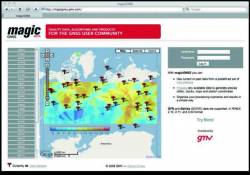
GMV Aerospace and Defense S.A. has announced its new magicGNSS, a set of software tools that supports a wide variety of GNSS projects and objectives, including service volume simulations, core operational functions (such as orbit, clock, and ionosphere determination and prediction), receiver performance analysis, added-value services including integrity, local augmentation developments, and all related performance and accuracy analyses.
By Glen Gibbons
Phi Ward with ION 2008 Kepler AwardPhillip W. Ward, a pioneer designer and developer of GPS receivers, received the lifetime achievement award from the Institute of Navigation at its annual GNSS conference on September 19 in Savannah, Georgia USA.
Ward was senior technical staff member at Texas Instruments Defense Systems and Electronics Group for more than 20 years, where he developed five generations of GPS receivers including, in 1982, the first to enter the commercial market: the TI 4100 NAVSTAR Navigator.
By Inside GNSSQuellan Inc., of Santa Clara, California, offers the QHx220 active RF noise canceller for GPS applications.
Like noise cancelling headphones, the QHx220 senses unwanted internal noise and applies an opposite signal to the receive path, using sophisticated high-speed analog techniques integrated on a single one square millimeter, low-power integrated circuit.
According to the company, the canceller provides up to 25dB of cancellation, 360º of phase coverage, and operates on a single 1.8V supply voltage.
By Glen GibbonsWi-Sys Communications Inc., based in Ottawa, Ontario, Canada, has launched the WS1551QF L-band + GPS (L1) Quadrifilar Helical Antenna.
An active right-hand circularly polarized, quadrifilar helical antenna, the WS1551QF provides an omni-directional, cardoid radiation pattern, with peak gain optimized at elevation angles between 0° and 40°. The wideband antenna covers both the L-band downlink frequency band (1525 to 1560 MHz) and the GPS (L1) frequency band (1574 to 1576 MHz).
By Glen GibbonsAfter nearly a year of silence, Magellan has returned to the OEM GNSS space with the MB 500 GPS/GLONASS/SBAS dual-frequency board — reportedly the first of a series of new products by the long-standing brand.
By Glen Gibbons
Trimble has announced its new GNSS reference receiver — the Trimble NetR8 — for precise scientific and network infrastructure applications. The NetR8 reference receiver has 76 channels and supports GPS L1, L2, L2C and L5 signals as well as GLONASS L1/L2 signals.
Four additional channels are dedicated to tracking space-based augmentation systems
(SBAS), including Wide Area Augmentation System (WAAS) in North
America, European Geostationary Navigation Overlay System (EGNOS) in
Europe, Multi-functional Satellite Augmentation System (MSAS) in Japan,
Omnistar services and others.

The U.S. government has committed itself to maintaining the signals characteristic needed for semi-codeless GPS applications until December 31, 2020.
By Glen Gibbons