Harris Corp. Delivers Fifth Advanced GPS III Satellite Navigation Payload
Harris Corporation has provided Lockheed Martin with its fifth of 10 advanced navigation payloads contracted for the U.S. Air Force GPS III satellite program.
By Inside GNSSHarris Corporation has provided Lockheed Martin with its fifth of 10 advanced navigation payloads contracted for the U.S. Air Force GPS III satellite program.
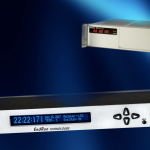
By Inside GNSSPrecision time and frequency solutions provider EndRun Technologies recently announced the release of a new Cesium Control Module for the Meridian II Precision TimeBase designed to combine the extraordinary benefits of GPS, 5071A Cesium Primary Frequency Standard, and Ionospheric Corrections. The unique and powerful integration of these technologies provides a time and frequency standard with unparalleled accuracy, stability and holdover performance for the most demanding applications including communications and metrology, according to the company.
By Inside GNSSThrough the Advanced Signals Design Sprint, the Air Force Research Laboratory is looking to discover what already exists and what is possible in the realm of advanced Positioning, Navigation and Timing (PNT) signals.
The event, sponsored by the Center for Technology, Research and Commercialization (C-TRAC), takes place June 19-21 at the Catalyst Campus in Colorado Springs, Colorado.
Orolia announced today that its atomic clock solutions have been selected for the Galileo Global Navigation Satellite System (GNSS). Under contracts totaling 26 million euros, or approximately $30 million, Orolia will deliver its stable, accurate timing solutions to 12 additional Galileo satellites.
By Stan Goff
Commercial UAV EXPO Americas 2018 takes place October 1-3 at The Westgate in Las Vegas, Nevada. If you register by May 31, you can save $300 and also enter for a chance to win two free hotel nights.
A successful drone operation depends on reliable and up-to-the minute information. It’s not easy to keep up when the technology and regulations are constantly evolving. Fortunately, this event brings together the key people, the newest technology and the education you need for success — Commercial UAV Expo Americas.
Here’s a sample of the conference programming:
Plenaries:
Vertical Industry “Deep-Dive” Tracks:
Below is a selection of confirmed speakers:
|
|
Precision measurement professionals rely on Commercial UAV Expo to deliver the high-level content and quality programming they need for complex projects.
Check www.expouav.com for continual updates and here to register.
By Inside GNSS
The Technology Roadshow continued its steady roll around North America building on Topcon’s Intersection of Infrastructure and Technology message. Along the 28-city tour, the traveling trailer stopped for several days in beautiful Pleasanton, California, just down the road from Topcon Positioning Systems’ headquarters in Livermore.
From the start, this four-day event, hosted by RDO Integrated Controls, Engineering Supply, Papé Machinery and 5D Solutions, provided attendees with a little extra insight into the potential of technology-enabled construction in infrastructure.
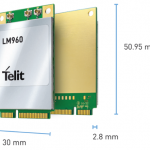
By Inside GNSSTelit recently announced the LM960, descrbed as the world’s first global full-size PCI Express Mini Card (mPCIe) for enterprise routers and appliances. The global, 23-band product, supporting LTE Advanced Category 18 (Cat 18) with download speeds of up to 1.2Gbps and 5-band fallback to 3G, will be available in select markets in third quarter of 2018, according to ongoing mobile network deployments of Cat 18 service*.
According to Telit, it’s the first product in industry in the mPCIe form factor to support Cat 18. The rugged LM960 delivers significant flexibility and a competitive edge to original equipment manufacturers (OEMs) looking to quickly deploy next generation products delivering carrier broadband-like user experience. The new LM960 is a sibling product of the Cat 11 LM940 and the two products are fully interchangeable. This provides OEMs the opportunity to create new products based on designs already using the LM940, or to create product families in different grades of performance based either on the LM960 for high end, or the LM940 for mid-market.
“By bringing 5G-like performance to the market with the LM960, we are making it easier not only for customers looking to innovate in 1Gbps applications enabled by the new LM960 but also for customers across all industries and application areas,” said Manish Watwani, vice president global product marketing, Telit. “Telit continues to boast the broadest and most respected and globally supported portfolio of IoT modules, data cards, data plans, platforms and professional services for enterprise IoT adopters making vendor selection easy in an already crowded industry.”
“We are pleased to work with Telit to deliver the power and flexibility OEMs need to address a broad range of commercial and industrial applications in an increasingly connected world,” said Gautam Sheoran, senior director, product management, Qualcomm Technologies, Inc. “The Qualcomm® Snapdragon™ X20 modem will power a variety of products to function in a diverse set of operator deployments worldwide, while maximizing their global reach and scalability.”
“Band 14 support will not only facilitate use by first responder agencies in conjunction with the public safety network but will also benefit customers more broadly when the spectrum is not in use by first responders,” said Sam Lucero, senior principal analyst, IoT, for IHS Markit, a global business information provider.
Additional Technical Features include:
By Inside GNSS
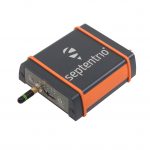
GNSS receiver manufacturer Septentrio announced the arrival of its AsteRx SB, which was first showcased at Expomin in Santiago, Chile and Intermat in Paris, France, and then was on display at the recentIEEE/ION Position Location and Navigation Symposium (PLANS) in Monterey, California.
The AsteRx SB delivers Septentrio’s ground-breaking quad-constellation RTK in a low-power, IP68 compliant housing. Built around the hugely successful AsteRx-m2 GNSS receiver engine, the AsteRx SB features WiFi, Bluetooth, USB, Ethernet and serial connectivity. Septentrio’s GNSS+ suite of positioning algorithms converts difficult environments into good positioning: LOCK+ technology to maintain tracking during heavy vibration, APME+ to combat multipath and IONO+ technology to ensure position accuracy during periods of elevated ionospheric activity, according to the company.
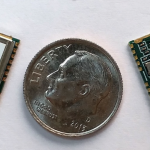
By Stan GoffSkyTraq Technology Inc., a provider of GNSS positioning technology, recently introduced S1216F8-GI2, a NavIC + GPS/GAGAN receiver module for the emerging Indian market. It integrates L1/L5 RF front-end and baseband processor capable of receiving up to 14 L5 NavIC signals and up to 20 L1 GPS/GAGAN signals simultaneously. With currently usable 6 NavIC signals and 3 GAGAN signals, it offers a total of 18 ~ 23 usable signals for navigation compared to 9 ~ 14 usable signals with conventional GPS receivers. This is designed to provide improved accuracy in urban canyon environments with signals often blocked by high buildings, according to the company.
By Inside GNSSThe GPS Innovation Alliance has announced the appointment of J. “David” Grossman as executive director. Grossman will lead the Alliance as it further builds its organizational presence in Washington on behalf of its members and the GNSS industry as a whole.
“David’s appointment ushers in an exciting new chapter for our organization” said Jim Kirkland, president of the GPS Innovation Alliance and senior vice president and general counsel of Trimble Inc.
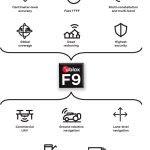
By Inside GNSSu‑blox and Qianxun Spatial Intelligence Inc. are joining forces to deliver high precision positioning solutions to the Chinese market. By coordinating their product offerings, they seek to meet growing demand for increased positioning accuracy for mass market applications.
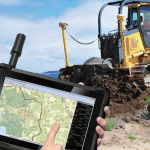
By Inside GNSSSan Jose, California-based DT Research, a leading designer and manufacturer of purpose-built computing solutions for vertical markets, recently announced the DT301T Rugged RTK Tablet (DT301T-RTK), a lightweight military-grade tablet that is purpose-built for GIS mapping applications with real-time kinematic (RTK) satellite navigation used to enhance the precision of position data derived from satellite-based positioning systems. This tablet enables 3D Point Cloud creation with centimeter-level accuracy — meeting the high standards required for scientific-grade evidence in court.
The DT301T-RTK is military-grade with an IP65 rating, yet lightweight — offering the versatility to be used in the field, office and vehicles. A dual frequency GNSS module is built into the tablet, which uses real-time reference points within 1- to 2-centimeter accuracy to position 3D point clouds created from aerial photogrammetry, using GPS, GLONASS and Galileo receivers. Users can measure with the RTK GNSS positioning directly using a foldable antenna or connect to an external antenna for more robust receiving and survey grade precision.
“We’ve seen a dramatic uptick in the need for rugged tablets to be purpose-built for a range of mapping uses across industries,” said Daw Tsai Sc.D., president of DT Research. “In designing the DT301T with RTK satellite navigation, we also took into consideration the other features and capabilities necessary within a rugged tablet to quickly and easily conduct forensic mapping, land surveying, e-construction, Building Information Modeling and other mapping scenarios.”
The DT301T-RTK tablet is compatible with existing GIS software for mapping applications and brings together the advanced workflow for GIS data capture, accurate positioning and data transmitting. The tablet can be used in a variety of scenarios, including:
Forensic Mapping — Public safety teams, investigators and crash reconstructionists can use the DT301T-RTK Tablet to accurately collect measurements that are scientifically defensible by using the real-time centimeter reference points to position 3D point clouds created from aerial photogrammetry or take stand-alone measurements, according to the company.
“When reconstructing a crime scene, crash scene or natural disaster — forensic mapping needs to have scientific-grade precision in order to stand up as evidence in court,” said Andrew S. Klane, a former Massachusetts State Police Lieutenant who teaches Forensic Mapping and is now the Chief Operating Officer at Forensic Mapping Solutions Inc. “As more drones are being used for mapping, there is a growing need for ground control positioning devices. By using a DT301T-RTK Tablet in combination with a drone, users can more quickly and cost-effectively create a 3D model to deliver an accurate representation of the scene with scientific-grade tolerance that will hold up in a court of law.”
The DT301T-RTK Tablet has been purpose-built for precision mapping in a variety of environments and includes the following features and capabilities:
MicroPilot and Trimble have entered into an agreement that will enable the integration of Trimble’s high-precision Global Navigation Satellite Systems (GNSS) technology into the MP2128 Triple Redundant UAS Autopilot.
MicroPilot produces autopilots for all types of professional drones, including fixed-wing, multi-rotor and vertical take-off and landing (VTOL). As Trimble looks to gain market share in the UAS industry, the team at MicroPilot can offer their years of expertise integrating guidance, navigation and support systems in these platforms.
“MicroPilot has phenomenal integration abilities,” Trimble’s Strategic Initiatives Director for Wireless & UAV InTech Division Joe Carey said during this year’s AUVSI XPONENTIAL conference in Denver. “They have a team that integrates the autopilot into the airframe. We want to be integrated into as many airframes as possible. It’s an emerging market and we want to be part of it, but we don’t want to be in the airframe business.”
Integrating autopilots can be difficult because a lot of settings have to be fine-tuned, Carey said. The team at MicroPilot offers support through the design cycle and completes extensive testing to ensure they provide a reliable autopilot that safely guides and controls drones.
MicroPilot works closely with high-end drone companies that make high-capability systems and wanted to join forces with a professional GNSS manufacturer that could support the precision and reliability needs of their customers, said Howard Loewen, President of MicroPilot. Trimble is a leader in this category and will be able to support MicroPilot customers with product development, testing and operations. Trimble’s GNSS receivers are used for many applications, including robotics and autonomous vehicle guidance.
“We’ll benefit from better technical support and better access to their technical team and vice versa,” Loewen said. “We’ll be able to take better advantage of all the features Trimble products have to offer.”
By Inside GNSS