Air Force Space Command announced Wednesday it will begin the next phase of its plan to buy another 22 GPS III satellites in two weeks.
The November 22 posting on Fed Biz Opps (fbo.gov) said the highly anticipated Request for Proposals (RFP) would be released on or about December 7. The contract for the new space vehicles is "planned as a single, predominantly Fixed Price Incentive-type contract awarded via full and open competition for production of 22 GPS III SVs."
By Inside GNSSThe Global Positioning Systems Directorate, which is poised to launch its procurement of another 22 GPS III satellites, has given its next tranche of spacecraft a name.
"We are officially calling this GPS IIIF," Col. Gerry Gleckel, the Directorate’s deputy director, told the November meeting of the National Space-Based Positioning, Navigation, and Timing (PNT) Advisory Board. "Just as there was a IIF that was the follow-on for the GPS II’s, this is the follow-on for the GPS III."
By Dee Ann Divis
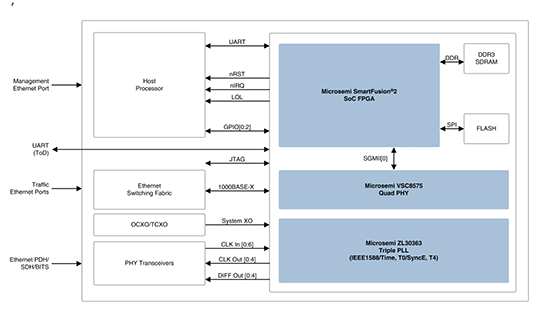
Example of IEEE 1588 Timing Synchronization Module in Centralized Architecture. Image courtesy of Microsemi.
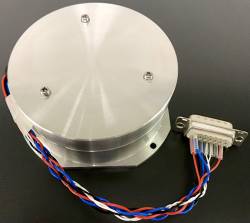
The TA7774 iFOG is suitable for autonomous driving and mobility applications, and ADAS. Photo courtesy of AdvanTech International.Tamagawa Seiki, an advanced inertial sensing technology provider for aerospace, military and automotive applications, is launching a new, low-cost, tactical grade, interferometric Fiber Optic Gyroscope (iFOG) suitable for autonomous driving and mobility applications, and ADAS (Advanced Driver Assistance Systems).
By Inside GNSS
Col. Steven Whitney, the director of the GPS Directorate. Air Force photo.Though lawmakers have made clear their interest in having U.S. military receivers incorporate European navigation signals, an agreement to use the encrypted Galileo signal remains elusive and the normal military requirements process could substantially delay implementation.
By Inside GNSS

Photo courtesy of GPS.gov. House and Senate authorizers are forcing a reorganization of the Pentagon’s management of military space programs, giving authority to a soon-to-be-named official to prioritize space budgets across services and setting planning in motion for a possible new department. They also approved spending the full amounts requested for the military GPS programs and mandated that defense officials both test a backup to GPS and look at incorporating European and Japanese GNSS signals into military user equipment.
By Inside GNSSAccording to reports out of China, new, very accurate rubidium atomic clocks onboard two BeiDou-3 satellites launched into space on November 5 have greatly improved the accuracy of the system.
The country launched two BeiDou-3 satellites into space via a single carrier rocket to support its global navigation and positioning network at 11:45 UTC on Sunday (November 5). The satellites were aboard a Long March-3B carrier rocket which took off from Xichang Satellite Launch Center in the southwestern province of Sichuan, according to the China Xinhua News Agency.
By Inside GNSS

The long-running, high stakes battle between the GPS community and Ligado Networks may enter a new phase next month when the firm presents to the nation’s leading GPS experts its plan to develop a combined terrestrial/satellite network using its spectrum neighboring the GPS band.
By Inside GNSSThe nation’s leading satellite navigation experts have invited Ligado Networks, a firm whose plans are widely viewed by many as a threat to satnav, to present at their November 15 meeting. If the company accepts, it could illuminate the structure of the terrestrial service it has in mind and either ease, or add fuel to, the ongoing dispute between Ligado and the GPS community.
By Dee Ann Divis
Carla Bailo, AVP for mobility research and business development at OSU, spoke at ION GNSS+ on Sept. 26. Photo: Institute of Navigation. If all goes as planned, Columbus, Ohio will become one of the smarter cities around, using drones to deliver medical supplies, autonomous shuttles for college students, and a smart infrastructure that will help with buses, traffic congestion, collision avoidance for both vehicles and pedestrians, and much more.
By Inside GNSS

Tallysman’s TW2643POC GPS/Iridium antenna. Photo: Tallysman.Tallysman announced that Facebook has selected the Ottawa, Canada company’s TW2643POC GPS/Iridium antenna for the Facebook Open Cellular Platform.
The TW2643POC employs Tallysman’s unique Accutenna technology in a magnet mount, passive right hand circularly polarized antenna for the reception of all of the GNSS constellations (GPS L1/GLONASS G1/ Galileo E1/ BeiDou B1) plus Iridium: 1559 to 1626.5 MHz frequency band. It is certified and specially designed to maximize the performance of Iridium Voice and Data Modems plus the upper GNSS band (1559 – 1606MHz).
By Inside GNSS

TimeProvider 5000 IEEE 1588 Precision Time Protocol (PTP) grandmaster clock. Photo source: Microsemi Corp.
TimeProvider 5000 IEEE 1588 Precision Time Protocol (PTP) grandmaster clock. Photo source: Microsemi Corp.Microsemi Corporation announced the hardware on its TimeProvider 5000 IEEE 1588 Precision Time Protocol (PTP) grandmaster clock has been updated to support Internet Protocol version 6 (IPv6) and multi-GNSS constellations to ensure better reception and higher security in a wide variety of telecommunications network applications.
By Inside GNSS