April 1, 2020
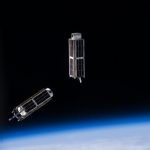
Hundreds, thousands of tiny satellites no bigger than a breadbox orbit the Earth, gathering a staggering amount of data and relaying petabytes of communication. These nanosatellites, commonly called cubesats, serve a variety of research and, increasingly, commercial roles. They work for science, exploration, technology development, education, telecommunications and other operations.
They are built to a standard dimension of 10 cm x 10 cm x 10 cm, or small multiples thereof. Typical weight is less than 1.33 kg (3 lbs) per U, or Unit, which equals on 10 cm cube.
Among other launch opportunities, the National Aeronautics and Space Administration’s (NASA’s) CubeSat Launch initiative (CSLI) can give a ride up to small satellites as auxiliary payloads on planned rocket missions.
To meet performance requirements, commercial cubesats must often report from a precisely known location. Faulty positioning can produce inaccurate data that will adversely affect commercial operations on Earth. Cubesats typically carry a commercial GPS L1 receiver to determine their orbit, as altitude and orbit determination and control form key parameters.
Cubesats often fly in formation and wil then use a GPS/GNSS receiver to co-ordinate and synchronize among themselves. Finally, they use GNSS for onboard synchronization of operations and for precise timestamping of Earth observation data
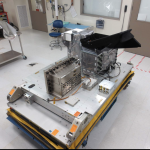
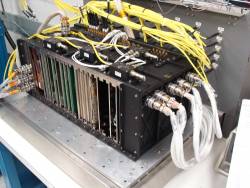
Though small is size, cubesats can carry a large price tag, up to hundreds of thousands of dollars per project. Pre-launch testing for quality assurance is critical, particular of the satellites’ PNT capabilities. Earth-bound testing cannot replicate the conditions of low-Earth orbit, where the satellites will be moving at several kilometers per second, and need to maintain awareness of the also moving GNSS satellites above them in mid-Earth orbit. Thus the key role of GNSS simulation in this burgeoning industry.
The content of this article is largely drawn from a blog post by Talini Pinto Jayawardena, a space science technologist with Spirent Communications, and also a research manager at the University of Bath. To read her full blog, which contains a detailed description of key performance criteria to test with a simulator, visit here.
Extensive discussion of Doppler shift handling, precise orbit determination, antenna performance, time synchronization, special events, onboard interference handling, and the impact of environmental test (vibration and thermal vacuum) is presented.
By Inside GNSS