Hemisphere GPS Unveils New Antennas, DGPS Receiver for Handheld Mapping
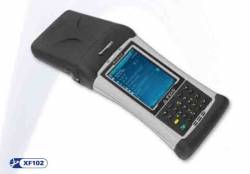
XF102Hemisphere GPS has launched its XF102 DGPS receiver, the latest addition to the company’s XF-Series of differential GPS receivers for handheld mapping.
By Inside GNSS
XF102Hemisphere GPS has launched its XF102 DGPS receiver, the latest addition to the company’s XF-Series of differential GPS receivers for handheld mapping.
By Inside GNSS
The Radio Technical Commission for Maritime Services (RTCM) has recognized Dr. Rudy Kalafus for his 25 years of service as Chairman of RTCM Special Committee 104 (SC104) on Differential Global Navigation Satellite System (DGNSS) Service.
By Inside GNSS
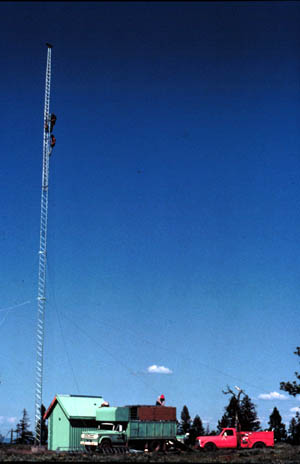
Top tower- Starkey Loran Research Photos 2001Enhanced Loran (eLoran), the proposed backup to GPS that has made a career out of surviving efforts to eliminate its Loran-C foundation, now appears to be only two signatures away from extinction — and both appear likely.
A House-Senate conference committee version of the fiscal year 2010 (FY10) appropriations bill for the Department of Homeland Security (DHS) approved October 7 allows for termination of the Loran-C signal on January 4, 2010.
By Inside GNSSThe 38th International Loran Association conference—ILA38— will be held at the Sable Oaks Marriot in South Portland, Maine from October 13-15 2009.
By Inside GNSS
Prof. Jingnan LiuA draft interface control document for China’s Compass (Beidou-2) GNSS system may be available by next year, according to remarks made at a September 30 presentation at the University of Nottingham (United Kingdom) by Jingnan Liu, principal scientist at the National GNSS Research Center of Wuhan University.
By Inside GNSS
Antonio Tajani, EC Vice-President for Transport Policy, announces EGNOS Open Service. During a press conference today (October 1, 2009), Antonio Tajani, European Commission vice-president for transport policy, announced the official start of operations for EGNOS, the European Geostationary Navigation Overlay Service. This is a major milestone for EGNOS, a satellite-based augmentation system that improves the accuracy of satellite navigation signals over Europe.
The EGNOS Open Service is now available free of charge for non-safety-of-live applications to all users equipped with suitable receivers – and most mass-market satellite navigation receivers being sold today are EGNOS-ready.
By Inside GNSS
NovAtel OEMStarNovAtel Inc. rolled out a series of new products and a firmware upgrade at the Institute of Navigation’s ION GNSS 2009 conference held September 22-25 in Savannah, Georgia, USA.
The Calgary, Alberta, Canada–based GNSS manufacturer announced the launch of their new single-frequency GNSS receiver, OEMStar. The low-cost, 14-channel, L1 receiver measures 46 x 71 millimeters and consumes just 750 milliwatts of power when tracking both GPS and GLONASS signals.
By Inside GNSS
Anritsu Corporation, a Japanese manufacturer of test and measurement equipment, has selected IFEN’s NavX-NCS Standard GNSS simulator as its assisted-GPS (A-GPS) test system for use in developing mobile terminals.
The NavX-NCS is a GNSS RF navigation constellation simulator capable of simulataneously simulating signals from up to nine L-band frequencies in the GPS, Galileo, GLONASS (including its new G1 frequency), and QZSS systems.
By Inside GNSSThe European Commission (EC) expects to declare in October that the European Geostationary Navigation Overlay Service (EGNOS) — which provides satellite-based augmentation signals for GPS and Galileo — is operationally ready as an open and free service for non-safety-of-life (non-SoL) applications, according to a press release from the GNSS Supervisory Authority (GSA).
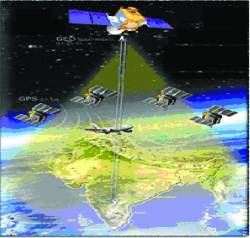
By Inside GNSSPCTEL, Inc., of Bloomingdale, Illinois USA, announced that its high-precision Wide Area Augmentation System (WAAS) ground station GPS antennas will be deployed in India’s GPS-Aided Geosynchronous Augmented Navigation (GAGAN) system.
By Inside GNSS
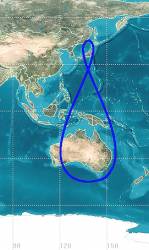
Officials from the National Oceanic and Atmospheric Administration and the Japan Aerospace Exploration Agency (JAXA) have unveiled a new ground station in Guam that will track spacecraft from JAXA’s upcoming Quasi-Zenith Satellite System (QZSS).
Designed to work seamlessly with the U.S. Global Positioning System, QZSS is a space-based augmentation system (SBAS) being developed by JAXA to improve navigation satellite coverage over Japan and surrounding areas. The first QZSS satellite is expected to launch in 2010.
By Inside GNSS
GLONASS-K spacecraft (artist’s illustration)With a nearly restored and modernizing GLONASS system beginning to make inroads into mass market products and services, Russia has revealed plans to build out a space-based augmentation system (SBAS) and establish its first ground monitoring stations outside the Russian territory.
In a July 30 presentation at an International Committee on GNSS (ICG) working group on interoperability, Dmitry Marareskul, head of the onboard satellite navigation sector of Information Satellite System Reshetnev Corporation in Zheleznogorsk, revealed Russia’s plans to expand its network of GLONASS monitoring and measuring stations to include sites in Australia, Cuba, and South America.
By Inside GNSSSpirent Communications plc has launched the GSS6300 Multi-GNSS Signal Generator, intended for high-volume production test applications for devices that use commercial GPS/SBAS, GLONASS, and/or Galileo receivers.
The GSSS6300 provides a comprehensive remote control interface, designed to facilitate integration into automated test equipment (ATE) environments.
By Inside GNSS