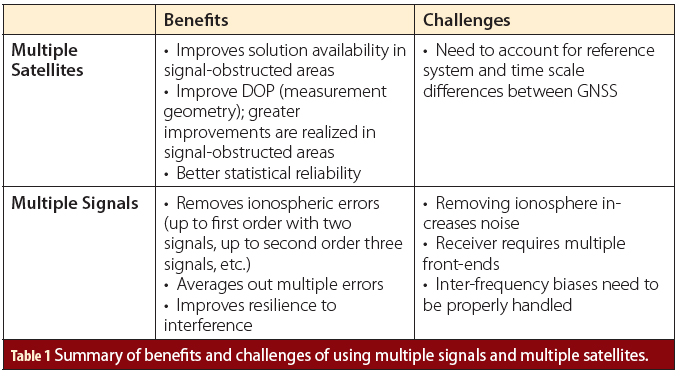
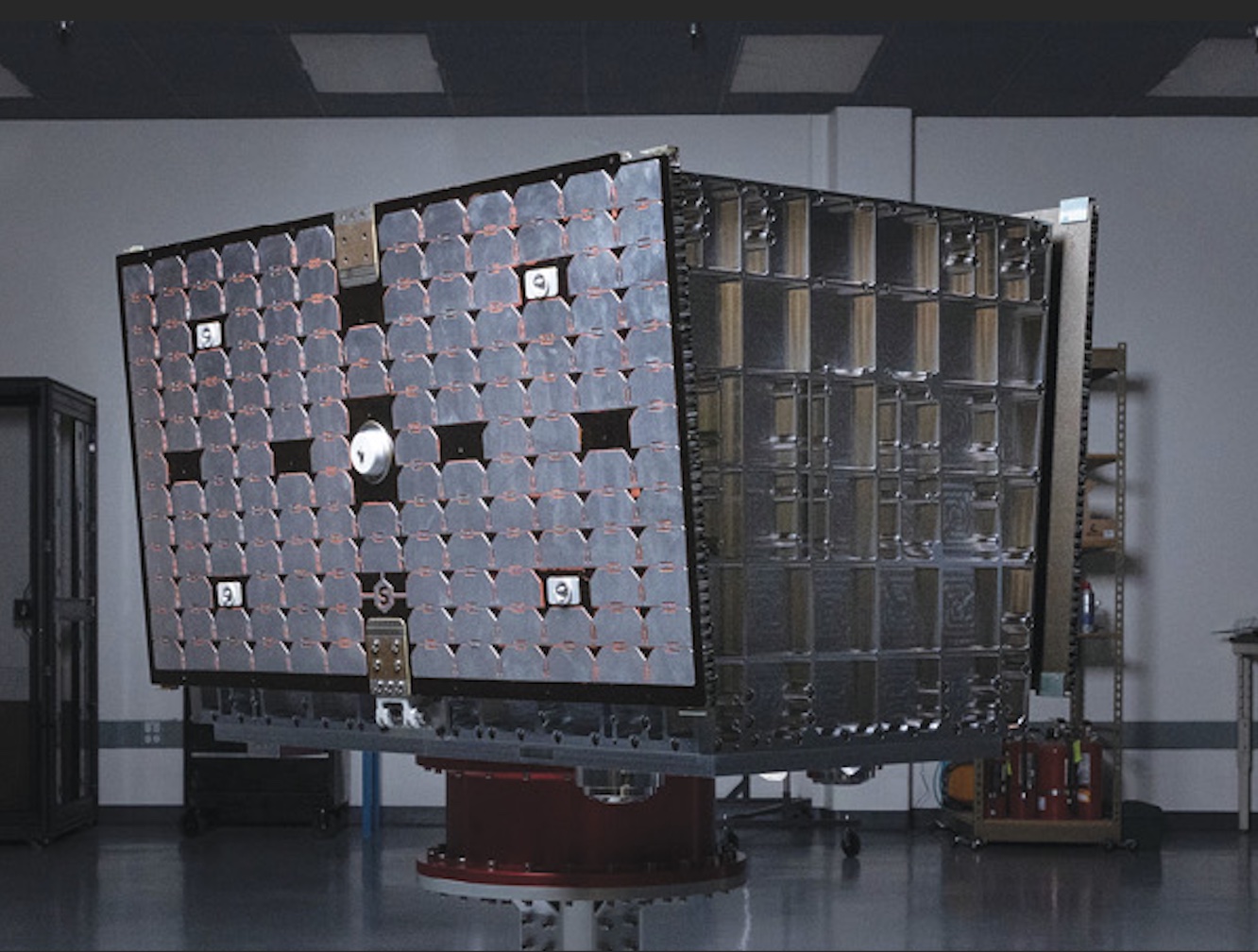
Xona Space Systems recently launched its first production-class LEO satellite into orbit, a major step toward the ultimate goal: offering a commercial service that will complement GNSS and become a critical part of a more layered approach to PNT.
Low Earth orbit (LEO) represents a new architecture for satellite navigation, one that can complement legacy GNSS satellites and serve as a backup when they’re denied. Many consider LEO satellites a key part of the layered approach to PNT that’s become such a focus of late, as the industry recognizes growing GNSS vulnerabilities and the critical need to add resiliency.
LEO’s untapped potential, with its closer proximity to Earth and fast moving satellites, provides inherent advantages over middle Earth orbit (MEO) and geostationary Earth orbit (GEO) satellites, and that’s generating excitement and investment from companies developing complementary PNT (CPNT) solutions. Xona Space Systems is among those setting their sights on LEO, and recently launched its first production-class LEO satellite, Pulsar-0, into orbit.
This significant step forward comes three years after Xona’s first satellite, Huggin, was launched. As the first commercial navigation satellite in LEO, Huggin proved that a new model for PNT was possible.
That set the stage for the recent Pulsar-0 mission, where the goal is to validate core technology designed to offer more accurate and robust PNT services in degraded or contested
environments. Pulsar-0 is the first in a series of satellites that will make up Xona’s commercial LEO-based PNT constellation.
“We initially want to test, is this signal able to be received by a receiver? That’s step one. That’s what’s happening now and what’s been happening for a little while internally,” said Bryan Chan, co-founder and VP of Strategy at Xona Space Systems. “Step two is getting into those higher level value props, things like ranging, things like encryption, authentication, corrections, faster convergence times, multipath error rejection, even reduced device power consumption.”
With this launch, Xona is primed to bring forth a technology that will enable a new category of innovation, providing a different way to localize hardware in the physical world and delivering high accuracy and resiliency to various industries.
Reaching Milestones
Pulsar-0 is a dedicated satellite, meaning its sole purpose is to “demonstrate dedicated PNT for the masses,” Chan said. Xona developed the satellite’s only payload, which is broadcasting Xona’s production frequencies, X1 and X5, both in the L band. Broadcasting at these frequencies is made possible by an FCC authorization the team sought as part of launch preparations.
The authorization, Chan said, represents a huge step forward, and is an acknowledgment of the importance of Xona’s signals and service offerings. Both Xona and the FCC are focused on ensuring Pulsar signals don’t interfere with GNSS signals, but rather serve as a complement to them.
Xona is also gearing up for demonstrations both in and outside the U.S., Chan said, including government run tests and Jammertest in Norway. Various commercial focused tests tailored toward specific customer requirements are also in the works.
“We’re completing check out of the signal and all the infrastructure behind it,” Chan said, “and from there, once it’s ready for partner and customer consumption, we’ll start doing structured tests where we’re broadcasting signals.”
A lot went into the design, build and testing of Xona’s LEO payload, Chan said, from signal to hardware generation to RF broadcasting to the simulating software that had to be developed around it. All that work created an ecosystem partners could rally around to make Xona Pulsar a reality. Now, most of the legal challenges (particularly with that milestone FCC authorization) and technical hurdles have been overcome; now it’s nearing time to use the signal in real world applications across various domains via live sky testing.

A New Era of Innovation
GPS has become an ubiquitous signal that’s unlocked many innovations and still powers modern life 50 years after its development. But the system has really only seen incremental progress over the years, while the technologies that rely on it have evolved quickly. Xona sees Pulsar as the next step, and the key to unlocking a new era of innovation.
“It’s an enabling technology that people are thinking about using not just from a dedicated perspective, but also as an extra tool in their toolbox they can apply to problems they’re solving today,” Chan said. “We’re past simulation mode. We’re past analysis mode. We’re broadcasting a real signal that people can ultimately characterize and see how it might fit with the technology they’re developing.”
While LEO satellites offer many benefits over MEO, including stronger signal strengths and less susceptibility to spoofing and jamming, Xona Pulsar can be adopted using equipment that’s already familiar to GNSS users, Chan said. A firmware update to existing GNSS receivers is all that’s needed to access the signal, making Pulsar “a scalable solution that can be adopted by all markets GNSS currently serves.”

The Users
Pulsar will operate in a way that’s similar to GNSS, Chan said, and it’s up to users how they want to integrate on the new signal. They can use one or both frequencies, for example, or add constellations. Xona sees their technology as an additional constellation to GNSS, but one with a number of different features and novel characteristics that other constellations don’t have—features that are must-haves for some of the more challenging applications.
“There are cases where a high signal power matters a lot, like when you’re trying to get a positioning or timing solution indoors, when there’s heavy tree cover or you’re in a GPS denied environment,” Chan said, noting Pulsar’s flexibility. “So, in these scenarios, maybe a receiver will be multi GNSS to start, but if you lose GPS, that’s when you fall back to Xona Pulsar.”
When developing Pulsar, Xona used GPS, the “ultimate dual use technology,” as a model. Like GPS, Xona Pulsar can be leveraged by government and commercial users, and Chan sees defense, heavy industry and consumer IoT among the early adopters who will be able take advantage of the commercial service right away. As the number of satellites grows to hundreds, other markets, like automotive, will be able to rely on the signal as well.
“We don’t take that charge lightly. We understand it’s a tough road and we can’t do it alone,” Chan said. “That’s really why we’ve taken this approach of partnering with a number of really key simulator vendors as well as receiver manufacturers. We understand we need to grow the ecosystem from the ground up to ultimately cater to all sorts of folks operating in all sorts of different conditions.”
Hexagon | NovAtel is among Xona partners, integrating the Pulsar signal into its GNSS receivers. A more recent partnership, just announced earlier this year, involves Trimble. Xona will work with Trimble to broadcast their RTX corrections service through Pulsar signals.
That corrections stream, delivered over satellite, will be receiver agnostic, meaning users can choose any receiver they’d like as long as it has the firmware baked in to decode and use those corrections.
“We see that as a big accelerator and opening the door to many more applications,” Chan said. “For example, consumer IoT applications, even smartphones, where oftentimes they’ve been locked out of traditional satnav corrections.”
In the beginning, Xona Pulsar will provide a one satellite view, persistently, over mid latitudes, Chan said. That will enable precision timing, GNSS corrections and augmentation to GNSS.
GNSS corrections are important to heavy industry, especially satellite derived corrections, Chan said. Providing that, and taking an agnostic receiver approach to doing it, will open up many new opportunities for this market.
“We can provide a nanosecond timing level service with the highest signal power,” Chan said. “That signal can be accessed in traditionally impossible environments, like indoors or under canopy.”
The defense market is interested in signals that provide anti jam and anti-spoofing capabilities, Chan said. Xona Pulsar offers that, along with encryption and authentication, making the signal an attractive option for military applications.
For consumer IoT, Chan said, it’s more about satellite availability. In cities where there isn’t much of a sky view, any number of satellites will help with positioning.
Regardless of the application, LEO satellites offer many advantages over GNSS, Chan said, including faster convergence times, elimination of multipath errors from signals bouncing off buildings, and, ultimately, reduction in receiver power consumption.
“That’s a huge selling feature, something people really care about,” Chan said of the reduced power consumption. “So, if you’re able to get these fast moving LEO satellites in addition to the stronger signal power, which is much more available, that starts to get really exciting for a lot of these folks.”
Moving Forward
Recently, Xona received $92 million in new funding, including a Series B round led by Craft Ventures and $20 million in non-dilutive funding through a Strategic Funding Increase (STRATFI) award from SpaceWERX—investments that have moved up Xona’s timeline to launch and deploy a commercial service, which is now expected in 2027. They are shifting from the research and development stage into delivery at scale, moving from a single satellite to hundreds in orbit in the coming years.
With the funding, Xona has put in commitments toward launch vehicles and future satellites builds, Chan said. And though he couldn’t go into specifics, Chan confirmed a number of satellites are scheduled to be launched next year.
Of course, Xona will continue to innovate moving forward. Industry can expect a “continued cadence of satellite launches and more features being rolled out,” in the coming years. And the features added will be based on lessons learned from previous launches as well as feedback from those who are using the system.
“We’ve been listening for years now about what people want, how they want it, what they prioritize and how they intend to use it,” Chan said. “Just being a commercially focused company, that’s a big difference from what traditional GNSS has typically operated on.”
The GPS we rely on today was built for a different era, Xona co-founder and CEO Brian Manning wrote in a recent blog post. While today’s GPS satellites are “masterpieces of engineering,” they have lengthy contracting, design and build cycles—and that means it can take decades for new capabilities to reach users. That simply isn’t fast enough to meet the growing threats that are “evolving on the scale of years, months or even weeks in recent conflict zones, leaving a critical gap between what’s needed and what’s available.”
This reality calls for new solutions to complement PNT in both defense and commercial applications, to provide a backup when GNSS is denied. Xona Pulsar represents one of those solutions, bringing new capabilities, much shorter design cycles and a reliable signal that adds much needed resiliency.
“Our vision is straightforward,” Manning wrote. “Make satellite navigation dramatically more accurate, secure and available. That means rebuilding it from the ground up in low Earth orbit.”