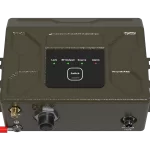

As GNSS denial becomes a baseline condition across military and civilian operations, VIAVI Solutions is building a modular, multi-layered PNT ecosystem that integrates precision timing, inertial navigation and signal intelligence. With strategic acquisitions and field-proven technology, VIAVI is redefining resilience at the edge—where assurance is not optional, and adaptability is mission-critical.
For Oleg Khaykin, President and CEO of VIAVI Solutions, the company’s recent acquisitions in positioning, navigation and timing (PNT) represent more than tactical expansion—they mark a strategic alignment with the evolving demands of modern defense and infrastructure. In an era shaped by contested signals, electronic warfare (EW) and autonomy at the edge, VIAVI is building a platform that not only withstands disruption but is engineered to operate through it.
“The acquisition of Jackson Labs Technologies [JLT], combined with Inertial Labs, positions VIAVI as a leader in the resilient PNT space,” Khaykin explained. “We now offer complementary technologies that enable us to provide complete solutions addressing the entire PNT signal chain—from signal generation and distribution to detection and validation.”
This “signal chain” view of PNT is central to VIAVI’s thesis. Inertial Labs contributes leading sensor fusion and visual navigation capabilities. Jackson Labs brings high-performance timing, holdover stability, and signal conversion through its transcoder platform. But what matters most is how these components function as part of a reconfigurable system.
“By bringing together the precision timing technologies of Jackson Labs with the inertial navigation solutions from Inertial Labs, we have created a comprehensive PNT portfolio that few others can match,” Khaykin said. “This is especially important in applications where GNSS signals are degraded or denied.”
Khaykin was direct about the evolving threat environment: GPS signals, once assumed secure, are now routinely denied, spoofed or degraded—particularly in peer or near-peer conflict zones.
“The growing threats to GPS—both accidental and deliberate—require a new approach to PNT,” Khaykin continued. “VIAVI is addressing this challenge by delivering modular, interoperable and scalable solutions that support multiple layers of PNT resilience.”
This platform mindset builds on VIAVI’s long-standing strengths in test, validation and network visibility, now applied to navigation and timing environments.
“Our heritage in test and measurement means we understand how to ensure performance, reliability and interoperability in complex systems,” he said. “This gives us a unique advantage as we scale PNT solutions across both defense and commercial applications.”
And while national security applications remain a primary focus, Khaykin noted the demand for resilient, verifiable time and navigation is growing rapidly in civilian sectors as well.
“Resilient timing and navigation are becoming essential for critical infrastructure, telecommunications and emerging autonomy markets,” he said. “VIAVI is building the technology foundation to meet those needs.”
EDGE ENGINEERING: VIAVI AND INERTIAL LABS
VIAVI’s strategic vision is built on more than acquisition—it’s about integration with purpose. That vision becomes tangible through VIAVI’s collaboration with Inertial Labs, where the emphasis is on engineering at the edge: leveraging onboard sensors, reusing existing hardware, and delivering GNSS-resilient capabilities through sensor fusion, visual odometry, and precise time alignment.
What sets VIAVI apart is not just its ability to survive signal denial—but its modular, sensor-fused approach that adapts to each mission’s constraints and maximizes what’s already onboard.
The Challenge: GNSS Vulnerability and the Path to Resilience
In an era where EW saturation and GPS denial are no longer hypothetical but expected conditions of the battlefield, traditional PNT systems are struggling to keep pace. Doug Russell of VIAVI captured the sentiment succinctly: “Even in a GPS-denied environment, our integrated systems can still provide a robust signal that looks like GPS for the rest of the vehicle’s systems to operate. That is a huge cost and capability advantage.”
The operational landscape now assumes degraded or denied environments as the baseline. M-Code, low Earth orbit (LEO) constellations, and alternate navigation strategies are being prioritized by U.S. Department of Defense (DoD) modernization efforts and critical infrastructure entities alike. The need for layered, modular and cost-effective solutions is pressing.
Built for the D3SOE: Resilience by Design
Today’s mission planners no longer treat GNSS degradation as a possibility—they expect it. The DoD defines this new normal as the D3SOE: Denied, Degraded and Disrupted Space Operational Environment, where contested signals, spoofing and jamming are routine, not the exception.
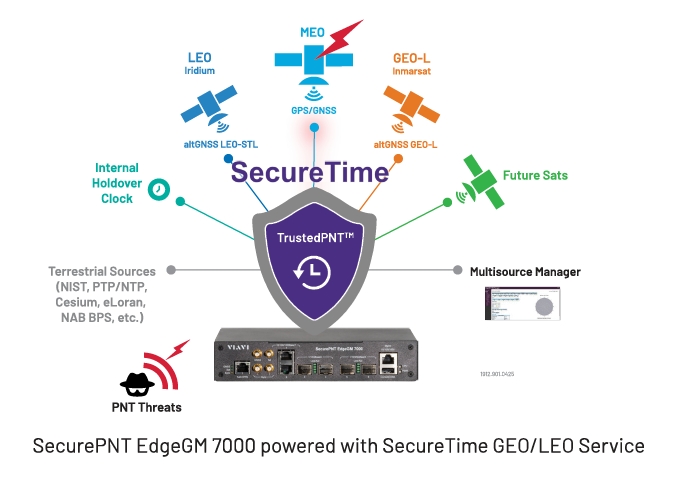
VIAVI’s integrated PNT platform is purpose-built for this environment. With components that interoperate across GNSS, inertial, visual, RF, and holdover timing domains, the system provides multiple, redundant pathways to maintain trusted PNT. By embedding resilience at every layer—from edge sensor fusion to transcoder-based retrofits—VIAVI ensures users can operate confidently, even when space-based signals are compromised.
This is not just survivability under threat—it’s assured performance, engineered for contested space from the start.
Integration as Differentiator: A Platform Built for Modularity
Jamie Marraccini, CEO of Inertial Labs, explained: “We start with what the platform already has—radios, cameras, antennas—and reuse that data. That means better SWaP-C and faster integration, especially for UAVs and expeditionary systems.”
Russell emphasized how this vision translates into practice: “For any given engagement, customers might need a GNSS receiver, maybe M-Code, maybe not. They might prioritize holdover clock performance or sensor fusion accuracy. What we provide is a menu of capabilities that the customer can build from—tailored to their mission set.”
Perhaps the most novel approach from the Inertial Labs side is their philosophy of sensor reuse. “A camera, already onboard for visual targeting or surveillance, can double as an input for visual navigation,” Marraccini said. “That is savings in both cost and power. Same goes for radios—
already on the platform for comms, but also usable for positioning via time-of-flight measurements.”
This reuse-centric design not only improves SWaP-C but also accelerates deployment timelines by reducing integration complexity.
One of the standout elements in this platform is the transcoder. “It allows you to disconnect an antenna and connect the output of the transcoder,” Marraccini said. “To the legacy system, it appears as a standard GPS L1 signal—but what it’s actually receiving is resilient, reconstructed navigation data.”
Russell added: “From a cost standpoint, that’s enormous. You’re upgrading without retrofitting the whole platform.” The transcoder outputs GPS-compliant signals derived from GNSS, inertial and even visual navigation inputs, enabling legacy platforms to function effectively in contested environments. What makes this platform especially future-ready is the decision to push processing and data alignment capabilities to the edge.
Marraccini noted: “We offer all time-stamped data to customers. They can use our fusion engine or run their own. We also provide access to synchronized data streams, allowing them to control how that data is exported to other systems.”
Time-stamping and physical alignment between sensors are critical for high-precision navigation. “If you’re 2,000 meters up and your camera and IMU aren’t aligned, you could be off by tens or hundreds of meters on the ground,” Marraccini said. “We calibrate the camera, IMU and magnetometer as one unit to ensure perfect alignment.”
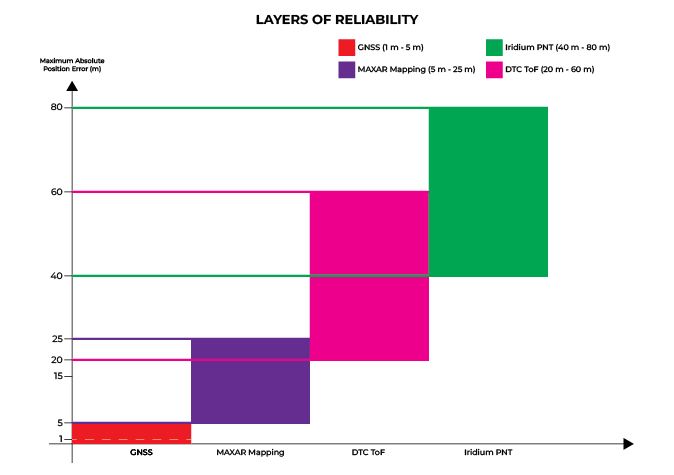
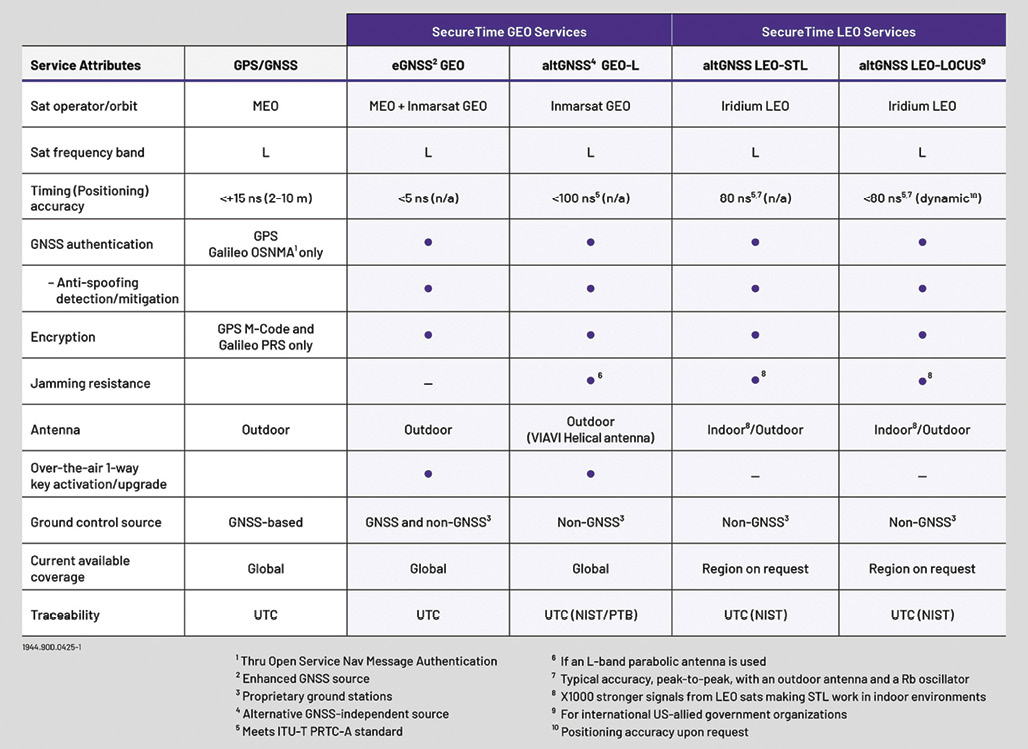
This results in visual geolocation accuracy of 5 to 25 meters in most scenarios—without GNSS. Timing accuracy, meanwhile, can fall well below 100 nanoseconds, depending on the configuration. “We’re squeezing every ounce of performance out of the sensor and timing systems,” Russell said. “It is the compounded value of incremental improvements.”
The architecture accommodates inputs from M-Code, GEO, MEO and LEO constellations. Marraccini emphasized, “We’re the only company doing time acquisition from LEO, MEO and GEO
simultaneously.” That capability enables robust holdover performance and diverse signal acquisition, significantly boosting system resilience.
Holdover clocks are configurable by application—ranging from basic solutions to CSAC-level timing stability. Said Jackson’s custom algorithms, developed at JLT, discipline these clocks for optimal performance.
The deeper the integration goes, the more apparent the value becomes. “We’ve found instances where a customer was already using Inertial Labs and Jackson Labs products independently—unaware that we are now part of the same ecosystem,” Russell said. “Now, we can remove redundancies, improve SWaP and reduce total system cost—all while boosting performance.”
While military applications remain a central focus, VIAVI’s platform is clearly dual-use. “The same resilience that matters in a GPS-denied battlefield also matters for first responders, utilities and transportation networks,” Marraccini said. “And now, we are not just talking about defense-grade performance. We’re making that available at a price point suited for commercial and civil applications.”
Russell and Marraccini consistently returned to the value of open architecture. “MOSA [modular open systems approach] allows customers to define their solution, using our fusion engine or plugging in their own,” Russell explained. “They’re not locked into a black box.”
That customer-first, open integration approach has become a defining feature of VIAVI’s strategy. “Whether they want to use our cameras, or theirs, our radios or theirs, our mission is to empower the integrator,” Marraccini said. “Everything we do is modular by design.”

PROVING GROUND: OPERATIONAL VALIDATION AT WHITE SANDS
As Inertial Labs pushes the boundaries of edge-based integration and sensor fusion, VIAVI’s broader platform must still prove its resilience under real-world conditions. That validation came in the New Mexico desert, where VIAVI deployed its full PNT suite against some of the most advanced jamming and spoofing threats in use today.
At NAVFEST—conducted by the U.S. Air Force’s 746th Test Squadron at White Sands Missile Range (WSMR)—VIAVI’s integrated PNT system was subjected to a series of mission-representative scenarios designed to emulate the EW conditions of a modern battlespace. The objective was clear: validate that VIAVI’s modular, multi-layered architecture could deliver assured PNT under threat, confirming not just technical soundness but full operational readiness for deployment across joint and contested environments.
The following section draws on insights from three key leaders—Marv Rozner, Senior Director of Military Programs and Synthetic Products at VIAVI; Said Jackson, founder of Jackson Labs and now VIAVI Vice President; and Giovanni D’Andrea, VIAVI Senior Director of Business Development—who were directly involved in the effort.
A New Architecture for PNT: Mission-Driven, Not Tech-Driven
One of the central themes emphasized by all three leaders was a departure from technology-first thinking toward mission-first design. “We don’t want to block our customers into a corner,” Jackson said. “We want to provide capabilities that do not lock them into a particular ecosystem. All of our products are orthogonal to each other. If you want to buy your GNSS receiver from someone else, you can.”
The team explained that the combined VIAVI platform offers customers a flexible mix of high-performance PNT components—from holdover timing to inertial navigation to GNSS receivers—that can be mixed and matched based on the requirements of the mission, platform or budget.
“It is not about throwing the most expensive IMU or rubidium clock at every problem,” Rozner said. “It’s about delivering the level of capability that the CONOPS requires.”
Rozner underscored the team’s commitment to open standards and modular design: ”Our new platforms are modular, utilizing an M.2 form factor—delivering standardized, high-speed, compact interfaces used in billions of devices annually. That allows us to scale a platform from a handheld unit to a tank.” Jackson elaborated, noting the goal is to enable plug-and-play interoperability not just within their ecosystem, but with any standards-compliant architecture. “Whether you’re building a low-SWaP UAV system or upgrading an Abrams tank, we are designing subsystems that can slot in and scale up or down.”
A centerpiece of JLT’s contribution to the VIAVI platform is the transcoder—a software-defined module that bridges incompatible systems in a secure and scalable way. Originally conceived in 2015 to address the Army’s challenge of retrofitting tens of thousands of dismounted GPS units without depot-level upgrades, the transcoder is now widely adopted across tier-one defense programs.
“We essentially insert a smart antenna in front of the legacy receiver,” Jackson said. “It looks like a standard GNSS antenna to the host system, but it’s actually feeding corrected, authenticated, M-Code-capable or spoofing-resistant data. The soldier swaps an antenna, not a manpack.”
D’Andrea added, “This allows us to upgrade billions of dollars of fielded gear in minutes instead of months. That matters.”
JLT’s reputation was built on world-class timing. As Jackson noted, “We’ve been improving timing since 2005. We took rubidium, MEMS and cesium clocks and made them better. Today, we offer 1 to 5 nanosecond timing accuracy using L-band correction data—without a cesium price tag.”
Rozner emphasized that timing remains the bedrock of the entire system. “Without the ‛T’, the ‛P’ and ‛N’ do not matter.”
JLT’s approach includes GNSS spoofing authentication using ground-based verification systems, as well as dynamic fallback to holdover timing in contested environments. Their upcoming Ku-band capabilities and L-band services add further layers of resilience.
With the integration of Inertial Labs, VIAVI can now offer a full stack of PNT capability. The platform adds visual odometry, IMUs and sophisticated sensor fusion to the mix. The result is not just redundancy, but enhanced awareness.
“We can detect spoofing through signal analysis and motion inconsistency,” Rozner said. “If the visual and inertial systems say one thing and GNSS says another, we know something’s wrong.”
D’Andrea expanded on the benefit: “It is not just about survivability. It is about giving customers options. We can mix-and-match the best of each capability to meet their operational needs.”
When asked about their edge in performance, Jackson said, “It is all about optimization. We design our own IP. We write the software from scratch. We don’t just take reference designs from vendors. That gives us flexibility to squeeze every ounce of performance out of these integrations.”
Rozner echoed the point, highlighting that the company’s software-defined radio (SDR) heritage plays a crucial role. “Everything from our L-band timing services to our Ku-band receivers are running on the same SDR hardware. That is why we can pivot faster and deliver more with less.”
VIAVI and JLT are designing their ecosystem to meet a spectrum of needs, D’Andrea said. “We’re building a hub of core technologies that can serve everyone from a first responder to a SOCOM operator. That is what Transcoder 2.0 is about—you pick the INS you want, the level of holdover you want, the GNSS you need.”
Rozner summarized the philosophy: “Whether it’s a $300 timing module or a full-up PNT subsystem for a vehicle, we want to give the customer what they need without forcing them to buy what they do not.”
VIAVI | JLT remains the only known provider using ground-based infrastructure to authenticate GNSS signals outside the network itself. This complements spoofing detection and fallback protocols across the VIAVI platform.
“We believe spoofing detection is the first problem to solve,” Jackson said. “If you cannot detect spoofing, then nothing else matters. Once you know, then you can fall back to our trusted timing or switch to authenticated sources.”
All three leaders agreed: VIAVI’s platform is not just a new product. It is a modular, standards-based architecture for delivering PNT resilience at scale. With IP ownership across timing, navigation and integration layers, and a pricing model built around COTS efficiencies, the company believes it is uniquely positioned to lead the next era of assured PNT.
“We do not just future-proof our solutions,” Rozner said. “We future-proof our customers.”
While the field trials at White Sands demonstrated the VIAVI platform’s resilience under electronic attack, the real innovation lies in how those capabilities are architected from the ground up.
Compound Gains Through Collective Innovation
What VIAVI and its subsidiaries have created is not just an amalgamation of parts—it’s a precision-engineered system where each improvement is magnified by the next. The combined capabilities of Jackson Labs, Inertial Labs and VIAVI offer customers a foundation that scales from platoon-level kits to enterprise-wide PNT infrastructures.
“We build capability at the pace of operational need,” Russell said. “And increasingly, that means making smart use of what’s already there, integrating it with the best we can build, and delivering it in a form that works right now—not in five years.”
From holdover timing to georeferenced vision, and from transcoder-based
retrofits to edge-fused intelligence, VIAVI’s integrated PNT platform stands ready to meet the evolving challenges of GNSS resilience with ingenuity, adaptability and performance.
Layers of Reliability: An Engineered Advantage
This cohesion is no accident. Once independent centers of excellence, Jackson Labs and Inertial Labs are now fully embedded within VIAVI—not as acquisitions, but as integral innovation hubs aligned under a unified operational vision. Their fusion brings more than just expanded capabilities—it adds depth, agility and resilience across the platform.
Leveraging Inertial Labs’ robust aiding data ecosystem, VIAVI’s integrated PNT architecture builds layers of reliability that sustain performance even under the harshest GNSS-denied conditions. Each element—visual, inertial, RF, and timing—reinforces the next, forming a tightly coupled web of complementary technologies. This multi-layered approach does not just guard against signal loss; it ensures bounded absolute position accuracy through redundancy, adaptability and smart sensor fusion.
With this foundation, VIAVI delivers more than an alternate to GNSS—it delivers operational assurance. The result is a system built for today’s contested environments and tomorrow’s evolving threats.
A Unified Vision, Proven in the Field
Taken together, these three perspectives reveal a consistent thread in VIAVI’s approach to resilient PNT: a CEO’s vision for unified capability, a field team’s validation under real-world EW conditions, and an engineering ethos grounded in modularity, reuse and intelligent integration. Khaykin’s strategy is more than aspirational—it’s operational, as demonstrated by the team’s performance at WSMR.
That performance is no coincidence. It reflects a deliberate, layered framework engineered by Jackson Labs and Inertial Labs and now fully realized within VIAVI. From executive leadership to ground-level deployment, VIAVI is aligning innovation with mission urgency—delivering the kind of trusted PNT foundation that modern operations not only require, but increasingly demand.