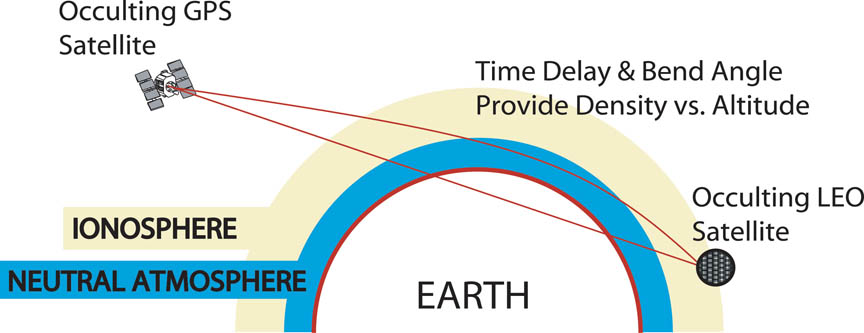
NASA has awarded PlanetiQ an expanded contract through its Commercial Smallsat Data Acquisition (CSDA) program, adding high signal-to-noise ratio (SNR) GNSS polarimetric radio occultation (PRO) data to the company’s existing CSDA portfolio.
PlanetiQ already provides NASA with ionospheric scintillation data, ionospheric total electron content measurements, and high-SNR GNSS radio occultation data under the program.
The expanded offering gives government researchers access to observations designed to improve understanding of precipitation processes, atmospheric structure, and Earth system dynamics. Polarimetric radio occultation extends traditional GNSS-RO by using dual-polarization receivers — capturing both horizontally and vertically polarized returns from circularly polarized GNSS signals. Because raindrops and snowflakes tend to flatten as they fall, the horizontally polarized component is slightly delayed relative to the vertical; measuring that phase difference yields information about rain and snowfall structure, melting layers, horizontal precipitation banding, and storm intensity variation.
PlanetiQ’s high-SNR receivers are central to the capability’s value for precipitation applications, where greater sensitivity to lighter precipitation and certain cloud structures is critical.
“As more researchers gain access to high-SNR PRO data, we expect both the scientific understanding and the potential operational uses of the technology for precipitation and severe weather monitoring to expand,” said Dr. E. Robert Kursinski, Chief Scientist of PlanetiQ.
Access through the CSDA program is available to NASA researchers, other U.S. government agencies, and international collaborators. PlanetiQ, founded in 2015 and based in Golden, Colorado, received NOAA’s largest-ever commercial satellite weather data contract in 2025, valued at $24.3 million, and holds a $15 million U.S. Air Force STRATFI contract for next-generation weather data from space.