As Ukraine uses Starlink-enabled drones to target Russian fuel logistics in occupied Ukraine, Russia’s military is reportedly scaling up efforts to solve one of the harder tactical EW problems of the war: locally denying Starlink connectivity without having to suppress the entire constellation by scaling deployment of an electronic warfare system called Volna Kupol Garant, or “Wave Dome Guarantor.”
According to a Telegram post by Ukrainian Defense Ministry advisor Serhii “Flash” Beskrestnov on June 16, Guarantor was developed by the company Rossiysky Kupol LLC based in Simferopol, Crimea and first appeared in 2024 near Kharkiv—where at least one system was destroyed.
But recently in 2026, Russia began multiplying Guarantor deployment along the southern highway “land bridge” between Russian soil and Crimea to counter Ukraine’s destructive medium-range strike drones that have ravaged fuel truck logistics, causing a stark fuel shortage in Crimea.
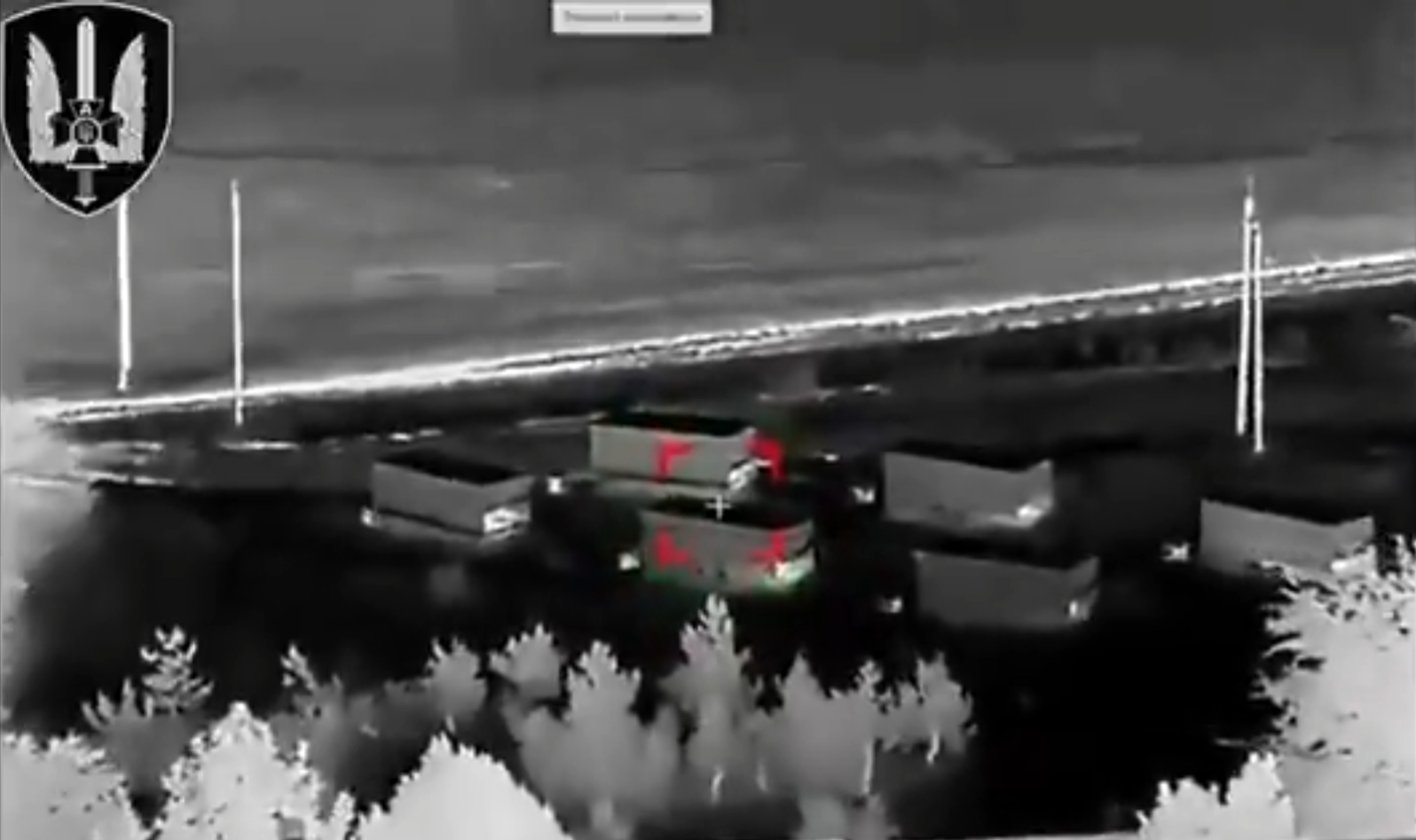
In response, Ukraine’s military has released videos showing two strikes on individual trailers of Guarantor systems by the 422nd “Luftwaffe” Unmanned Systems Regiment—attached to the 17th Corps operating in central-southern Ukraine.
Beskrestnov describes an approach intended to interfere with a Starlink satellite’s reception of terminal uplinks by transmitting interference in the relevant Ku-band uplink channels:
“Technically, a Starlink satellite receives signals from terminals in the 14–14.5 GHz range. This range is divided into 8 channels, each 62.5 MHz wide. The Russians basically took 8 satellite dishes, pointed them at the satellite, and each dish transmits interference on its own channel.” Beskrestnov claims this can effectively “deafen” the satellite to terminals in the affected area.
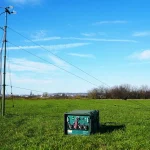
He further details that each Guarantor system encompasses six trailers, each with capacity for two of the system’s eight rotating dish antennas, each of which is covered by egg-shaped domes. Implicitly, then, some trailers carry just one antenna. The antennas can be optionally dismounted, and the power-hungry system can either be sustained by trailer-mounted generators or from external sources.
Beskrestnov concludes each system can effectively deny Starlink access across “roughly 20 square kilometers.” Calculating backwards, this implies a circular radius of just over 2.52 kilometers, or 1.57 miles.
That suggests point defense of a local area, but the radius remains small enough that a Starlink-controlled drone with automatic target tracking could still acquire an optical lock from outside this defensive bubble on targets within the protected area, including Guarantor systems themselves. Indeed, optical lock-on seems possibly present in at least one of the videos released by the 422nd Regiment.
Russian Telegram drone blogger “Unmanned Brotherhood” claims Guarantor is causing Ukrainian forces to complain of “significant problems” but concedes the system has downsides: “the EW system is currently quite large and conspicuous, though this issue is expected to be rectified in the future.” Another Russian technical specialist, Sergei Trukhachev, told Russia’s TASS news agency that the system demonstrated “high effectiveness during local tactical operations.”
Beskrestnov claims the systems are being sold at the “absolutely magical” price of $1.5 million apiece. While that does not seem prohibitive by American standards, in consideration of the limited area protected, that price point may prevent deployment from being scaled to extend coverage over large areas like the hundreds of miles of highway in southern Ukraine under assault by Starlink-enabled drones.
That Ukraine itself is striking Guarantor systems suggests they are effective enough to be worth attacking, but nonetheless apparently vulnerable to strikes. Besides being targetable at distance with electro-optical guidance, the system’s high-power emissions could also make it vulnerable to emitter-location tactics, including electronic support measures, loitering munitions cued by RF detection, or purpose-built home-on-jam weapons.
Jamming a cloud of gnats
Starlink is notoriously difficult to jam compared to traditional geostationary satellites, for the same reason it is harder to swat a cloud of gnats than an individual fly: it consists of a network of over 10,000 low-Earth orbit satellites that are constantly moving at high speed. Although each satellite remains overhead for roughly five to seven minutes, Starlink’s network timing and beam/satellite management operate on short, synchronized intervals, and user terminals can transition among satellites as geometry changes, complicating attempts to focus jamming on a single moving spacecraft.
This means that a huge number of emitters would be needed to continuously jam Starlink over a wide area; for example, a study by China’s Zhejiang University and Beijing Institute of Technology estimated China would require at least 935 high-powered, or 2,000 low-powered, aerial jamming platforms to deny Starlink across an area the size of Taiwan, or 13,900 square miles.
With its focus on just one satellite at a time, it is not clear how well Russia’s Guarantor overcomes the Starlink “cloud of gnats” challenge. Is an external system continuously re-cueing the Guarantor jammers to target the next most relevant satellite as their orbital positions shift? And if Guarantor only jams one satellite at a time, does that really suffice to ensure another Starlink satellite is not also able to cover that area simultaneously?
It is also worth bearing in mind that Starlink’s jamming resistance extends beyond distributed targeting to other design characteristics, including the ability to adaptively null interference returns from areas generating jamming signals.
Intel on Rossiysky Kupol LLC
A Russian article in March 2025 provides additional details on a C-UAS “super EW” system developed by approximately 150 scientists at Rossiysky Kupol LLC, funded in part by local authorities in Crimea, and allegedly effective against UAS targets at a 20-kilometer radius, or 12.4 miles. Without otherwise mentioning satellite jamming, the article alleges this system “unintentionally suppressed” GPS signals in a neighboring European country, presumably Romania, and allegedly “prevented” an attack by 25 drones targeting a plant near Rostov.
The rise of satellite mega-constellations
It is instructive to observe Russia’s efforts to defend against a distributed satellite mega-constellation, because this technology is not destined to remain uniquely in American hands.
Russia itself is spending approximately $5.3 billion attempting to build a constellation of 292 satellites by 2030 called Rassvet, or “Dawn,” with plans to further scale to 900 satellites. Progress to date has been slow, with 16 operational satellites launched from Plesetsk, one of which has since failed.
Meanwhile, China is advancing three mega-constellations: the commercially oriented Qianfan, or “Thousand Sails,” aiming for 15,000 satellites; the state-owned GuoWang, or “National Network,” a dual-use constellation with 13,000 satellites; and the telecom-oriented Honghu-3, aiming for 10,000 satellites.
Implications for LEO constellation resilience
Guarantor is clearly no panacea. It cannot broadly overcome the distributed redundancy of the Starlink mega-constellation—a single system covering 20 square kilometers against a network of more than 10,000 satellites performing rapid handoffs is, at best, a pinhole defense. Yet the ability to shield a limited, high-value area can still be meaningfully preferable to having no defense at all, and Russian commanders appear to have drawn that same conclusion.
The more consequential lesson is strategic. Russia, China, and the United States all possess broader, not fully disclosed counterspace capabilities, but those tools are rarely available to tactical field commanders. What Guarantor represents is an attempt to bring satellite denial to the unit level—trading coverage breadth for deployability. As LEO mega-constellations multiply and become the backbone of battlefield communications for multiple powers, the tactical demand for localized counter-constellation tools will only grow. The U.S. and its allies, potentially facing adversary LEO networks of comparable scale within a decade, would be prudent to treat Guarantor not as a curiosity but as an early indicator of a new category of tactical electronic warfare.