
Rohde & Schwarz has announced new signal simulation capabilities supporting Pulsar, the Low Earth Orbit positioning, navigation, and timing constellation being developed by Xona Space Systems.
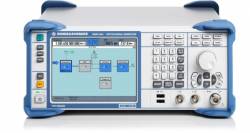
The functionality will be available as a software option for the R&S SMBV100B and R&S SMW200A vector signal generators, giving device manufacturers a production-ready pathway to test and validate receiver compatibility with Pulsar signals ahead of the constellation’s commercial deployment.
Pulsar is designed to complement existing GNSS infrastructure — including GPS — by leveraging LEO orbital geometry to deliver stronger signals, improved accuracy, and enhanced resilience against jamming and spoofing. Where legacy GNSS constellations operate in medium Earth orbit at altitudes above 20,000 kilometers, LEO satellites orbit at roughly 500 to 2,000 kilometers, resulting in significantly stronger received signal power and reduced signal travel time. The tradeoff is that individual satellites pass overhead quickly, requiring a larger constellation to maintain continuous coverage — which Xona is building toward commercial scale.
The practical challenge Rohde & Schwarz is addressing is the test gap that precedes a new signal type’s deployment. Before device manufacturers can build and certify receivers that support Pulsar, they need the ability to simulate Pulsar signals in a lab environment — verifying receiver performance against known signal parameters without requiring an operational constellation overhead. Adding that simulation capability to established signal generator hardware provides an accessible, production-scalable route for validation.
“Navigation technology is entering a period of rapid evolution,” said Matt Hammond, North America Satellite Technology Manager at Rohde & Schwarz. “By adding Pulsar signal simulation to our signal generator portfolio, Rohde & Schwarz is preparing our customers for the next evolution of satellite navigation.”
“Test and measurement solutions play an important role in enabling device manufacturers to evaluate compatibility as new signals become available,” said Bryan Chan, co-founder and VP of Strategy at Xona Space Systems. “Rohde & Schwarz brings deep expertise in precision signal generation that helps make this possible.”
The R&S SMBV100B and R&S SMW200A will join Pulsar’s verified ecosystem program, which recognizes devices and test solutions validated for compatibility with Pulsar signals. Rohde & Schwarz showcased its navigation test solutions at Space Symposium 2026 in Colorado Springs this week.