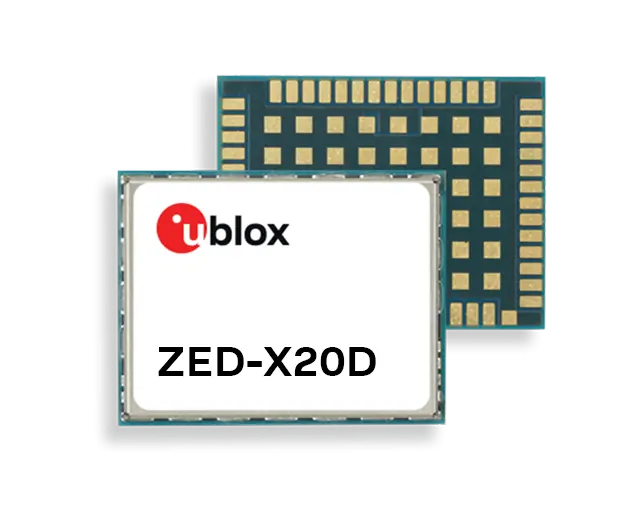
u-blox has introduced the ZED-X20D, a dual-antenna, all-band GNSS heading module that brings centimeter-level positioning and motion-independent heading to high-volume industrial applications.
Built on the company’s X20 high-precision platform, the module delivers RTK-grade performance while maintaining precise GNSS-based heading even at low speeds or standstill, a key requirement for auto-steering and autonomous operation. Target sectors include precision agriculture, unmanned aerial vehicles, autonomous machinery, marine and robotics navigation.
All-band on both antennas, with scalable corrections
The ZED-X20D tracks all major GNSS constellations on L1, L2, L5 and L6, and adds L-band reception for PPP correction services, an “all band on both antennas” approach that is intended to maximize heading availability and stability in challenging environments. To meet different accuracy and deployment needs, it works with RTK, PPP-RTK and PPP correction services, including u-blox’s PointPerfect offerings for regional and global coverage. Built-in support for Galileo E6 enables use of the free Galileo High Accuracy Service (HAS), giving equipment makers multiple options to source corrections.
u-blox is positioning the ZED-X20D as a drop-in upgrade for existing designs by retaining the established ZED form factor and pairing the module with its ANN-MB2 all-band antenna and PointPerfect services as a turnkey high-precision bundle. The company says this combination is aimed at simplifying design, reducing system cost and accelerating mass adoption of automated and autonomous equipment across agriculture, UAVs, construction and other industrial domains.
Security and interference resilience for trusted heading
The module includes u-blox’s end-to-end hardened security, with secure boot, signed firmware and a hardware root of trust for cryptographic material, as well as support for Galileo OSNMA and encrypted correction data. All-band frequency diversity and interference monitoring are designed to improve resilience against jamming and other RF threats, while access to high-quality GNSS measurements supports reliable post-processing and integrity monitoring—features likely to appeal to developers building safety-critical or highly automated systems on top of the new heading platform.