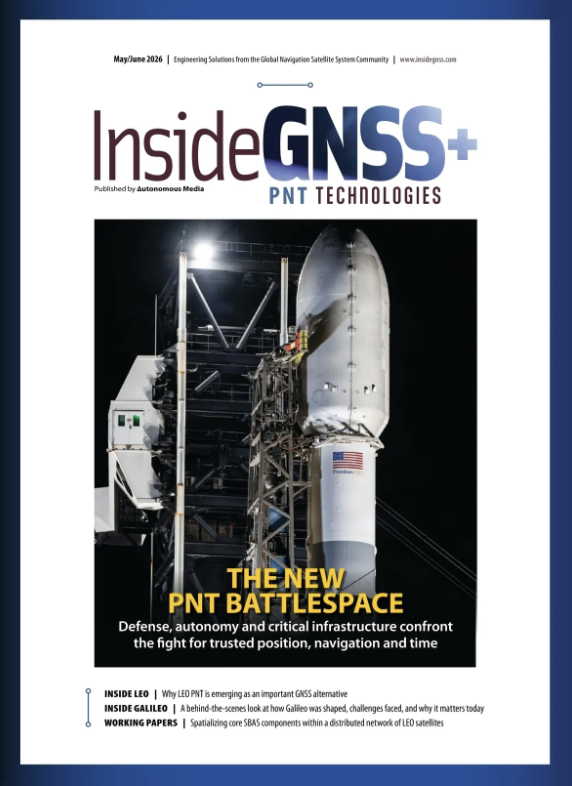

Trends, risks and architecture considerations. The need for more resilient precision navigation has never been greater.
MATT PICCHETTI, VICE PRESIDENT AND GENERAL MANAGER, NAVIGATION AND SENSORS, HONEYWELL AEROSPACE TECHNOLOGIES
Spurred by the increasing threat of jamming and spoofing to Global Navigation Satellite System (GNSS) constellations and the desire for more autonomous operations, navigation suppliers, militaries and commercial operators are investing in next-generation technologies.
By understanding the current PNT landscape, including the latest technologies and vulnerabilities, operators can determine which solutions are the best fit to meet their current and future platform needs.
Growing Risks and Vulnerabilities
Traditional navigation systems involve combining inertial sensors with GNSS receivers to provide a blended navigation solution. These technologies are complementary, as inertial navigation (INS) determines position by integrating platform motions over time based on an initial position, while GNSS receivers provide an absolute position update. The combination of these two technologies provides a robust, high-integrity, precise position.
GNSS jamming and spoofing, which corrupts the GNSS and degrades the performance of the INS/GPS navigation system, has become ubiquitous to modern conflict, as we’ve seen in Eastern Europe. In 2024, Zurich University of Applied Sciences reported more than 700 jamming and spoofing incidents per day, forcing countless pilots and unmanned aerial vehicles to fly without access to GNSS data. Fortunately, inertial navigation systems are immune to jamming and spoofing, but their accuracy is a function of the distance/time traveled. As these sensors have intrinsic residual error factors, such as bias drift, their accuracy degrades over time without additional aiding sources like GNSS.
These incidents generally fall into two categories: jamming and spoofing. Jamming involves using radio frequencies to interfere with GNSS signals, disrupting all the GNSS systems (such as GPS) in the affected area, which will be detected by navigation equipment but will result in degraded performance. Spoofing involves using counterfeit satellite signals to deliver incorrect data to GNSS receivers. It can be more complicated and concerning because it can go undetected by the navigation equipment, leading to misleading navigation data.
Both jamming and spoofing highlight the fragility of traditional navigation solutions, creating dangerous vulnerability. Whether it’s a commercial plane parked on the runway until its system is fixed, or a fleet of autonomous drones unable to carry out the mission, jamming and spoofing can create significant disruptions to operations and safety.
This can be costly, as GNSS disruptions can mean the difference between a successful or failed mission.
While there are steps operators and providers can take when they suspect jamming and spoofing, one of the most important steps is to have alternate navigation procedures and equipment to enable continued operations during these disruptions.
That’s where the new suite of technologies comes into play. Here, we take a look at these technologies and some of the emerging trends that will help reduce GNSS dependency.
Trend 1: Inertial sensors (accelerometers and gyroscopes) that are better performing and/or reduced size, weight, power, and cost (SWaP-C) to broaden use-cases.
Significant investment in long-standing and innovative technologies will deliver sensor improvements over time. These include:
RING LASER GYROSCOPES (RLG) are the current standard for most aerospace applications that require affordable and high performing systems. Its ability to produce RLGs of various sizes to meet SWaP-C versus performance tradeoffs, its field pedigree supported by billions of operational hours, its robust environmental capability, and its ability to produce at scale make the RLG the obvious first choice for operators.
MICRO-ELECTRO-MECHANICAL SYSTEMS (MEMS) inertial sensors, which are made from silicon-based wafers and are widely used in consumer and automotive applications, have continued to grow their market share in traditional aerospace industries as incremental performance improvements have enabled displacement of legacy technologies such as fiber optic gyroscopes (FOGS) and RLGs. Currently, MEMS provides the smallest SWaP-C offerings available and are becoming prevalent in unmanned aerial vehicles, autonomous industrial applications, and flying taxis.
FOG based navigation systems are prevalent in many aircraft applications, particularly for platform stabilization and flight control use cases, and will continue to be relevant in navigation. Next-generation investments focus on photonics and fiber core technologies, aimed at reducing SWaP-C and increasing size/performance.
HEMISPHERICAL RESONATOR GYROSCOPES (HRG) have been in development for decades, but have had producibility challenges due to the cost and complexity of the production process. Navigation suppliers continue to invest in this technology, in the hopes of closing these gaps with existing RLG and FOG solutions.
QUANTUM-INERTIAL NAVIGATION, while still in early development, carries the potential to generate much higher performance at SWaP when compared to today’s systems. Because this technology is still in its infancy, the ability to miniaturize and affordably scale it is still in question. Over time, quantum could become the new standard for inertial sensors, or it may only materialize as a commercially viable solution for niche use cases.
INS SOFTWARE ENHANCEMENTS are also being developed to enable the monitoring, detection and mitigation of GNSS disruptions via traditional INS/GNSS architectures. These software solutions will significantly improve situational awareness and recovery from GNSS disruptions.
Trend 2: Alternative Navigation Solutions
Today, more companies are selecting alternative navigation modalities to complement their INS/GNSS solutions, which enable platforms to navigate when traditional systems are degraded or unavailable. The intent is not to replace the traditional systems, but to add to the suite of technologies available so there are backups in place if one technology is impacted.
There are a mix of mature and nascent technologies that commercial and military operators can use for PNT intelligence. Each technology or modality has strengths and weaknesses. By combining them in a common architecture within a single navigation solution, companies can achieve a holistic solution that meets all their operational needs.
Mature altnernative technologies include:
VISION-AIDED NAVIGATION uses a live camera feed to compare images on the ground with a map database to determine position, as well as compare subsequent camera images to each other to determine velocity. There are also vision systems designed specifically for automatic landing. Vision technology performs well in GNSS-denied environments and is among the most accurate alternative navigation technologies, but its effectiveness is limited by visibility and over-land operations.
LOW EARTH ORBIT (LEO) satellite navigation uses stronger, lower-altitude satellite signals that are more resistant to jamming than GNSS. LEO satellites can provide a solution in poor visibility and over water. However, limited satellite coverage requires frequent handoffs, adding system complexity. These systems still have the potential to be jammed or spoofed.
RADAR ALTIMETERS provide highly accurate measurements of height above terrain, offering precise measurements that can be matched against a terrain elevation map to determine position. They are limited to a maximum operating altitude due to the range of the radar, and are active (emitting) sensors, which some customers may prefer to avoid from a detection perspective.
On the nascent to developing end of the spectrum:
MAGNETIC ANOMALY-AIDED NAVIGATION determines location by detecting known variations in the Earth’s magnetic field using a high-precision magnetic sensor. It works in GNSS-denied conditions and is unaffected by weather, but loses effectiveness at high altitudes and is dependent on high-quality magnetic variation maps. Currently showing high performance in demos, it will be rolling out in systems within the next few years.
CELESTIAL AIDED NAVIGATION uses a star tracker to observe stars and resident space objects (such as satellites and space debris) to provide a passive, not-jammable solution with GPS-like accuracy in GPS-denied or spoofed conditions. The key technology advancements are related to RSO maps enabling better performance and improved day-time operations, but relative to others, it is a larger, more expensive technology.
If there’s one takeaway from reviewing this growing suite of technologies, it’s there is no silver bullet to replace GNSS in all use-cases. The best approach is to develop a suite of several solutions on board, aligned to the goals of the specific program, and integrate them via a common navigation solution.
Trend 3: Bolstering GNSS Resiliency Through Additional Constellations
In addition to the national GNSS systems—GPS, GLONASS, BeiDou and Galileo—we’re seeing a proliferation of private space constellations reshaping the industry. These additional constellations can provide benefits to navigation solutions when navigation equipment monitors multiple constellations (multi-constellation/multi-frequency) to enable a more robust solution.
Private constellations, such as Iridium, are either beginning to or have the potential to support PNT services using numerous less-expensive LEO satellites. The lower orbit of these constellations (LEO versus MEO) provides a higher power signal but requires more satellites to maintain similar coverage to traditional GNSS constellations.
Many new constellations are expected to enter service in the coming years—likely a mix of commercial and military operations, with different performance levels and capabilities. Some constellations will operate in L-band with GPS, while others will use completely different frequency bands, helping to alleviate today’s jamming and spoofing issues.
It should be noted that these constellations will require ongoing investment to maintain their effectiveness and are not impervious to jamming and spoofing.
Trend 4: Timing is Everything
In the past, most systems relied on GNSS to keep track of timing, thanks to high-performance clocks on satellites and ground stations. But today, given growing GNSS fragility, there’s a need to maintain accurate timing on-board without relying on GNSS.
Several emerging technologies, such as MEMS and quantum, also can be applied to timing solutions and can hold accurate time down to the picosecond (one trillionth of a second.) However, the length of time they can hold such accuracy varies—and as technologies scale up in performance, they also scale up in size and cost.
Not every system needs picosecond-level accuracy, but many do—especially technology that will be used in collaborative fleets or autonomous systems that require precise synchronization. By evaluating specific system needs, operators can choose the technology that aligns to their mission goals.
Correcting Misconceptions
There are a few longstanding misconceptions that can lead providers down the wrong path when evaluating what technology or product is best for their specific need.
One common error is to evaluate between options based on high-level or lab specs that may not translate to performance in realistic conditions. One of the most complex technical challenges with new sensors is the application work required to ruggedize them to meet customer and mission requirements. For example, some providers will promote the performance of an inertial measuring unit at constant temperature, but the specs won’t indicate performance over the full operational temperature range that is more indicative of use in the field. Instead of relying on one high-level result based on optimistic lab conditions, consider the whole system of conditions the solution will operate in when deciding the right fit. If that data isn’t provided in the specs, ask.
Another mistake is to focus only on performance ability right out of the box, without considering if it will perform to the specification over time. An affordable option may perform well on its first day, but can end up drifting out of specification quickly. Consider the product’s lifespan, because replacing it multiple times can negate any cost benefits from selecting the least expensive option.
Lastly, it doesn’t always work to compare the price point of emerging technologies against existing solutions. For example, it’s worth considering how the proliferation of affordable GNSS is largely due to billions of dollars of government investment over many decades. As quickly as new technologies are emerging, they won’t all reach the same level of accuracy and affordability overnight. This is particularly important to convey to stakeholders who may not understand why the prices don’t align. As more customers invest in the latest technologies, the cost curve will likely come down. But those looking to stay at the forefront and protect against the latest threats should invest sooner, rather than waiting for disaster to strike.
Left unaddressed, these misconceptions could result in field issues with integrated navigation systems, which could result in expensive system redesign efforts, failed testing and verification, and—at worst—field failure.
Charting the Path Forward
The future of PNT involves a combination of better inertials, enhanced GNSS resiliency, and a suite of alternative navigation technologies to safeguard against single points of failure.
Just as an operator must rely on multiple technologies stacked together in flight, providers should look to reduce single points of failure by adopting multiple PNT technologies tailored to the application and end goals.
The good news is, it can be relatively easy to combine multiple navigation systems in one platform. For example, the Honeywell Alternative Navigation Architecture integrates data from vision-aided navigation, magnetic anomaly-aided navigation, and LEO satellite navigation to assist in GNSS-denied environments.
A layered architecture like that allows users to mix and match alternative systems to meet operational requirements and ensure mission success in this ever-shifting landscape.
Author
Matt Picchetti leads the Electronic Solutions Navigation and Sensors business. His responsibilities include developing strategy and new product roadmaps that deliver world-class solutions to aerospace and industrial customer segments.