
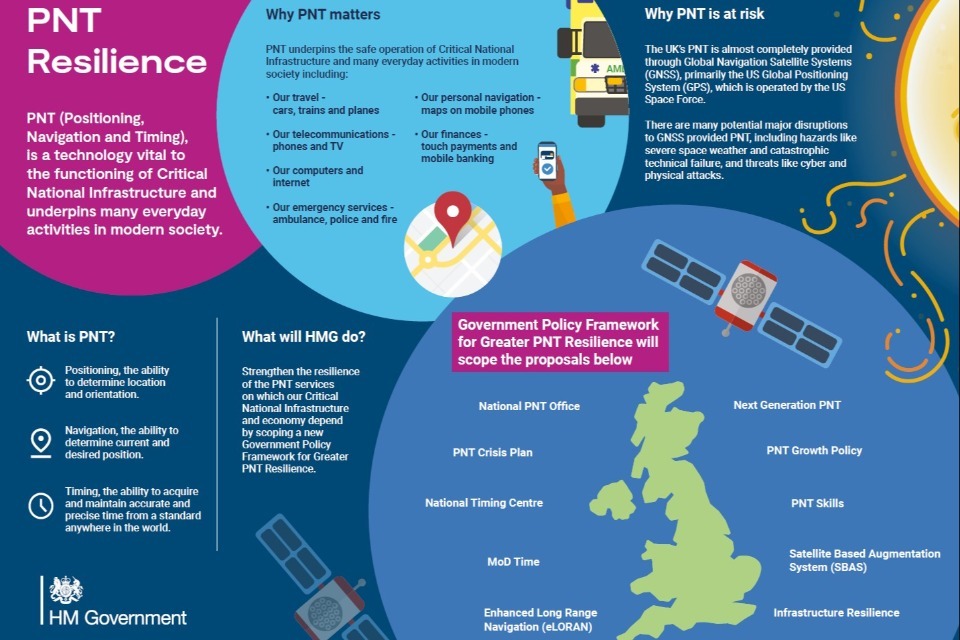
The UK government has launched a £180 million programme to harden its national timing infrastructure against disruptions to GNSS, funding a new phase of the National Timing Centre (NTC).
It will distribute highly accurate time signals from atomic clocks over terrestrial networks as a complement and backup to space-based systems.
Terrestrial timing to complement GNSS
Announced by the Department for Science, Innovation and Technology, the investment will support the next phase of the NTC programme, led by the National Physical Laboratory (NPL). Two dedicated sites equipped with advanced atomic clocks will generate an independent national time scale and distribute it via fibre and satellite links, providing a terrestrial timing source alongside GPS, Galileo and other GNSS constellations.
The government’s statement frames the goal clearly: reduce the UK’s reliance on satellite-delivered timing that can be “targeted and disrupted,” and ensure that critical services – including telecom networks, online banking, transport systems and emergency services – continue to function even during GNSS outages.
Free timing over air, internet and fibre
A key feature of the NTC build-out is wide distribution. The timing signal will be provided free over the air, via the internet and through fibre networks, giving operators multiple ways to access resilient time.
When existing timing sources fail or are degraded, the NTC infrastructure is intended to act as a safety net for “vital digital infrastructure,” from mobile base stations and financial trading platforms to energy networks and data centres.
According to NPL, the programme is also designed to support emerging high-precision, low-latency applications such as 5G/6G networks, smart cities and connected autonomous vehicles, all of which require tightly synchronised time across distributed nodes.
GNSS vulnerability and economic stakes
The timing expansion is explicitly framed as a resilience measure against GNSS disruption, an issue that has moved steadily up the risk agenda for PNT professionals. The UK government notes that satellite signals can be deliberately jammed or spoofed, and that an extended outage affecting timing-dependent services could cost the UK economy on the order of £1.4 billion in just 24 hours.
Those concerns echo a wider international debate. Recent analysis has highlighted both accidental incidents – such as the 2016 GPS timing anomaly – and deliberate interference, including Russian jamming of GNSS signals in and around the Ukraine conflict, as evidence that “single-string” reliance on space-based timing is no longer acceptable for critical infrastructure.
In that context, the NTC’s terrestrial time distribution looks less like a niche scientific project and more like a national security and economic continuity measure, similar in intent to work on eLoran, portable atomic clocks and distributed time networks in other countries.
Atomic clocks, supply chain and skills
Beyond the network itself, a portion of the £180 million will go into the UK timing ecosystem: supporting domestic supply chains for critical timing components and expanding the skills base in precision timekeeping.
The NTC programme will fund training for graduates, apprentices and PhD-level specialists, reflecting the fact that resilient timing is becoming a cross-cutting requirement for telecoms, finance, energy, transport and quantum technologies.
That emphasis on both hardware and human capital is notable. GNSS timing remains central, but as more infrastructure operators move to “multi-source” architectures – combining GNSS with disciplined local oscillators, terrestrial time feeds and holdover strategies – the availability of in-country expertise and trusted components becomes a competitive and security factor in its own right.
What it means for the PNT community
For the global PNT community, the UK’s move is another concrete example of a GNSS-heavy economy investing in terrestrial timing as a first-class utility rather than a backup of last resort.
Key implications:
- Critical infrastructure operators in the UK can plan around a nationally supported, standards-based terrestrial time source instead of building bespoke solutions in isolation.
- The programme reinforces the shift toward layered PNT resilience, where GNSS is complemented by terrestrial timing, local atomic clocks and, potentially, other alternative PNT (A-PNT) technologies.
- By putting significant funding behind NPL and the NTC, the UK is signalling that precision timing is not just a scientific capability but a strategic asset, on par with national compute resources and secure telecoms.
The development is a reminder that timing, not just positioning, is now driving major infrastructure decisions. As more countries pursue similar investments, the interplay between satellite time transfer and terrestrial time distribution is likely to become a central theme in PNT architecture and policy debates over the rest of the decade.