
When Dr. Brad Parkinson takes the stage, his authority is unmistakable. He is not theorizing about PNT resilience from the sidelines; he built the original system that underpins it all.
His “Protect, Toughen, Augment” (PTA) framework for PNT reflects decades of lessons learned from both technical triumphs and hard-won policy battles. As he noted in his IEEE/ION PLANS 2025 keynote address: “It is not enough to recognize the vulnerabilities. We must design layered responses. That is the essence of assurance.”
A Foundation of National Power
The United States is massively dependent on GPS and broader positioning, navigation and timing (PNT) services. Independent studies place its economic contribution at roughly $1 billion per day, a staggering figure that illustrates how deeply embedded GPS is in daily commerce and national infrastructure.
From aviation, maritime navigation, and agriculture to financial transactions, energy distribution and telecommunications, the U.S. economy runs on the invisible timing pulse of GPS. This overwhelming reliance means GPS is more than a convenience—it is a major foundation of national power. That fact alone validates and reinforces the need for a clearly defined National Goal of Assured PNT.
As Dr. Parkinson reminds us, the United States cannot afford to leave such a foundation exposed to disruption. Assurance—making sure PNT is always there when it is needed—is no longer optional. It is a national imperative.
Defining Assured PNT: Five Categories of Application
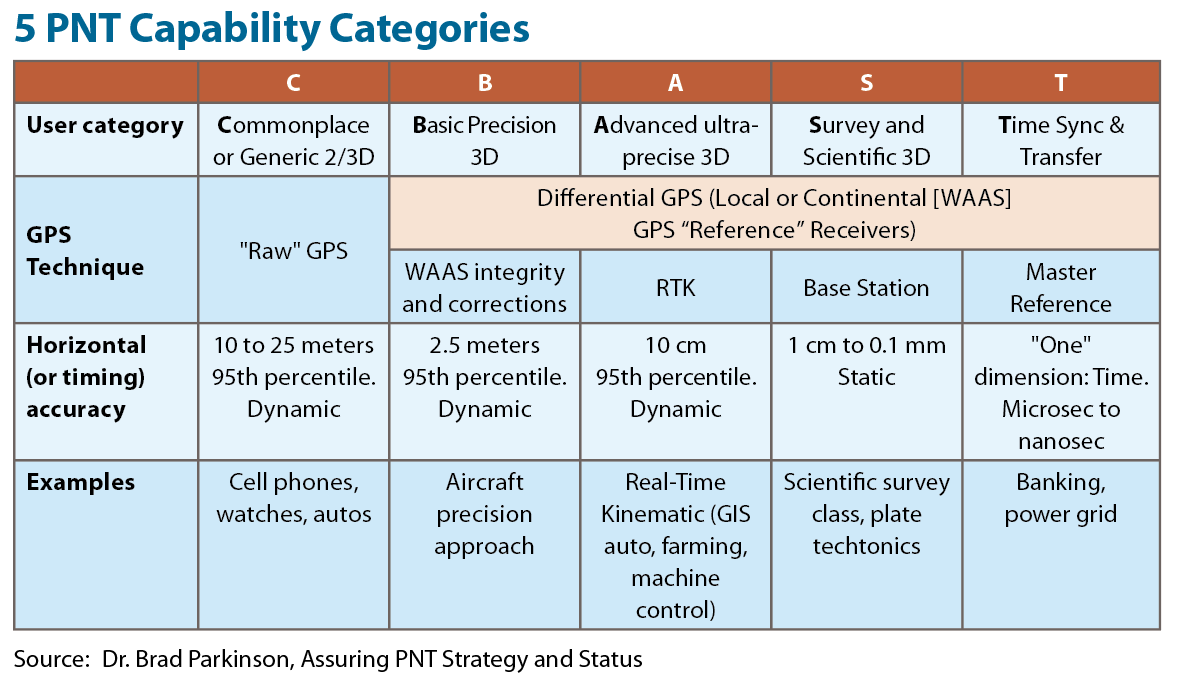
For decades, the term “assured PNT” has floated between marketing brochures, government strategy documents, and defense contractor pitches, often with little shared definition. Parkinson’s most important contribution may be to pin it down—to define what “assured” actually means in operational terms.
His proposal is to establish five measurable categories of application. Each implies different levels of assurance, each tailored to the unique needs of specific domains:
• Category C: Common. Raw GPS horizontal accuracy must be better than 10 to 20 meters (95% level).Two dimensions usually meets these requirements. This category covers consumer applications where occasional disruption may be more tolerable. Examples include smartphones, fitness trackers and vehicle infotainment.
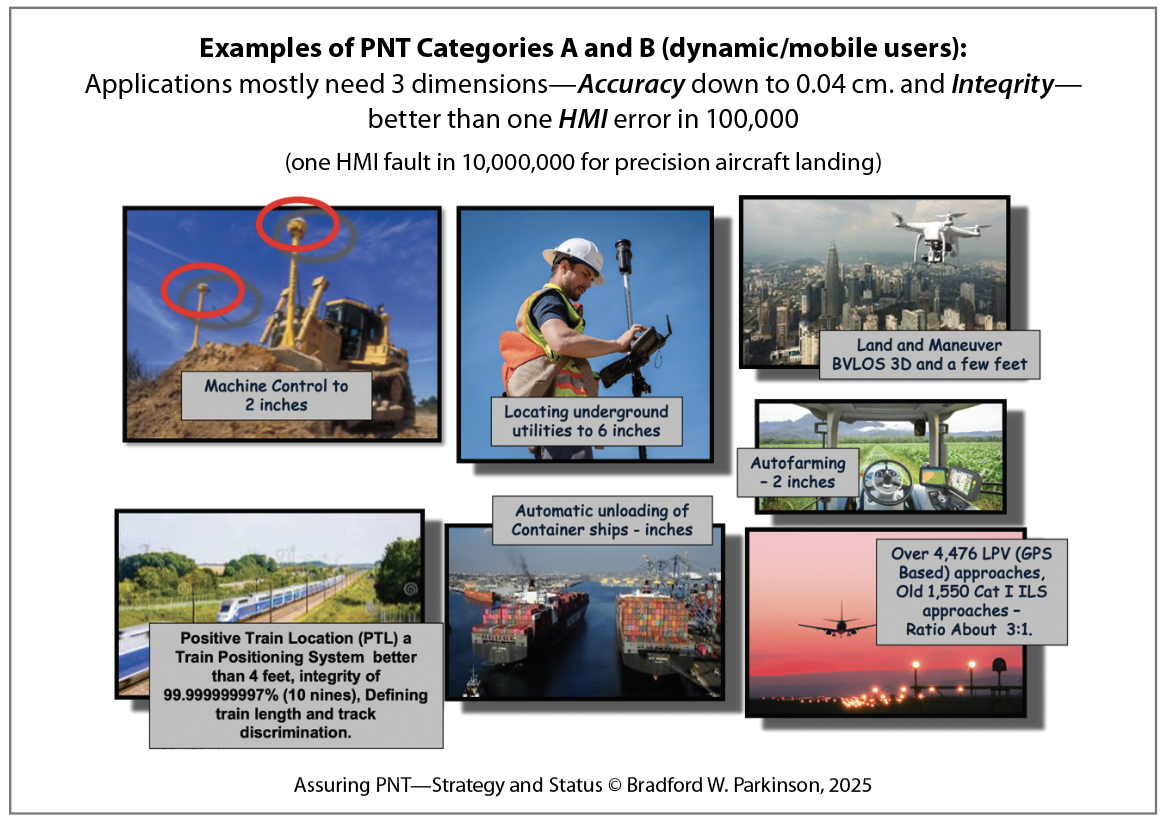
• Category B: Basic Operational Use. This category covers aviation and precision transportation applications with WAAS-enabled accuracy better than 2.5 meters at the 95th percentile. Integrity requirements are extremely high, and continuity is critical.
• Category A: Advanced Positioning and Machine Control. At better than 10 cm, these users have the highest dynamic accuracy requirements. They rely on real–time kinematic techniques (RTK) with a nearby differential station. Users require high reliability and include sectors like heavy construction equipment control, precision farming, container ship unloading and Geographic information systems.
• Category S: Survey and Scientific. These are static PNT categories that exploit time averaging to achieve accuracies down to sub-millimeters in three dimensions. This category includes land survey, which was the first user group, long before GPS was declared operational. Major use is in accurately measuring tectonic plate shifting and estimating built up tensions that lead to earthquakes.
• Category T: Timing Only. Reference back to International Time Standards or to a user’s local time base, with acuracy from microseconds to nanoseconds and is typically done with a GPS “disciplined” atomic clock. These users require extreme resilience for operations in contested environments. All systems must withstand deliberate jamming, spoofing and denial.
By framing assurance through these five categories, system providers can measure specific levels of performance, preventing “assured” from being a vague marketing slogan.
The Threat Environment: Jamming and Spoofing
GPS’s very design—low-power, open, continuous—makes it universally valuable but uniquely fragile. Jamming devices, available for less than $50 online, can disrupt GPS reception across city blocks. Spoofing attacks, once theoretical, have been demonstrated in maritime environments and even against UAVs.
“When people tell me GPS is too weak, I tell them: It was designed that way,” Parkinson noted. “The fragility is not a flaw—it is a by product of its universality.”
The most significant threats to assured PNT remain jamming and spoofing. Without effective defenses, GPS users remain exposed to intentional interference and hostile deception.
The PTA Strategy: Protect, Toughen, Augment
1. Protect the Signal
Parkinson has consistently called for the development of rapid jammer detection and elimination capabilities. Time-difference-of-arrival (TDOA) localization techniques, distributed across ground-based monitoring nodes, can pinpoint jammers to within tens of meters.
Such monitoring could be incorporated in every cell tower, with results fed back to the Coast Guard Center that monitors GPS for civil use. What’s missing, he insists, is not technology, but authority and coordination.
2. Toughen GPS
If protection is about external enforcement, toughening is about internal resilience.
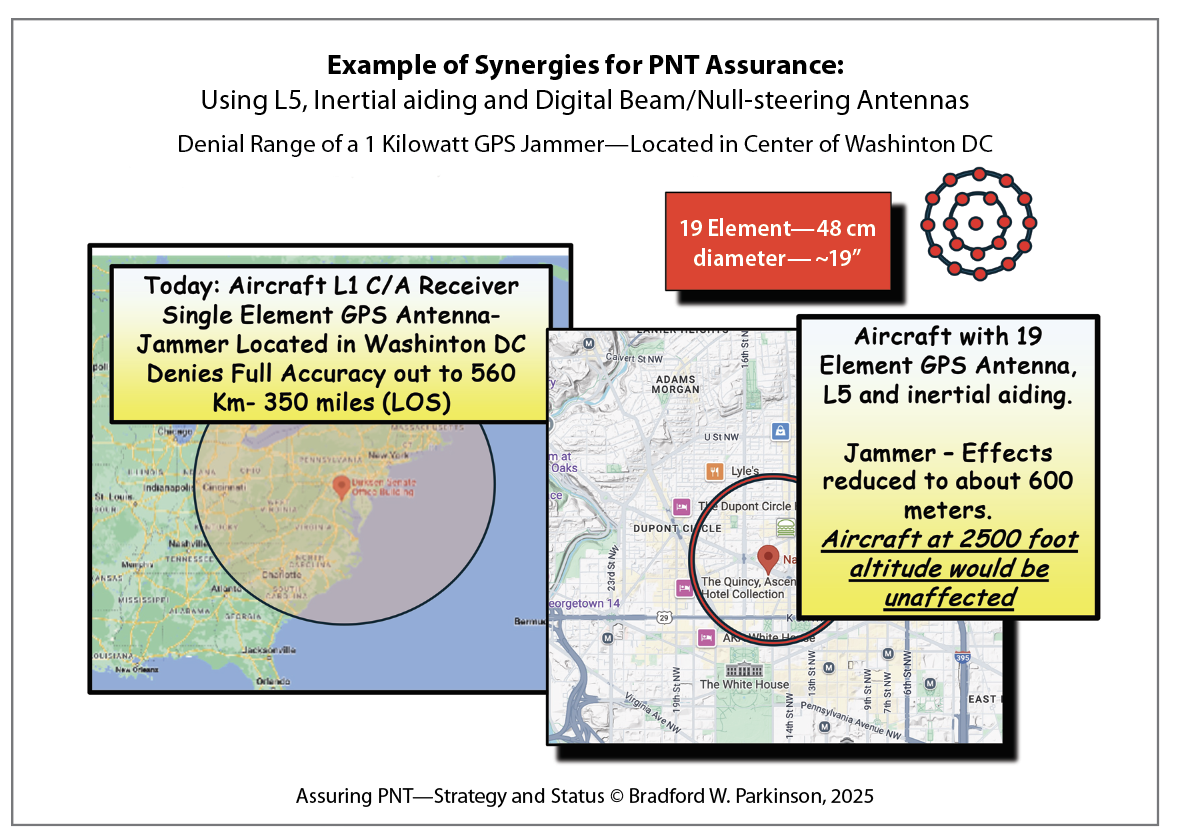
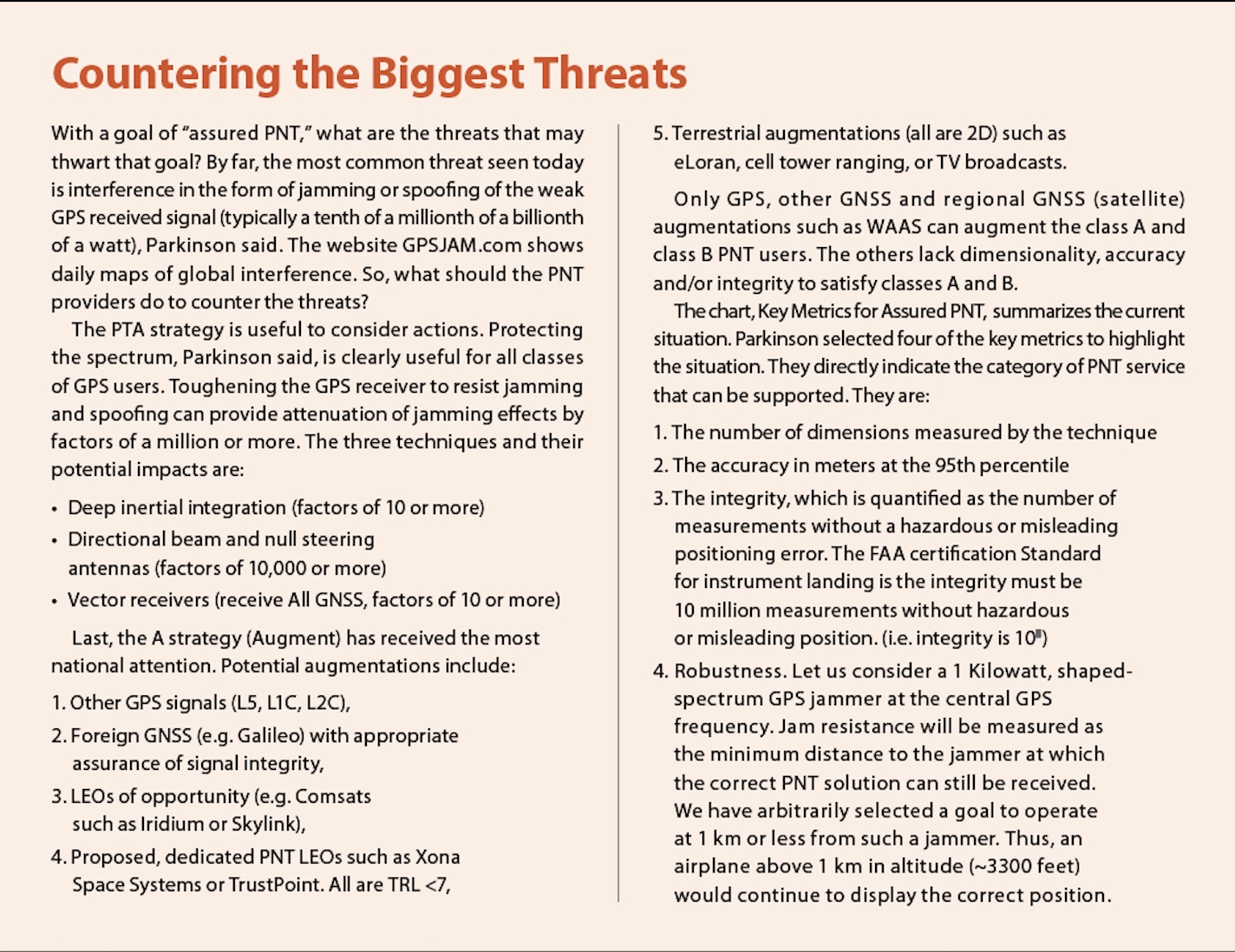
Parkinson pointed to directional antennas as a primary defense, noting even relatively small arrays can reject interference signals arriving from non-satellite directions. Such interfering signals are routinely attenuated by factors of 10,000 or more.
Equally urgent is regulatory reform. For decades, Controlled Reception Pattern Antennas (CRPAs)—the most effective anti-jamming technology—were restricted under the International Traffic in Arms Regulations (ITAR), classified as munitions alongside missiles and explosives. Beginning in September, CRPAs will be reclassified under the Department of Commerce’s Export Administration Regulations (EAR), allowing civil adoption and allied deployment while still protecting sensitive designs. After decades of being “handcuffed,” the United States is finally poised to accelerate the global adoption of robust GPS receivers.
More than 40 years ago, while leading the original GPS development, Parkinson and his team demonstrated a high anti-jam receiver that could fly directly over a 10-kilowatt field of jammers with no interruption of GPS.
“This is a life-saving margin in high interference environments,” he said.
These steps will also help thwart spoofing and jamming:
• CRPAs: With regulatory barriers easing, CRPAs can reduce jammer effectiveness by factors of 100,000 or more.
• GPS L5 activation: Provides >96% jammer reduction.
• Inertial integration: MEMS and advanced units bridge outages, ensuring diversity of failure modes.
• Authentication: Civil GPS must add authentication to reduce spoofing risk and strengthen integrity.
3. Augment GPS
Parkinson acknowledged the momentum behind augmentations but cautioned against viewing them as substitutes for GNSS.
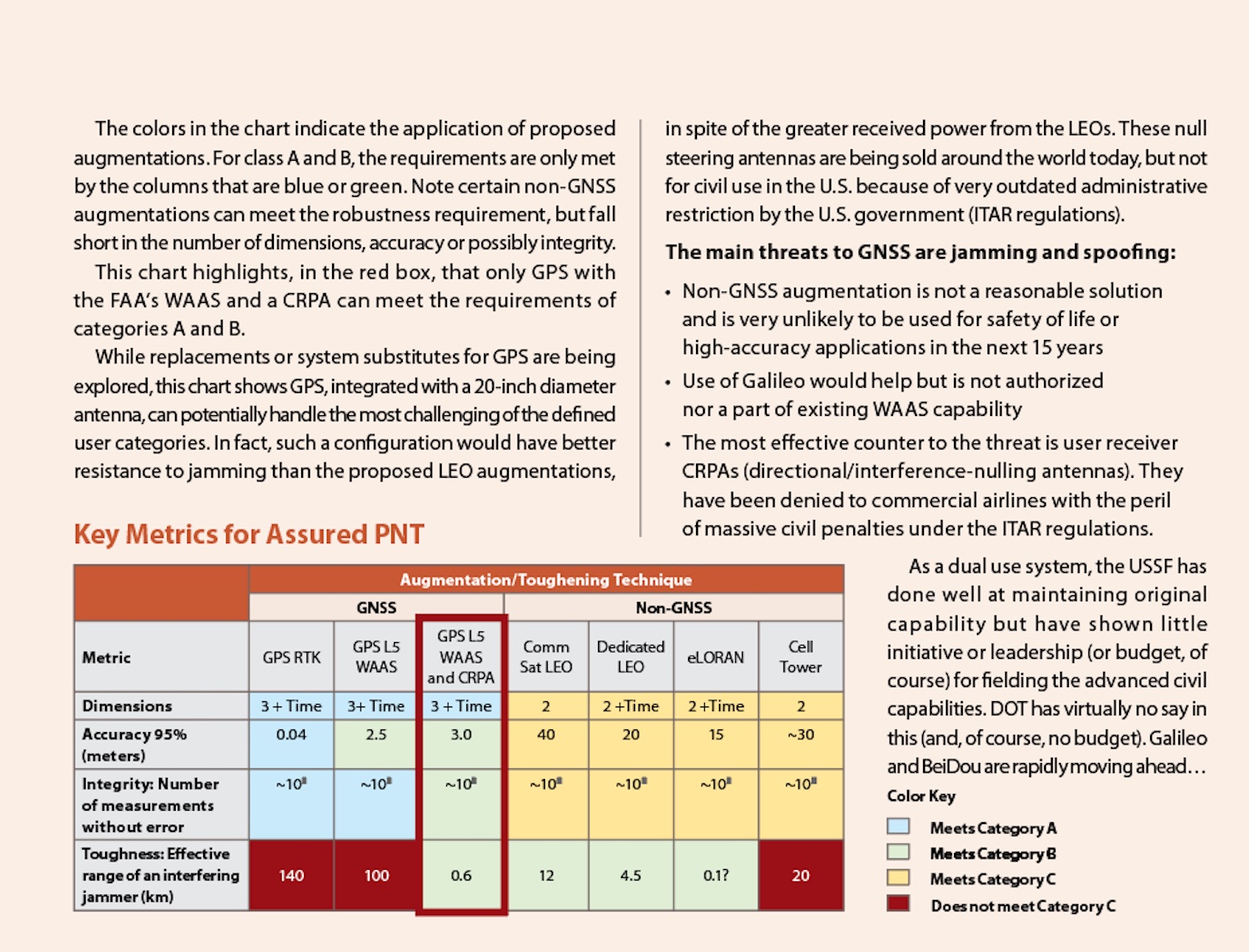
• Other civil signals (Galileo with assured integrity), LEO satellites, eLoran, fiber timing and cellular networks.
• Valuable, but insufficient for categories A, B and S.
• Must be tested for Accuracy, Affordability, Availability, Dimensionality, Integrity, Continuity, Toughness (AAADICT).
“Assurance is not about backups in a drawer,” Parkinson said. “It is about layers working together.”
Sensor Fusion: Diversity of Failure Modes
Parkinson’s framework for assurance is not monolithic. It is pluralistic, emphasizing sensor fusion—the deliberate integration of technologies that fail in different ways.
In aviation, an excellent example is fusing Common GPS with L5, inertials and directional antennaes. In finance, it may mean pairing GPS timing with rubidium oscillators and fiber synchronization. In defense, it may mean fusing M-Code with LEO signals, inertials and visual odometry.
The principle is simple but powerful: diversity of failure modes. If GPS and Galileo are jammed, inertials allow “flywheeling” through an outage. If eLoran is less accurate, it is far more difficult to jam. If fiber timing can check against spoofed satellite time, integrity rises.
Prototypes exist. The barrier is not ideas but deployment—hampered by certification bottlenecks, fragmented governance, and inconsistent funding. “We don’t lack ideas,” Parkinson said. “We lack execution.”
The Leadership Imperative
Parkinson’s message was clear: Assured PNT will not emerge from incremental programs alone. It requires leadership and includes:
• Policy reform: Now including the CRPA reclassification, easing ITAR restrictions that long blocked resilience.
• Enforcement: Establish national jammer-hunting teams with modern TDOA tools.
• Investment: Federal funding and public-private partnerships to scale deployments.
• Standards: Shift from advisory committees to measurable assurance.
The U.S. once led the world by developing GPS from idea to global utility. To maintain that leadership, Parkinson argues, America must now designate a visionary leader with authority and resources to coordinate across agencies and industry.
A Strategic Roadmap
Parkinson outlined a staged roadmap for moving from vulnerability to assurance:
• Short-Term (1–3 years): Define and publish assurance categories, establish jammer enforcement units, ease targeted restrictions, launch pilot tests of augmentation.
• Mid-Term (3–7 years): Roll out prototype LEO and eLoran, establish certification frameworks, monitor assurance levels, explore shared procurement.
• Long-Term (7–15 years): Deploy an upgraded assured PNT architecture, enable GNSS units interoperability with techniques to stay ahead of threats.
From Vulnerability to Assurance Levels
For Inside GNSS readers, the lesson is direct. Just as GPS reshaped global navigation in the 20th century, assured PNT will determine reliability and
resilience in the 21st.
The measure of success will not be prototypes, but performance. The PTA strategy offers a path. The five assurance categories provide standards. Sensor fusion brings resilience. What remains is leadership.
As Parkinson concluded: “We don’t need another prototype. We need deployed cap-ability—measurable, certified and trusted.”
That is the call to action: Protect the signal. Toughen the receivers. Augment with complementary systems. Define assurance levels as enforceable standards. And ensure the backbone of modern life remains not just available, but assured—for generations to come.