
Why Europe must invest in optical PNT options. In recent years, society has undergone a digital transformation. Today, the invisible foundation of our modern society actually extends beyond pure digital data—it hinges on integrating data with spatial and temporal information.
Gabriele Giorgi, Juraj Poliak DLR, Jan Speidel OHB, Andrea Coluccia Thales Alenia Space, Sebastian Villamil SPACEOPAL
Positioning, navigation and timing (PNT) systems serve as the backbone of countless critical functions from synchronizing stock exchanges and energy grids to guiding aircraft, shipping fleets, and emergency responders. The ability to determine the “where” and the “when”” with high precision is no longer optional—it has become a crucial enabler for responding to key societal challenges.
For decades, space-based PNT systems, such as Europe’s Galileo, have provided global, reliable PNT services. These systems bring significant socio-economic, political and strategic benefits by enhancing efficiency, safety and productivity across various sectors. Acknowledging the evolving geopolitical landscape, the growing ecological challenges posed by climate change, and the rapidly increasing reliance of the economic and defence sectors on GNSS, the demands on current and future PNT systems are rising dramatically.
Considering these ever-increasing demands and, on the downside, the growing threats to critical PNT infrastructure, Europe faces a strategic decision to either maintain the current PNT capabilities and risk European PNT becoming obsolete, or embracing novel technologies to ensure its leadership in an evolving world.
Among those novel technologies that can offer improved performance, greater autonomy, resilience and extended reach, laser-based connectivity for optical inter-satellite links (OISL) and optical ground-to-space links (OGSL) stand out as the most promising technology for PNT systems in the near to mid-term future. Already revolutionizing the field of satellite communications, optical link technologies are now poised to transform PNT systems and applications.
The key question is not whether this transition to optical PNT will happen, but when and under whose lead.
OpSTAR: Optical Synchronized Time and Ranging
While optical terminals have been used for communication in space for years, adapting them for timing and ranging introduces new challenges and opportunities. Unlike traditional radio frequency (RF) signals, optical links can transmit massive volumes of data with virtually no sensitivity to interference, making them a robust, resilient form of communication. Optical PNT technology also can be used to synchronize clocks among satellites and ground assets down to the picosecond. Even more so, optical links can provide precise ranging, measuring distances between satellites over thousands of kilometers to within millimeters.
These features open a path toward satellite systems that no longer suffer from the limitations of classical radio navigation technology or need continuous data feeding from large networks of ground stations to achieve high-end user performance. With optical technologies, Europe’s navigation systems could become significantly more accurate, more secure, more resilient and less reliant on ground infrastructure and/or complex onboard atomic clocks—making it significantly more difficult to disrupt or manipulate its PNT services.
Because optical technology is already well established for fleets of communications satellites, optical PNT systems would be intrinsically ready to integrate into the layered, interconnected space networks of the future—networks that extend not only across orbits, but eventually beyond Earth.
Yet, the full promise of optical PNT cannot be immediately realized without real-world concept, technology validation and de-risking. This is the role of the Optical Synchronized Time and Ranging (OpSTAR) in-orbit demonstrator (IoD) mission—not just to test technology, but to validate optical PNT system concepts under operational-like conditions in space to effectively direct the evolution of navigation to embrace this new capability and to shape the architecture of future EU PNT system of systems without introducing disruption.
A New Architecture for a New Era
Just as crucial as the technology itself is the deeper understanding that OpSTAR will bring about regarding the overall PNT system architecture. OpSTAR is much more than another laser terminal on a satellite. It is a mission designed to challenge assumptions, redefine processes and rethink well-established GNSS system architectures, leading to an optimized distribution of assets and functions in future systems. OpSTAR will make it possible to identify new modes to achieve autonomy, where satellites can operate with much greater independence based on an integrative approach that benefits from both optical and RF technologies to boost resilience and availability.
By exploring these directions now, Europe will have the means to make informed decisions when it matters most. OpSTAR, in this sense, is a decision-enabler.
From Satellites to Society: Transforming the User Experience
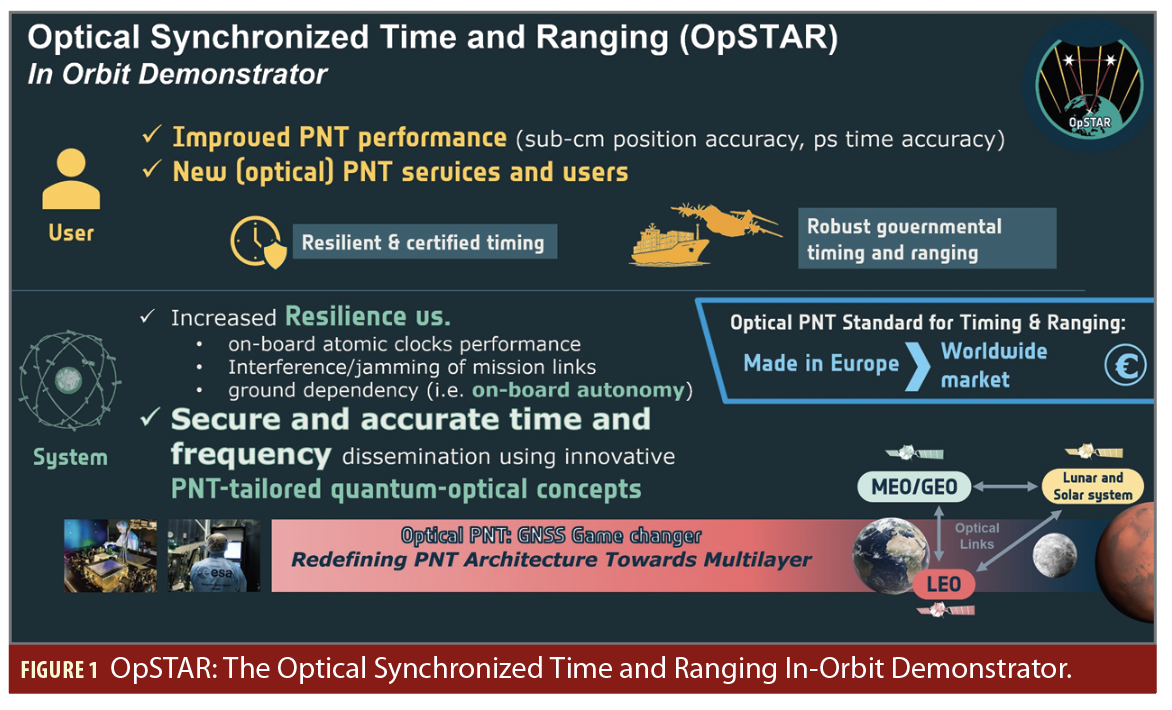
The projected advantages of optical PNT extend beyond system operators, affecting millions of users across various sectors who rely on accurate and reliable navigation and timing services.
For critical infrastructure operators, optical technology offers the possibility of certified and resilient timing services. Financial networks, telecom operators, and power grids need synchronization that is not just precise, but also provably secure. In an age where GNSS signals can be easily jammed or spoofed by cheap hardware and the slightest timing errors can cost millions, optical technologies offer confidence and continuity.
In the public sector, particularly for emergency response and crisis management, law enforcement, defense and security, the need for robust navigation is immanent. Governmental operations rely on precision timing and positioning, but in many scenarios, access to ground-based infrastructure or reliable RF signals is not guaranteed. Optical PNT could support autonomous systems to operate safely and securely via dedicated links, even in challenging, contested or GNSS-denied environments. Today, drones in active conflict zones are being guided by physical optical fibres as a stopgap against jamming. Tomorrow, those systems may turn to space for robust PNT, and OpSTAR will have laid the foundations.
For operators in the space sector, OpSTAR represents an essential step toward interoperable space-based networks. Future Lunar and Martian missions (both manned and unmanned) will demand timing and navigation systems that operate autonomously, accurately and reliably far beyond Earth orbit and outside the reach of current GNSS constellations. Optical links, validated by OpSTAR, could form an essential cornerstone of those systems.
For the public, the direct benefits will be better PNT performance, faster location services, and more secure digital interactions. However, the indirect benefits to society are equally relevant. Optical PNT technologies hold transformative potential across various sectors. In agriculture, industry, construction, traffic and transport, they enable more efficient resource management. The energy sector benefits from precise timing for synchronizing power grids, forecasting renewable energy output. Digital services are enhanced with secure timestamps and location-aware applications. More effective and efficient infrastructure management would be possible through better awareness, oversight and optimized monitoring and maintenance processes. Additionally, synchronizing smart systems, particularly in urban areas, will benefit from improved operational efficiency and capacity management.
All these benefits will be strengthened with PNT systems interconnected more precisely and resiliently than ever before via optical links. These systems will go far beyond traditional GNSS, enabling new classes of secure timing services for critical infrastructure and governments alike.
The Strategic Imperative: Why Europe Must Act Now
The envisaged capabilities for future PNT systems will surpass traditional GNSS by far, enabling new classes of secure timing and positioning service capabilities for critical infrastructure and governmental use. To seize these benefits, Europe can leverage its industrial leadership in optical communication technologies.
Maintaining leadership in such a rapidly evolving field remains precarious as other space powers are investing in upgrading their PNT infrastructure. Without decisive action, Europe faces the risk of losing its market position and strategic autonomy.
OpSTAR is poised to facilitate the drive toward developing a new generation of optical terminals enhanced with PNT capabilities, engineered and manufactured in Europe, with the
capability to support communication, navigation and timing services on a global scale.
The technology driving optical PNT systems is projected to attract interest not only from public initiatives but also from commercial satellite operators, sovereign entities, and emerging space economies.
Beyond maintaining technical leadership, OpSTAR also aims at ensuring Europe retains control over its vital supply chains and influences the technological standards and specifications already emerging.
By investing in OpSTAR, Europe makes the strategic decision to lead and not to follow. This initiative is about Europe’s place in a global ecosystem where infrastructure, accessibility, availability, security and innovation are increasingly defined by leadership in space technologies.
The OpSTAR Mission in Detail
To validate OpSTAR’s technologies, an in-orbit demonstrator mission, which the European Space Agency (ESA) has consequently proposed to its member states, is required. This mission will focus on validating the key capabilities that, once deployed in a multi-satellite GNSS constellation, can provide unprecedented improvements to Europe’s PNT services.
With the support of many ESA member states, a powerful industry consortium was formed bringing together key players and experts in the domain of European PNT for a Phase A/B1 study and to further evolve the concept to a feasible mission design. This study is comprised of more than 30 European companies across more than 14 nations. The consortium is led by OHB System of Bremen (Germany), which brings its expertise in coordinating large GNSS Space projects, gained in their role as prime contractor for 34 Galileo full operational capability (FOC) satellites. The goal is to achieve System Preliminary Design Step 1 by mid-2026 and then continue to develop the mission with a targeted 2030 launch.
To successfully achieve its mission goals in time and with as low technological risk as possible, the mission is proposed to re-use already flight-proven and reliable satellite platforms, while adding components to the spacecraft essential to validate the OpSTAR concept. This significantly de-risks the mission and adds reliability, focusing on OpSTAR’s key technologies.
The OpSTAR mission is an IoD built around optical inter-satellite and satellite-to-ground links to autonomously synchronize all linked clocks, obtain accurate inter-satellite ranging to improve satellite orbit determination, and exchange mission data between space and ground segments with low latency. The mission serves as a testbed for validating system and processing architectures of a GNSS fully integrating optical inter-satellite links, with special focus on innovative approaches to system-wide synchronization. At the same time, the mission shall foster interoperability of PNT-enabled optical terminals by contributing to standardization efforts.
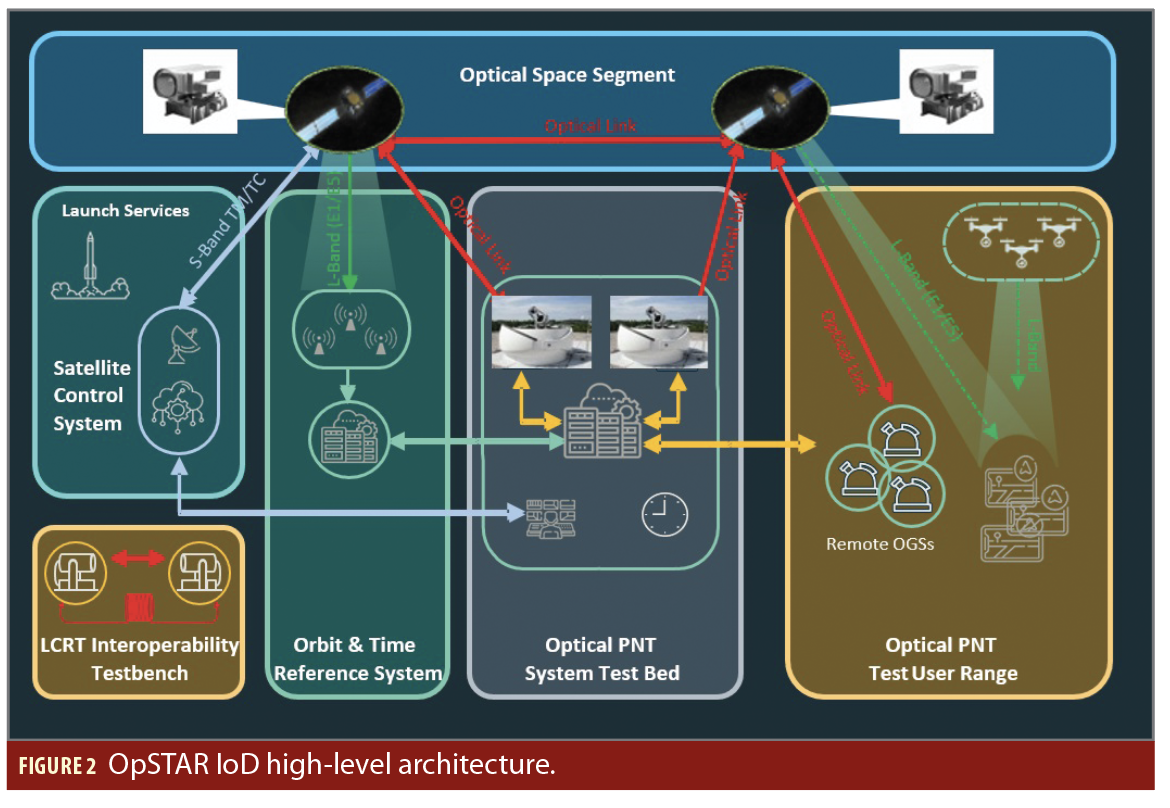
The overall OpSTAR mission architecture is depicted in Figure 2. The OpSTAR IoD is formed by several elements distributed across a space segment and a ground segment.
OpSTAR Space Segment
The mission baseline for the space segment is based on two satellites flying in a low middle Earth orbit (MEO), each carrying an optical payload comprising, at a minimum, two optical terminals to enable simultaneous inter-satellite and satellite-to-ground optical links, and a navigation payload to broadcast navigation signals in L-band.
OpSTAR Ground Segment
On ground, a mission control center oversees satellite operations, maintains and disseminates the operational reference system (OpSTAR system time, geodetic reference system), monitors, predicts, and disseminates the OpSTAR satellites’ orbits and clocks as part of the mission data flow (mission commands, telemetry, download and dissemination of mission-related data), interfacing with satellites via a network of ground stations and with the experimentation facilities of the OpSTAR IoD to exchange mission-relevant data.
OpSTAR Optical Payload: The Core of the Mission Demonstrator
Each satellite’s optical payload is comprised of two optical laser communication and ranging terminals (LCRTs) and one LCRT handling unit (LHU). For the purpose of the IoD, the LCRTs are based on heritage optical terminals from satellite communications (to reduce cost and risk) with the main addition inside the data electronics unit, where a modem is located. This supports not only physical-layer signal generation and processing but also the generation of PNT observables, allowing the overall mission demonstration. The optical head of the LCRT allows for fast repointing and reacquisition between individual nodes, a functionality needed for link geometry reconfiguration during one IoD orbit.
The LCRT development has strong ties to the European industry and includes companies such as Tesat Spacecom, Mbryonics, Thales Alenia Space, TNO, Safran and Indra, which are part of the OpSTAR consortium. Additional industrial partners can join the consortium at any time. Their active and direct involvement is crucial in leveraging the heritage technologies, while opening up the developments necessary to allow for accurate PNT. Also on ground, optical ground station developments have a strong background with institutions such as DLR-KN and companies such as Officina Stellare and Airbus DS NL, also part of the OpSTAR consortium.
In the field of communications, European-led standardization and specification efforts for optical link techniques have not only given rise to the ESA Specification for Terabit/sec Optical Links (ESTOL) [2], but also have influenced many CCSDS, ETSI and 3GPP standards. With this coordinated effort, a way is paved toward a European-led specification of PNT functions via optical links.
The optical links, in their essence, require an optical waveform for PNT functionality that, in its core, can be used for both accurate synchronization and ranging as well as high data throughput. An agreed structure and content of this waveform, including modulation format, frame structure and description of the PRN sequence, will be decided in OpSTAR. These results are planned to be used beyond PNT applications and allow for potential future inter-system interoperability with systems such as 6G-NTN, IRIS2, LEO-PNT and beyond. This contributes to the long-term vision of a future based on multi-orbit and multi-constellation communication/navigation systems.
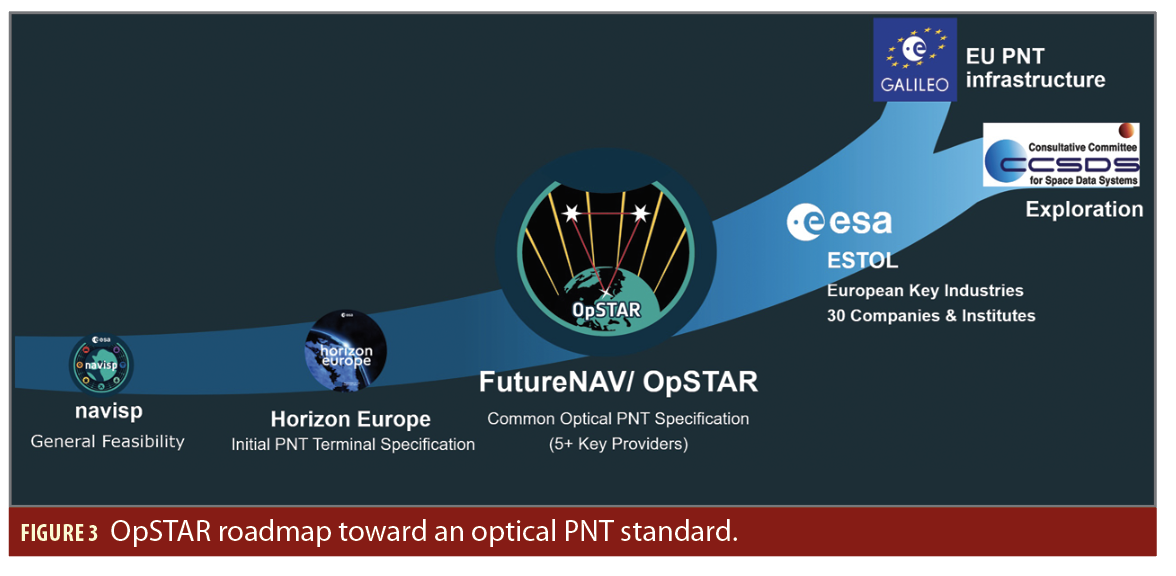
A possible road toward optical PNT standardization is illustrated in Figure 3. OpSTAR builds on previous work carried out under NAVISP—ESA’s Navigation Innovation and Support Programme, a key initiative driving innovation and competitiveness in the European PNT domain—where the general feasibility was first assessed. These efforts were subsequently advanced within the EU’s Horizon Europe program, which focused on defining initial PNT terminal specifications. Building on this foundation, OpSTAR will contribute to developing an optical PNT standard with the long-term vision of supporting not only future EU PNT infrastructure, but also broader missions aligned with CCSDS standards.
OpSTAR Experimentation Facilities
The OpSTAR mission experimental activities on ground are distributed between a centralized optical system testbed, focused on verifying the core optical technologies to allow (near) future system integration, and an optical PNT test user range, built around different end-use cases addressing system exploitation, with a special focus on hybrid optical-RF users.
The optical system testbed verifies the optical terminals’ operability and in-space PNT performance (time-transfer and ranging), a system synchronization concept based on optical observables, and provides an in-depth analysis of GNSS evolution to optimally integrate optical terminals into PNT capabilities.
The optical system testbed hosts at least two optical ground stations, co-located (or at a minimum, synchronized) to enable purposefully designed PNT verification chains, and a data processing facility operating a system synchronization testbed and processing mission data. The system synchronization testbed targets the definition and performance verification of a system-wide synchronization approach based on a processing architecture that implements a distributed (both in space and on ground) clock ensemble.
Such architecture would make it possible to directly and autonomously synchronize all satellite clocks to a common reference time scale without post-processing broadcast data, therefore significantly increasing the robustness of the GNSS concept and relaxing reliance on both satellite atomic clocks and ground segment processes. This consequently offers a novel system synchronization independent of, and complementary to, classical approaches.
All knowledge acquired during the OpSTAR mission will be transferred into a high-fidelity (full) system emulator for extrapolation to model the full navigation system and its end-user performance. The system emulator will reproduce the entire GNSS positioning chain, encompassing the satellite and ground clock simulation, synchronization algorithms and system time generation, modeling of satellite orbits, raw data generation (L-band and inter-satellite link observables), precise orbit and clock determination, and generating orbit/clocks prediction and broadcast navigation data.
The simulator will assess a number of performance parameters related to the signal-in-space (e.g. Signal-in-Space Range Error—SiSRE), and navigation and timing services (SPP and PPP accuracy performance, PPP convergence time, etc.). This emulation will enable a realistic evaluation of the new architectures’ capabilities when integrating the optical observables in advanced processing strategies. These range from the autonomous intra-system synchronization concept to enhanced satellite orbit determination thanks to accurate inter-satellite ranging, the provision of faster and more precise global positioning and timing services, and signal-in-space and end-user PNT performance in scenarios with loss of connection to the ground segment for extended periods (“autonav” function).
The input progressively obtained during the OpSTAR mission will flow into the simulator for an accurate evaluation of the benefits of implementing optical links and innovative processing strategies into a full GNSS system, supporting and facilitating system adoption in the ever-evolving European GNSS.
OpSTAR Experimentations
The planned experimentations of OpSTAR IoD focus on two overall objectives: Optical technology verifications, focusing on assessing the reliability of operations and accuracy of optical terminals with the implemented PNT functions; and more importantly, system concept verification, targeting exploitation of the optical links for system-wide synchronization, time and frequency transfer over continental region, inter-operability verifications, and (optical) end-user scenarios.
The OpSTAR IoD shall test long-term operations of the terminals for optical links and verify their performance in terms of (near-)continuous, automated and reliable operations. Uninterrupted and coordinated operations of the optical links, both between satellites and between satellite(s) and optical ground station(s), with the latter limited to satellite visibility periods, shall drive the terminals and platform design, especially in regard to physical, power and thermal dissipation aspects.
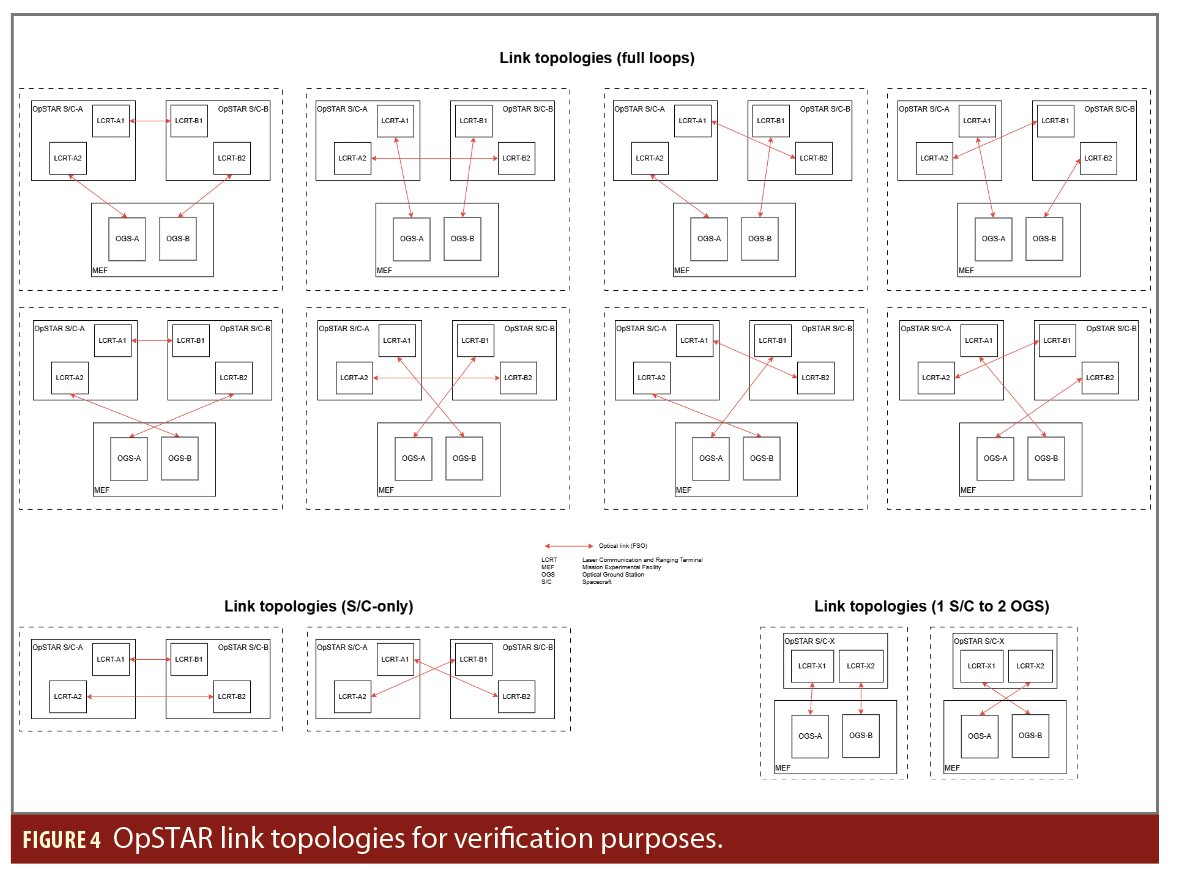
For system concept verification purposes, the simultaneous operations of two optical terminals on each satellite is required, allowing the design of multiple link topologies serving the verification chain. Figure 4 shows all potential link topologies that can be formed across satellites (OpSTAR S/C-A and S/C-B, each carrying two laser communication and ranging terminals—LCRTs) and optical ground stations (OGSs). Dual optical links between the satellites and between an OpSTAR satellite and two (possibly co-located) OGSs serve as verification of all hardware biases and PNT function accuracy by making optical observations available on two parallel channels, with minimal physical asymmetry. Multiple full link topologies can also be formed to verify consistency of all optical observables across the measurement chain, enabling verification of all interfaces, calibrations and biases.
The combined communication and PNT functions enabled by the optical terminals make it possible to devise a novel approach to system synchronization. In a system composed of multiple clocks in which pair-wise clock offsets can be observed at all times and relayed across the whole system with low latency, a synchronization mechanism based on a clock ensemble is the natural choice to implement system-wide synchronization [3].
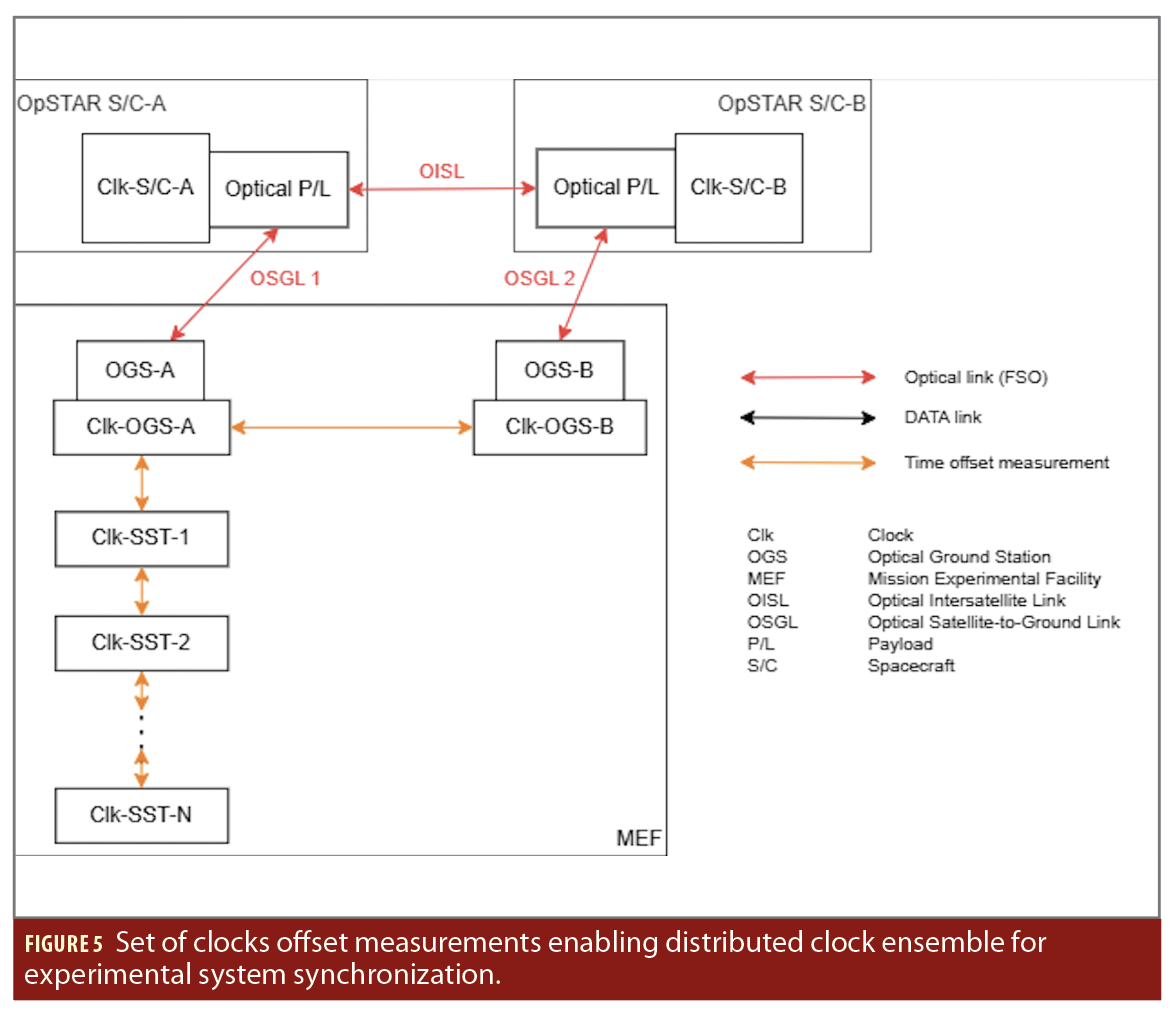
All units composing the clock ensemble compute the offsets of all participating clocks to a “virtual” common time scale, to which all clocks are to be synchronized. Because all units run the same algorithm using the same set of data, all participating clocks are inherently synchronized to a common reference. This process can be used to implement an experimental OpSTAR System Time and the process to keep all clocks synchronized to this (virtual) reference. The experimental testbed shall be composed by two OpSTAR satellite clocks, plus a number of additional units hosted on ground in a mission experimental facility hosting the key components of this synchronization testbed (Figure 5).
The inter-satellite clock offset between each satellite clock (Clk-S/C-A and Clk-S/C-B) is retrieved via the inter-satellite link. The offset between a satellite clock and a ground clock is obtained via a satellite-to-ground link, and time offset measurements among clocks on ground are obtained with purposefully developed time measurement devices. These devices can, in principle, be used to emulate the same time-transfer accuracy attained via the optical link, thus virtually realizing a wider constellation of clocks. The advantage of operating “virtual” satellite clocks on the ground with associated measurement devices is the possibility to test non-nominal scenarios, for example by injecting known faults, such as clock faults, biases or the unavailability of one or more clocks/optical links.
The experimental synchronization testbed will be activated whenever two satellites are co-visible by at least one OGS to obtain the ensemble of pair-wise clock offsets and relay all measurement across all participating elements. The convergence of all measurements to the experimental (ensemble) time scale shall be verified during experimental slots (arcs of co-visibility of both OpSTAR S/C from the experimental facility).
The OpSTAR IoD will also broadcast navigation signals, encoding a transmit time stamp driven by the satellite clock. The synchronization of clocks across the satellite constellation is the enabling function of any GNSS. The intended system synchronization approach based on a clock ensemble in space also will serve to synchronize the broadcast of the navigation signals. In post-processing, the timing of the navigation signals retrieved via a classical orbit determination and time synchronization (ODTS) approach shall be used to verify the accuracy of the synchronization attained with the novel approach. This will also account for additional hardware biases affecting the whole synchronization chain, a paramount aspect for a full exploitation of optical terminals in future GNSS.
The Transition Toward Optical GNSS
Once the feasibility and capabilities of optical links for PNT have been validated by the OpSTAR IoD mission, the technology and results will be ready for future operational systems. With the OpSTAR launch planned for around 2030, the validation will provide all the necessary information to introduce this new technology to the operational infrastructure. As this transition to “optical GNSS” needs to be carefully prepared, this exercise is already being investigated as part of the current OpSTAR Phase A/B1 study.
The transition from the current RF-based GNSS architecture to another supported by optical-enabled systems requires a phased approach to ensure interoperability, continuity of service, and progressive risk mitigation. Here’s a possible stepwise approach, describing the evolutions of the infrastructure as well as the enabled PNT functions, target implementation horizon and key benefits:
Step 1: Hybrid RF + Optical Backbone
Space Segment: OISLs for data exchange and inter-satellite ranging. A potential transition scenario may foresee the simultaneous presence on board of the satellites of both RF ISL and Optical ISL. The OISL would also provide high data rate connectivity across the constellation improving the inter-satellites capabilities (in term of ranging accuracy and time to exchange the data among satellites) made available by the RF ISL.
Ground Segment: The existing RF-based control infrastructure is maintained and no operational optical ground links are introduced at this stage; optical technology remains confined to the space segment.
User Segment: No change in user terminals; services remain RF-based only (L-band signals).
Enabled Functions:
• Inter-satellite time synchronization (picosecond level) and autonomous ephemeris sharing, reducing reliance on ground uploads.
• Enhanced orbit determination via two-way optical ranging measurements and time synchronization between satellites.
Key Benefit: Increased autonomy and resilience by reducing ground-segment criticality while maintaining full backward compatibility with current GNSS receivers.
Step 2: Hybrid Architecture with Optical Ground Links
Space Segment: Builds on Step 1 with additional optical terminals supporting ground-to-space links for secure command uplink, monitoring data downlink and precise time transfer.
Ground Segment: Deployment of OGS co-located with existing GNSS infrastructure to enable optical uplinks and downlinks under clear-sky conditions. These links complement RF channels, ensuring continuous operability under adverse weather conditions.
User Segment: Still based on RF L-band signals; optical interfaces limited to infrastructure.
Enabled Functions:
• Two-Way Optical Time Transfer (OTWTT), aligning onboard clocks to GNSS system time with sub-nanosecond accuracy.
• High-capacity mission data uploads (e.g., ephemerides, integrity data, cryptographic keys).
• Secure commanding through optical beams resistant to detection and spoofing attempts.
Key Benefit: Significant improvement in timing accuracy and link security while retaining a RF-based signal.
Step 3: Fully Optical GNSS Architecture
Space Segment: All inter-satellite and ground connectivity is optical, including ISLs, feeder links, and quantum-secure channels.
Ground Segment: Extensive OGS network with global redundancy, supplemented by optical fibre backbones for time dissemination and key management. RF links are minimized or retained only for legacy service compatibility.
User Segment: Two service layers:
• Legacy RF-based signal for mass-market compatibility.
• Specialized optical user links for high-end applications (e.g., metrology, secure timing for critical infrastructure)
Enabled Functions:
• Optical dissemination of time/frequency references from ground optical clocks with femtosecond-level accuracy
• High-throughput data distribution supporting dynamic service adaptation
• Inter-operability with the other systems, e.g. IRIS2 or LEO-PNT.
Key Benefit: A paradigm shift in PNT service quality, enabling sub-centimeter positioning accuracy and enabling the use of quantum technologies for PNT.
Conclusion
Introducing optical technologies into GNSS has the potential to become one of the most significant evolutions in the history of satellite navigation. The evolution of PNT will define much of the world’s technological progress over the next decades.
Integrating optical technologies—once validated by OpSTAR—could mark the beginning of a new space era: one where constellations are integrated into layered, interconnected space networks that are more autonomous, and more secure; where services may extend seamlessly beyond the Earth; and where timing and positioning are sources of strength.
With OpSTAR, Europe has the opportunity to lead and thrive in an evolving world—technologically, strategically, economically and diplomatically. The OpSTAR mission is designed to rigorously test and validate advanced optical technologies for PNT applications, thereby enhancing the precision and resilience of European navigation systems. Through comprehensive in-orbit demonstrations, OpSTAR will deliver essential data and insights, supporting well-informed decision-making regarding the future development of PNT infrastructure.
References
(1)https://www.esa.int/Applications/Satellite_navigation/ESA_to_develop_optical_technology_for_navigation
(2) https://connectivity.esa.int/esa-specification-terabitsec-optical-links-estol
(3) Trainotti et Al. Autonomous Satellite System Synchronization Schemes via Optical Two-Way Time Transfer and Distributed Composite Clock. ION GNSS+ 2022, 3646 -3661. Doi: 10.33012/2022.18296.
Authors
Gabriele Giorgi is leading the System Evolution Group at the Institute of Communication and Navigation of DLR in Germany. He holds a Ph.D. in Mathematical geodesy and positioning from the Delft University of Technology (The Netherlands). Since joining DLR in 2017, he has focused on research and development in system architectures for next generation GNSS, heterogenous clock ensembles, time-transfer methods and relativistic aspects in GNSS. He is the technical lead of a research group focused on integrating new technologies and approaches into next-generation satellite navigation.
Juraj Poliak leads the Optical Technologies for Satellite Links Group at the Institute of Communication and Navigation of DLR in Germany. He received his Ph.D. in Electronics and Communication Technologies in 2014, when he joined DLR. There he contributed to several ESA projects, including HydRON (Phase 0 – B1), for which he was the technical project lead. He leads the Optical and Technologies for Satellite Links Group research group, which focuses on coherent optical transceiver design and development for communications and navigation applications. He also was the technical project lead for Optical Ground Stations and Optical link Analysis during the OpSTAR Phase 0 project.
Jan Speidel is the Project Manager of the OpSTAR Phase A/B1 project. He is a member of the Navigation Directorate at OHB in Germany. Speidel holds master’s degrees from Luleå University of Technology (Sweden) and Université Paul Sabatier in Toulouse (France). At OHB, he started as a system engineer for the Galileo FOC Work Order 1/2 spacecraft. He then became the project manager for the Galileo Second Generation Phase B0/B1 Study and later the Galileo Payload Test Bed.
Andrea Coluccia is a system engineer at Thales Alenia Space—Italia (TAS-I), where he is mainly involved in system architecture definition and verification activities. He is specialized in model-based systems engineering (MBSE) for satellite navigation and optical communication systems. He has contributed to several international programs, including Galileo 2nd Generation, the Korean Positioning System (KPS) and Moonlight, with responsibility in functional architecture design. He has also been involved in the OpSTAR project, focusing on the integration of optical technologies for inter-satellite links and advanced time synchronization.
Sebastian Villamil is the project lead for the design and definition of OpSTAR’s Satellite Operations, Ground and End-User Segments within its current Phase A/B1 study at Spaceopal in Munich. He holds a master’s degree from the Delft University of Technology (The Netherlands). As Ground Operations and later System Engineer working with Europe’s GNSS Galileo Service Operator (GSOp), he gained considerable experience on successfully operating, managing and evolving extensive space and ground segments across various sites, while following the imperative of uninterrupted service availability.