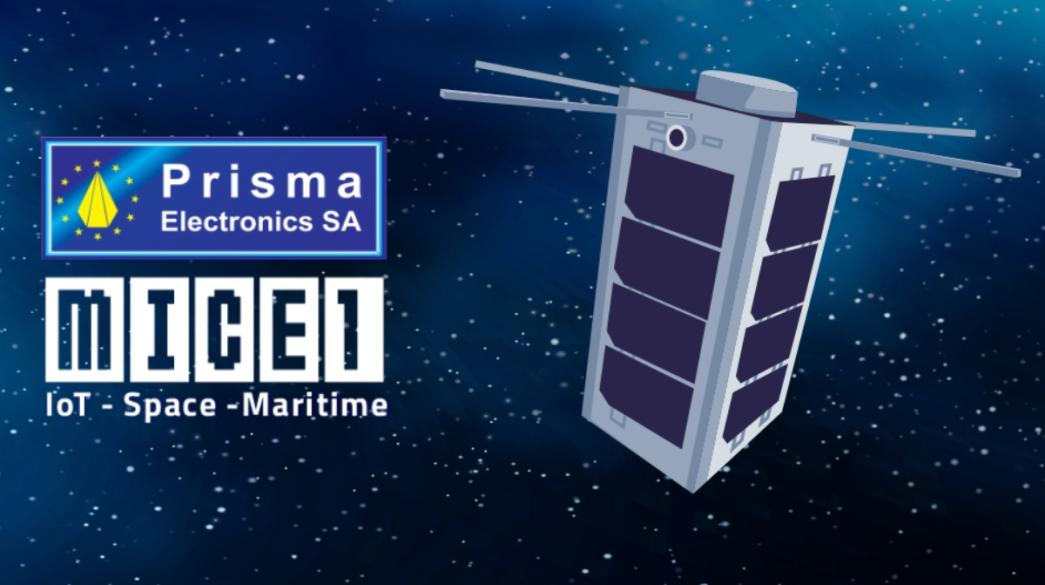
Greece has taken a significant step into operational space capabilities with the launch of MICE-1 (Maritime Identification and Communication System-1).
MICE-1 is a 3U CubeSat developed by Prisma Electronics, now functioning in sun-synchronous low Earth orbit (LEO) following deployment aboard SpaceX’s Transporter-15 mission.
Designed and built in Alexandroupolis, MICE-1 represents the first Greek nanosatellite dedicated to maritime IoT and communications applications. The project is part of Greece’s National Microsatellite Program under the Greece 2.0 initiative, with regulatory supervision and partial funding from the European Space Agency (ESA) and the European Union’s Recovery and Resilience Facility.
MICE-1 carries two primary payloads: an automated identification system (AIS) receiver for space-based ship tracking, and an S-band internet of things (IoT) transceiver. The transceiver interfaces with a proprietary Prisma system called LAROS, which collects, processes, and securely transmits maritime and remote infrastructure sensor data beyond terrestrial coverage.
AIS position reports received by MICE-1 are derived from onboard GNSS receivers carried by vessels, linking the mission directly to GNSS-based positioning and timing within the maritime PNT chain.
This integration enables real-time collection of positional and operational data from commercial vessels, including telemetry related to fuel consumption, engine performance, and route efficiency, even in ocean regions beyond the reach of conventional terrestrial receivers.
On the occasion of the MICE-1 launch, Frédéric Rouesnel, Greek Connectivity RRF Project Manager at ESA stated, “This marks a new chapter for Greek space technology… a dream that becomes reality thanks to joint national and European support.”
All systems go
MICE-1 has entered its operational commissioning phase, during which initial on-orbit activities are focused on communications verification and spacecraft subsystem assessment. Early communications with ground stations, supported in part by the Democritus University of Thrace, are aimed at validating data links and ensuring robust downlink of AIS and IoT datasets.
Looking toward 2026, mission planners anticipate MICE-1 will transition into a routine operational data service, feeding enhanced situational awareness into maritime analytics platforms, such as MarineTraffic and Spire Maritime, while providing a testbed for secure AI-driven processing of space-derived telemetry. The mission also lays groundwork for a planned wider Greek nanosatellite constellation providing comprehensive IoT coverage and maritime support.
With MICE-1 now in orbit, Greece joins a growing cohort of nations leveraging small satellites to address real-world navigation, tracking, and operational challenges, highlighting the expanding role of commercial CubeSats within the global PNT ecosystem.