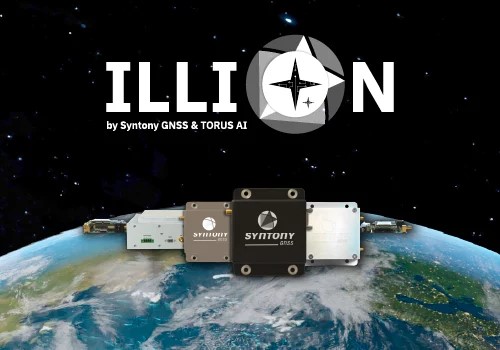
Syntony’s AI-enhanced ILLION project stands at the cutting edge of satellite navigation, fusing classic GNSS signal processing with machine-learning techniques to produce faster, more robust receivers for challenging environments.
Announced as a France 2030-supported initiative and developed in partnership with TORUS AI and Guide GNSS (Emitech Group), ILLION aims to shorten convergence times, improve accuracy in urban canyons and settings where multipath reigns, and strengthen positioning against interference by embedding AI directly in receiver chains.
The project builds on two complementary technology trends: first, the migration from single-constellation, single-frequency receivers to multi-constellation, multi-frequency designs that already benefit from Galileo and GPS, and, second, the use of data-driven filters to supplement traditional model-based estimation, such as PPP and Kalman filtering.
ILLION AI modules are trained on large sets of real and simulated signal conditions, enabling the system to detect and correct for biases, accelerate carrier-phase convergence, and maintain reliable fixes where conventional receivers struggle.
The time is right
ILLION arrives at a politically charged moment for European navigation and resilience. The EU has doubled down on sovereign positioning, navigation, timing (PNT) capabilities, including Galileo and associated downstream services, while at the same time stressing industrial autonomy and supply-chain resilience.
Brussels’ push to protect critical PNT-based services against jamming and spoofing is powering the more European GNSS innovation and procurement. Recent EU briefings and policy papers underscore the space policy link to strategic autonomy and industrial policy, factors that help explain national programs such as France 2030 backing projects like ILLION.
French industry is not alone; a wave of European companies are driving working to commercialize new GNSS technologies. For example, DARCII is a German research project led by Fraunhofer IIS. Like ILLION, it is developing AI-based techniques, in this case to detect and mitigate GNSS interference. Using federated and few-shot learning, DARCII enables mobile receivers and distributed sensors to recognize novel jamming and spoofing signals in real time, across diverse environments.
The AGORA project, coordinated by Spain’s Rokubun and funded by the European Agency for the Space Program (EUSPA), is developing a machine learning-enhanced GNSS receiver aimed at improving urban navigation resilience.
Projects like ILLION and those mentioned above are both technical and political responses, reducing dependence on foreign technologies, strengthening the European supplier base for PNT, and addressing growing concerns about GNSS interference that policymakers now frame as national-security risks.