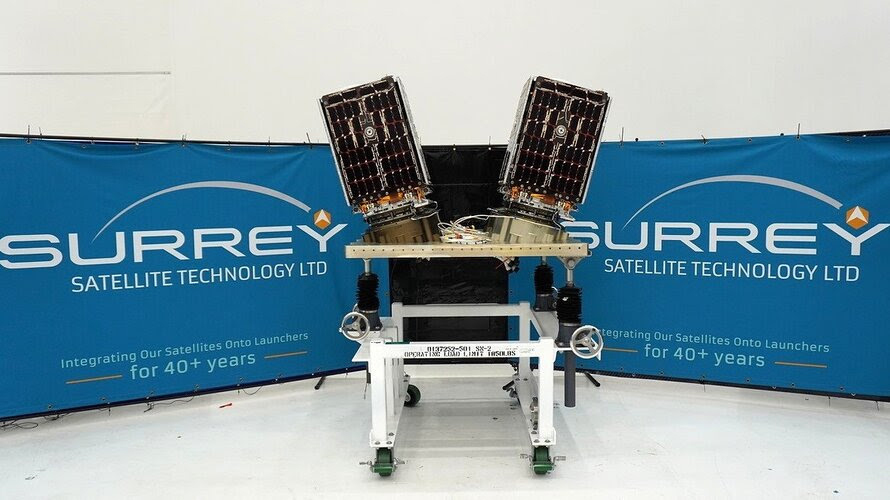
The European Space Agency (ESA) HydroGNSS mission is poised for launch at a moment of uncertainty in global climate diplomacy.
As world leaders assemble for the 30th Conference of the Parties (COP30) to the United Nations Framework Convention on Climate Change (UNFCCC) in Brazil, UK Prime Minister Keir Starmer warned that the international “consensus is gone,” on fighting climate change, signaling a political environment more fractured than at any point since the 2015 Paris Agreement. Yet, as geopolitical alignment weakens, the European GNSS community is readying a mission designed to deliver precisely the kind of objective, physics-based data that can underpin global climate action.
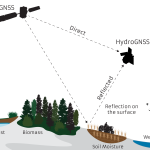
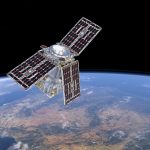
HydroGNSS comprises two identical small satellites flying in low Earth orbit (LEO) at roughly 550 km, positioned 180 degrees apart to maximize global revisit. Each spacecraft carries a GNSS reflectometry (GNSS-R) payload engineered to capture both direct and Earth-reflected L-band signals from Galileo, GPS, BeiDou, and GLONASS.
By comparing the properties of the reflected waveforms, such as delay, Doppler shift, phase coherence, and signal-to-noise ratio, the system derives geophysical parameters with resilience to cloud cover, limited sunlight, and radio-frequency variability. This makes GNSS-R particularly well suited for hydrological monitoring in regions where traditional sensors face constraints.
The mission focuses on four climate-critical variables: soil moisture, freeze-thaw state, inundation extent, and above-ground biomass. Soil-moisture retrievals support drought forecasting, precision-agriculture models, and wildfire-risk assessments. Freeze-thaw mapping contributes to monitoring permafrost integrity, a key uncertainty in carbon-feedback projections. Wetland-inundation observations help quantify methane emissions and track floodplain evolution. Biomass estimates provide independent constraints on terrestrial carbon stocks, complementing optical and radar-based methods.
Key climate insights
The political significance of HydroGNSS is difficult to overstate. As Starmer cautions that diverging national priorities threaten coordinated climate action, HydroGNSS will offer a globally consistent and well-calibrated data stream. Unlike negotiated pledges, GNSS-R observations cannot be distorted by political framing: if soil-moisture regimes shift, if thaw boundaries advance, if wetlands decline, HydroGNSS will record the change with uniform methodology across all continents.
For ESA and the GNSS community, the mission also showcases the value of the Scout-class model, i.e. rapid-development, cost-capped missions designed to adapt innovative techniques into operational tools. If HydroGNSS performs as expected, it will strengthen the case for future GNSS-R constellations capable of delivering near-real-time hydrological intelligence.
As COP30 exposes shifting political winds, HydroGNSS’s global, physics-driven data record will help ensure that climate-related decisions remain grounded in observable reality. HydroGNSS is being developed under ESA’s FutureEO programme, within the Scout-class missions designed for rapid, low-cost Earth observation innovation.