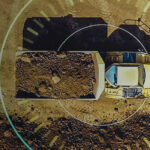
![On-site testing and validation of GreenAsph 4.0; Image courtesy Exact Control System[50]](https://insidegnss.com/wp-content/uploads/2025/11/On-site-testing-and-validation-of-GreenAsph-4.0-Image-courtesy-Exact-Control-System50.jpg)
Czech company Exact Control System, with support from the European Space Agency (ESA), is redefining digital road rehabilitation with multi-layer GNSS-guided milling, on-board 3D modeling, and selective asphalt recycling.
For decades, road resurfacing has depended on constant-depth milling, a road resurfacing method in which the asphalt layer is removed to a uniform depth across the entire surface, regardless of variations in the underlying pavement profile or drainage needs. This legacy method locks in surface distortions and limits the lifespan of the repaired road.
Developed under ESA’s NAVISP framework, Exact Control System’s GreenAsph 4.0 concept introduces 3D differential milling capable of removing each asphalt layer according to a precise geometric model.
The technology combines dual-GNSS receivers, cross-slope sensors, and edge-mounted antennas with a data-driven control algorithm that continuously adjusts the milling depth and drum orientation. Each pass not only improves smoothness but also captures data for the next layer’s digital design.
The system comprises a scalable microservice architecture hosted on Microsoft Azure. Kubernetes-orchestrated modules process data from multiple milling machines in parallel, synchronizing design updates via secure cloud links. Operators view live corrections through a simplified interface, reducing the need for extensive pre-survey and post processing.
At a recent ESA-hosted event, Exact Control System CTO Vítězslav Obr presented the final results of the GreenAsph 4.0 project, which involved extensive testing of the new system. Field demonstrations in cooperation with Prague’s road authority (TSK) confirmed measurable benefits: the international roughness index improved from 5 m/km to 0.6 m/km, 98 percent of cross-slopes were corrected, and service life projections rose by 30 to 50 percent.
Quantifiable improvement
Traditional mobile LiDAR surveys can deviate by ±50 mm, large enough to distort drainage gradients. Exact Street’s simulation environment and iterative on-site validation reduce mean GNSS trajectory error from 20 mm to between 2 and 4 mm, a five- to ten-fold improvement. That precision allows true layer-selective recycling, separating binder and surface materials for reuse instead of mixing them into waste.
Building on these results, Obr highlighted key lessons learned, such as the importance of accurate cross-slope calibration and the inclusion of 3D selective milling specifications in project tenders, which are now being applied in new pilot programs across Europe, Canada, and the U.S. With GreenAsph 4.0, GNSS moves beyond mapping into active control, closing the loop between design, construction, and long-term sustainability. “We are not only smoothing roads,” Obr said. “We are digitizing the resurfacing process itself.”