The European Union is rapidly redefining its space and defense posture, advancing autonomy, reinforcing resilience, and asserting global leadership through systems like Galileo and IRIS², and with a newly proposed EU Space Act.
Troubled by Russian aggression in the east and doubtful of transatlantic support to the west, the European Union (EU) is thinking and talking more seriously than ever about self-reliance. Immediate threats of cyber attack and space weaponization have the old continent pursuing coordinated defense and enhanced technological resilience across member states and with non-European partners.
With no time to spare, Europe now needs to maximize the strategic utility of all its autonomous assets, including satellite systems like Galileo, the most accurate space-based provider of positioning, navigation and timing (PNT) in the world.
Last June, the recently instated EU Commissioner for Defense and Space Andrius Kubilius met with officials at the European Agency for the Space Program (EUSPA) in Prague, where he said, “EU space projects like Galileo are very important for our daily life, but also for security issues. We have all seen the increased jamming and spoofing of GNSS in the Baltic region, and our capabilities to monitor and defend against these and other threats are now essential.”
Kubilius talked about the forthcoming Galileo Public Regulated Service (PRS), a more secure source of PNT for government users. “We are also delivering important secure satellite communication systems,” he said, “and we are building a new such system, IRIS², which experts have confirmed will be better than Starlink.”
IRIS² will be up and running in 2030, but the precursor GOVSATCOM system is already operational. Kubilius trialed GOVSATCOM while in Prague, communicating in real-time over a secured channel with Greek forces in maritime operations. “Modern defense depends on space-derived data,” he said, “but we have a number of concerns. We must strengthen EU launching and transport capacity. While we lost ground to the U.S. and Elon Musk during the launcher crisis, we are coming back.”
Adapting EU legislation for defense readiness is another pressing challenge. The old way of doing EU business has got to be revamped. “We can’t afford these five-year delays for filling in paperwork,” Kubilius said, “when we know Russia could be ready to attack Europe within three. That’s why we are simplifying regulations and encouraging Member States to adapt national legislation. Defense of space, and space for defense, are vital parts of the EU agenda.”
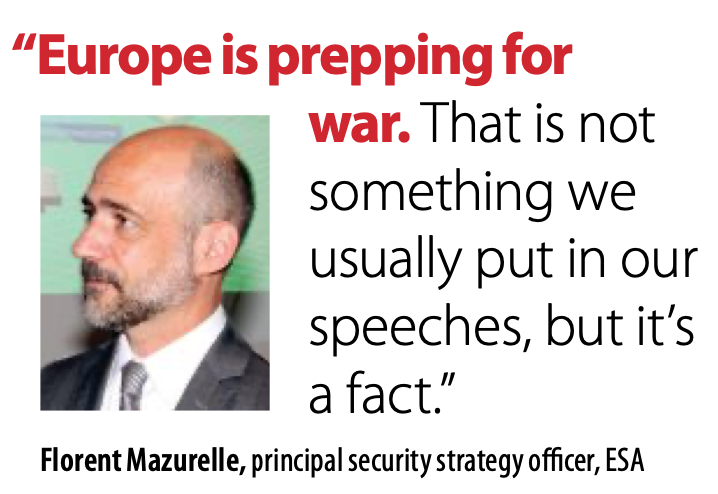
Kubulius’ words were on the minds of attendees of the 2025 European Space Forum, held a few days later in Brussels. “One thing that’s changed this year is the tonality,” said Florent Mazurelle, principal security strategy officer at the European Space Agency (ESA). “Europe is prepping for war. That is not something we usually put in our speeches, but it’s a fact. We’re looking at independence, immediate actions. We have the obligation, we’ve been cornered into becoming independent.”
ESA has, for 50 years, worked to create autonomous European space technologies and applications. For the past 20 years, it has partnered with the EU in strategic areas, from PNT to Earth observation to satcoms.
“The EU has now geared up its policy,” Mazurelle said, citing the EU White Paper on the Future of European Defense—Readiness 2030, published in March. It outlines a strategy to strengthen Europe’s defense capabilities by the end of the decade. Among other things, it calls for addressing critical capability gaps in air and missile defense, drones, cyber and other advanced technologies.
“The threats are well known,” Mazurelle said: “space weather, debris, cyber, anti-satellite—Russia destroyed a satellite just before its invasion of Ukraine—spoofing, blinding, rendezvous [close approach to a satellite or asset], eavesdropping. Space is now a contested domain. First targets in future military conflicts will likely be space systems.”
The Place for Galileo
Every day, Galileo quietly delivers services, from the most mundane to the life-saving, for billions of users. Uniquely European in design and manufacture, it is undoubtedly a dual-use system.
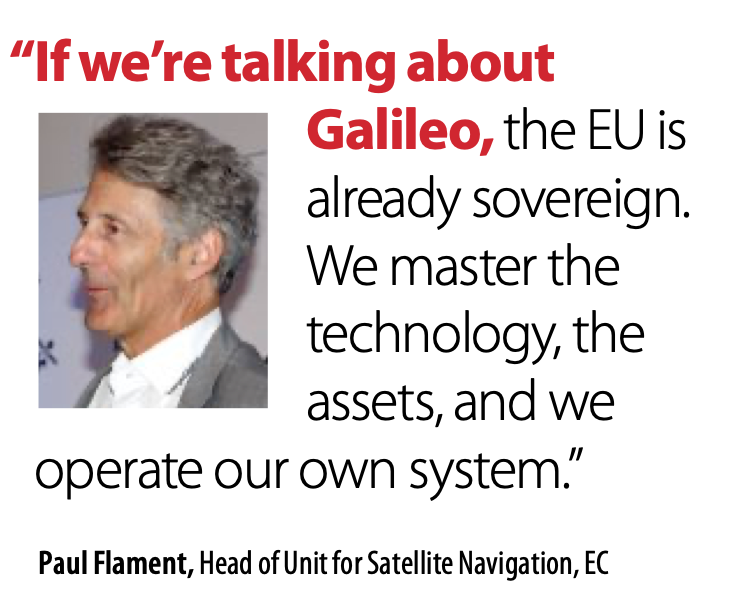
“If we’re talking about Galileo, the EU is already sovereign,” European Commission Head of Unit for Satellite Navigation Paul Flament said. “We master the technology, the assets, and we operate our own system. Galileo is three times more accurate than the closest competitor. For two years, we have delivered 20 cm accuracy, and we are used by half the world’s population.”
Galileo performance will continue to be enhanced, Flament said. “The PRS will be fully operational this year. We are preparing and building new, improved, second-generation satellites and, in the coming years, multiple launches will take place. We are working with ESA on a supplementary LEO [low Earth orbit] PNT layer, which will complement Galileo’s MEO [medium Earth orbit] infrastructure.
“So we don’t need an EU Space Act to enhance Galileo’s competitiveness, because we’re already there. However, like on our roads, where we need traffic lights, we do need rules in space.”
Rules to Live By
The EU Space Act, proposed by the European Commission in June , introduces a harmonized regulatory framework for space activities across the EU, aiming to enhance safety, resilience, and environmental sustainability, while strengthening the competitiveness of European industry.
It replaces the current patchwork of 13 national space laws, simplifying authorization and operational requirements, benefiting start-ups and SMEs.
Core pillars include: safety measures such as object tracking, collision avoidance, and end-of-life disposal; resilience in the form of tailored cyber security regulations, risk assessments, incident reporting, and supply-chain scrutiny; and sustainability mandates encompassing lifecycle assessments and environmental footprint declarations, encouraging in-orbit servicing and debris removal.
Importantly, and here’s the rub, the Act extends its reach to non-EU operators. In effect, any non-EU company or country wishing to operate in or collaborate with Europe’s space sector will need to align with the EU’s rules. It’s a tool for strategic standard-setting, reinforcing Europe’s position as a global regulatory power.
“The Space Act is still a proposal from the Commission,” Flament said, “and will go to the European Parliament and Council, so the discussion is still underway.”
On the utility of Galileo for defense and security, he said, “Everything is dual-use–roads and public transport, satellites, the military uses those things just like we do. Dual-use is not a flaw. It’s a strength. At the Commission, we consult both military and civilian stakeholders, extract their needs, and define system specifications.”
By all accounts, then, Galileo and other EU space assets reflect balanced, sovereign capabilities, crucial for European autonomy, NATO interoperability, and defense readiness. “In the past, we’ve overlooked the space dimension of defense,” ESA’s Mazurelle said. “We need a 360-degree outlook. ISR [intelligence, surveillance and reconnaissance], LEO PNT, secure satcoms.”
Under Article 2 of the 1972 ESA Convention, the Agency is to provide for and promote, “cooperation among European States in space research and technology and their space applications, for exclusively peaceful purposes…”. Asked how he squared this with today’s accent on dual use, Mazurelle said: “In 2003, we clarified that Article. The word ‘peaceful’ in the Convention is now taken to mean ‘non-aggressive,’ so basically we can’t place weapons in space, but dual use is fully within scope.” Ariane, Galileo and IRIDE–the €1B ISR constellation–prove the point. “We don’t care if a drone observes a ship, a battlefield, or crops,” Mazurelle said. “Member states decide that.
“In Europe, we are politicized and slow,” he continued, “but industry suffers as a result. They have to wait for a clear signal of priorities. So we need clarity now. ESA and the Commission have the tools. The ESA Convention is flexible, the Commission’s power enormous. If we can define our dual-use requirements and determine what’s urgent, we’re ready to deliver.”
Show Us The…
Money, of course, is the question on everyone’s mind, with Europe feverishly seeking the financing to realize its new defense aspirations. Under Readiness 2030, the EU plans to mobilize up to €800 billion by suspending EU fiscal rules to enable up to 1.5% of GDP extra defense spending and issuing €150 billion in joint loans via the Security Action for Europe (SAFE) instrument. The European Defense Fund (€8 billion from 2021 to 2027) and an additional Defense Equity Facility (€175 million seed) aim to stimulate research and development and private investment in dual-use technologies.
Meanwhile, space-focused financing includes the €10.5 billion IRIS² (€6.5 billion public funds) and ESA’s European Launcher Challenge, funded under CASSINI and EU-ESA collaboration. Together, these mechanisms represent an unprecedented, coordinated push by the EU to align space and defense financing.
“Of course, defense spending is a major topic, as we saw at the recent NATO Summit and the European Council,” said Zuzana Mazanova, head of unit for space single market at the European Commission. “The White Paper gives us €800B and a roadmap. The aim is to close capability gaps, while elevating space as a central defense domain, including Copernicus, Galileo and IRIS².
“Close coordination with member states is key, aligning priorities, avoiding duplication, and fully empowering space as a defense enabler. And we’re looking for synergies, between space and defense actors, with industry, seeing how the future space program can be corrected for defense needs.”
Friends and Acquaintances
From the diplomatic front, Regina Peldszus, Policy Officer at the European External Action Service (EEAS) said, “We’re undertaking a lot of civil-military cooperation. We have had over 15 years of close space and space security dialogue with our most important strategic partner, the United States, where we have a deep exchange on policy and technical levels.”
The EU also maintains close security relations with Japan, Canada, New Zealand, Australia and South Korea, and has relaunched cooperation, post-Brexit, with the UK.
“One of the political priorities of the current HR/VP [High Representative of the Union for Foreign Affairs and Security Policy/Vice-President of the European Commission] Kaja Kallas is the deepening of our relationship with NATO,” Peldszus said. “Here, the EU brings something unique; we own and operate space assets, including our Galileo fleet. NATO doesn’t do that. They draw on assets from their own alliance and commercial sources.”
The U.S. Response
The United States has long maintained support for international cooperation in space, particularly with Europe. However, the new EU Space Act will be seen by some U.S. interests as an attempt to tamp down on a burgeoning international market, in the wild west that is space in 2025.
On that question, Caitlin Poling, Foreign Affairs Officer at the U.S. Department of State, addressed the Forum: “In a moment of exponential growth in space activity, one of our priorities is supporting the U.S. commercial space sector by breaking down barriers to growth. Our office recently met with over 100 companies, representing 80% of the U.S. space industry, who expressed concern about the EU Space Act.
“We hope the final version supports industrial innovation and cooperation instead of hindering it, and does not disrupt joint business between the U.S. and Europe.” Companies on both sides of the Atlantic worry about increasingly onerous EU regulations that may stifle innovation or exclude U.S. participation, with heavy fines on U.S. companies.
“No one can regulate their way into a technological lead,” Poling said, “and the current American administration is concerned that a renewed quest for strategic autonomy, potentially at the expense of transatlantic cooperation, could pull Europe from important supply chains, over-regulate its own and international companies, and ultimately lead Europe to reliance on others, potentially including China.”
Indeed, one would be wary of Europe repeating the mistake it made when, in the name of autonomy, it embraced Russian launch services as a backup to Ariane, a move that backfired when Europe broke relations with Russia over the invasion of Ukraine.
Despite the transatlantic tensions revealed at the European Space Forum, the U.S., Poling said, remains deeply committed to working with Europe, while engaging in wider, established forums like the UN Committee on the Peaceful Uses of Outer Space (COPUOS).
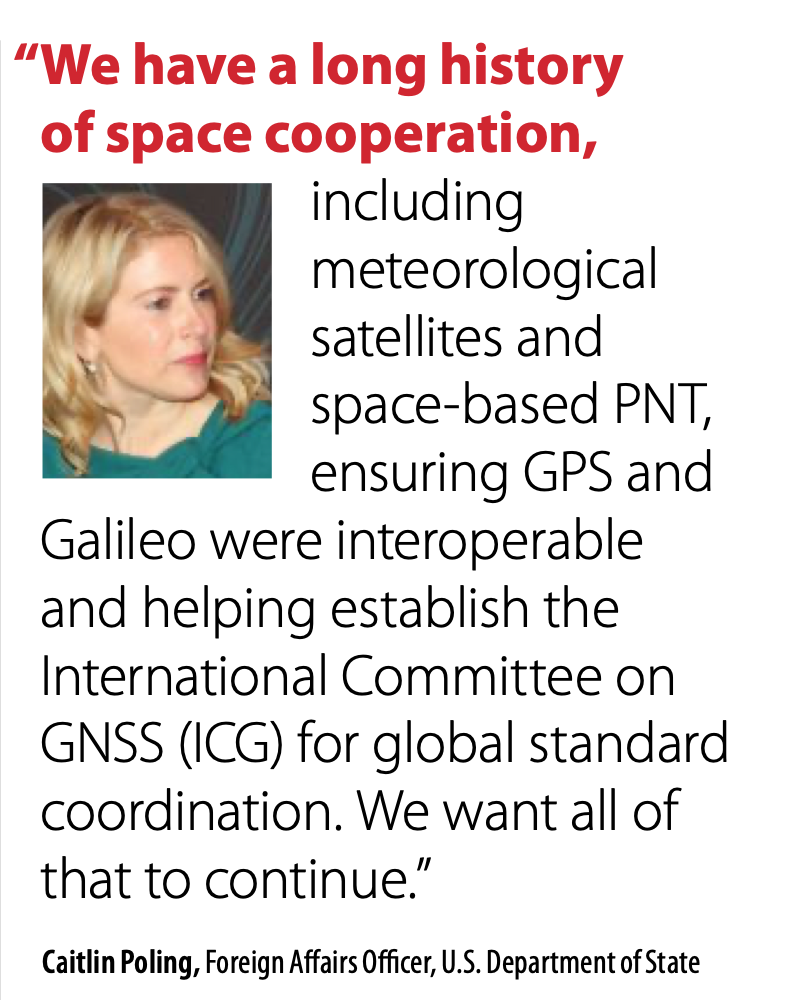
“We have a long history of space cooperation,” Poling said, “including meteorological satellites and space-based PNT, ensuring GPS and Galileo were interoperable and helping establish the International Committee on GNSS (ICG) for global standard coordination. We want all of that to continue.”
While Europe’s current pursuit of all-out autonomy is an exciting thing to watch, the Union will need to find the right balance between sovereignty and cooperation. Europe is accelerating toward self-reliance in space and defense. Galileo, IRIS², and the EU Space Act denote this pivot: autonomous, dual-use capabilities, backed by regulation and funding. Looking to 2030 and beyond, the EU must define its space vision plainly, while continuing to champion space as a domain of global cooperation rather than geopolitical rivalry.