
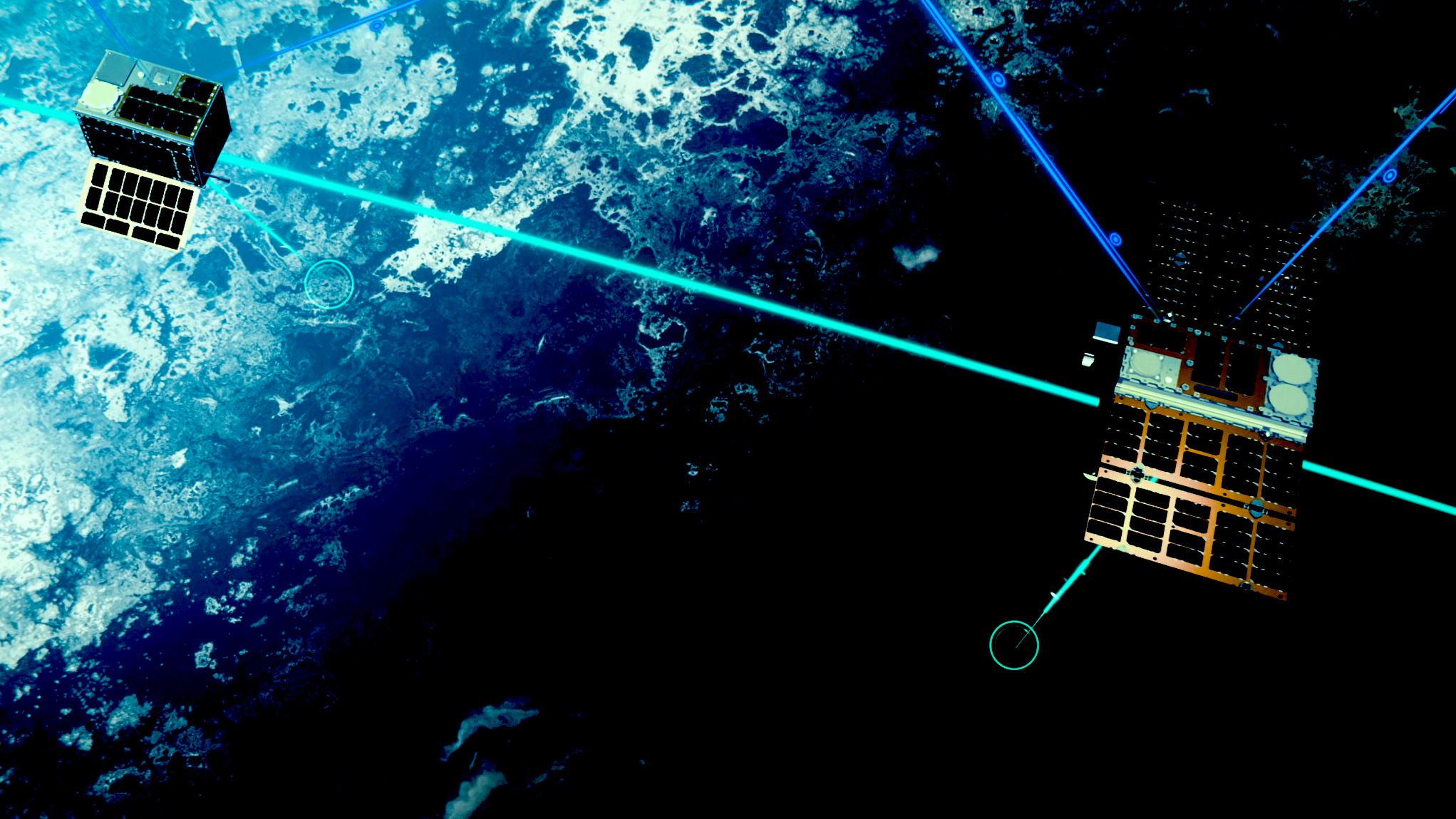
The European Space Agency (ESA) is preparing for the inaugural launch of the Celeste LEO-PNT in-orbit demonstration mission with the first two satellites scheduled to lift off no earlier than 24 March, aboard Rocket Lab’s Electron rocket from the company’s Māhia Launch Complex in New Zealand.
The first two satellites successfully completed their test and qualification campaign and were formally declared ready for flight.
The satellites are currently being shipped to Rocket Lab’s launch complex in New Zealand, where they will undergo final testing and integration in the Electron rocket ahead of their launch no earlier than 24 March.
Celeste flies with first two satellites
Similarly to the early stages of the Galileo programme, Celeste will begin with two demonstrator satellites to secure the assigned frequency filings and to test representative navigation signals until the end of the year.
The two satellites consist of two large CubeSats (12U and 16U respectively), both developed by two consortia composed of a wide set of European players, one led by GMV (Spain) and the other led by Thales Alenia Space (France).
Together, they will enable in-orbit testing of next-generation technologies, including autonomous precise orbit determination without reliance on ground infrastructure, as well as stronger and faster radionavigation signals in L- and S-band from low Earth orbit.
Over the past months, both satellites successfully completed payload integration, radio-frequency compatibility tests, and environmental qualification, including thermal vacuum, mechanical and electromagnetic compatibility testing.
More satellites to follow
Eight larger satellites with additional capabilities are under development, with GMV and Thales Alenia Space each responsible for four of them. Design and development are progressing steadily, with an opportunity for subsequent launches from 2027 onwards.
The eight satellites will build on the work of the first two satellites and demonstrate radionavigation with additional novel signals and new frequency bands:
- S-band two-way navigation signals, for advanced positioning capabilities using 5G satellite waveforms.
- C-band signals, for additional resilience against jamming and interference.
- UHF-band signals, for enhanced penetration and in-door positioning.
“On top of the eight satellites, an additional one will include a payload to test miniaturised atomic clocks on board, along with other technologies,” says Roberto Prieto-Cerdeira, ESA’s Celeste project manager.
Once fully completed at an orbit between 500 and 560 km, the demonstrator mission will offer an ideal in-orbit testbench for a broad variety of downstream applications, such as autonomous vehicles, maritime navigation, critical infrastructure, polar and arctic operations, wireless networks, emergency services, asset tracking and Internet-of-Things applications.
“By carrying out these experimentation and demonstration activities in orbit, we are opening a platform where ESA can work hand-in-hand with end-user communities and stakeholders to demonstrate innovative technologies in satellite navigation, push boundaries and demonstrate services in conditions that mirror the real world,” adds Roberto.
ESA is offering interested third parties from ESA Participating States the opportunity to participate in the experimentation phase of the Celeste in-orbit demonstrator. More information is available on ESA’s Open Space Innovation Platform.
Following Celeste’s in-orbit demonstration, Celeste’s in-orbit preparatory phase, approved at ESA’s Ministerial Council in November 2025 (CM25), will focus on technology development, industrialisation and in-orbit validation, preparing for a potential operational system as part of the European Union GNSS infrastructure together with Galileo and EGNOS, also supporting potential commercial initiatives.