Main Categories

February 4, 2013

FTC Report Recommends Greater Location Privacy Effort for Mobile Devices

The Federal Trade Commission (FTC) issued a staff report last Friday (February 1, 2013) that suggests companies consider offering a Do Not Track (DNT) mechanism for smartphone users among other measures to protect location privacy.

Use and possible abuse of real-time geolocation data was well up on the list of concerns addressed by the report, “Mobile Privacy Disclosures: Building Trust Through Transparency.”

Read More >

By Inside GNSS
February 1, 2013

Hemisphere GPS Sells Non-Agricultural Operations to Chinese Company

[Updated February 4, 2013] Hemisphere GPS Inc. moved closer to a final exit from the OEM GNSS space yesterday (January 31, 2013) by signing a definitive agreement to sell the business assets associated with its non-agricultural operations to the Canadian subsidiary of Beijing UniStrong Science & Technology Co. Ltd., which will operate under the name  The cash sale price was $14.96 million.

Read More >

By Inside GNSS
January 31, 2013

European Space Policy: Jobs the Bottom Line for Budget Battle, Galileo

MEP Dominique Riquet: “We will not say yes to a budget that cripples our space programs.” Peter Gutierrez photo.

Although they use a different vocabulary than their U.S. counterparts, European political leaders say that jobs would be the victims at the bottom of their fiscal cliff.

In his keynote speech to the 5th Space Conference on European Space Policy (subtitled “A Global Tool for Global Challenge” held this week in Brussels, European Commission (EC) Vice-President Antonio Tajani underlined the important role of space for restoring economic growth and employment.

Read More >

By Inside GNSS
[uam_ad id="183541"]

UK/US Deal on GPS Signal Patent Omits Galileo Version

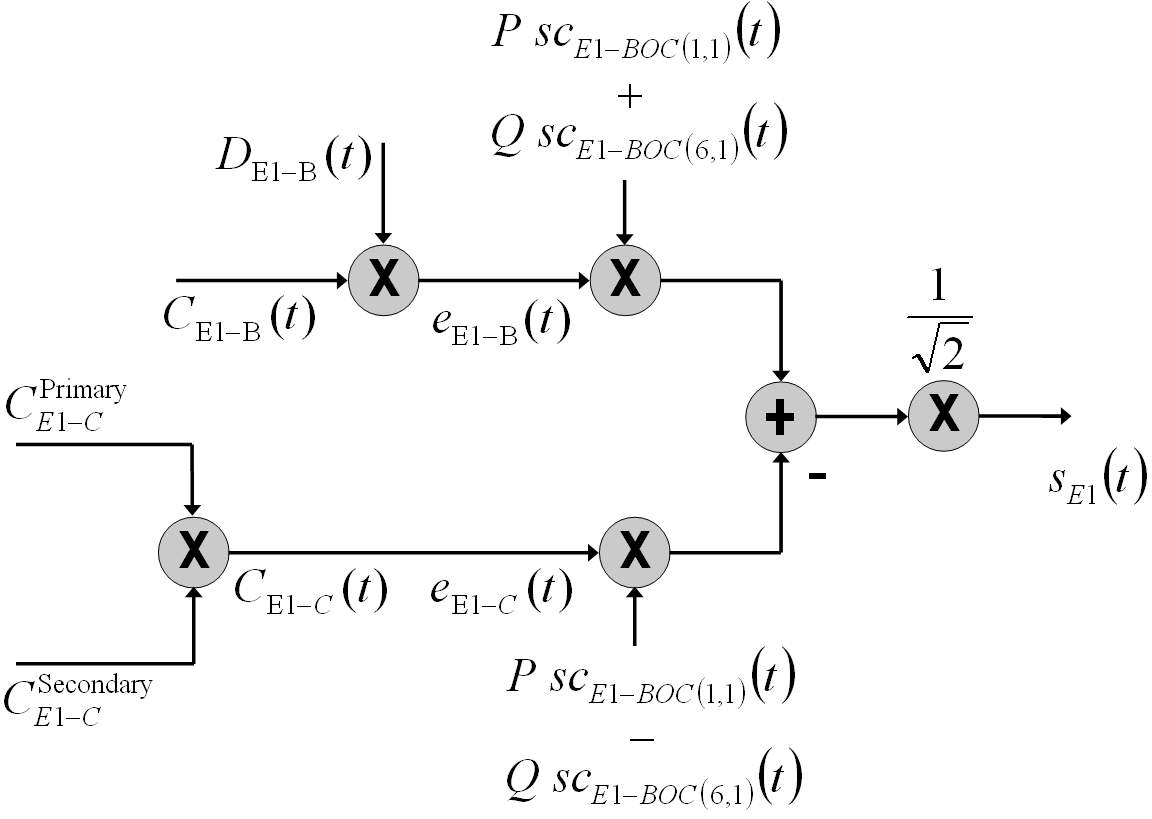
A recently announced deal between the United States and the United Kingdom to revoke the UK’s surprise patents on a key GPS technology has a glaring omission: Intentionally left out of the agreement are patents on the European Union’s version of the technology, a signal structure important to enabling Europe’s Galileo system to work seamlessly with America’s GPS constellation.

Read More >

By Inside GNSS
January 25, 2013

GNSS Hotspots | January 2013

One of 12 magnetograms recorded at Greenwich Observatory during the Great Geomagnetic Storm of 1859
1996 soccer game in the Midwest, (Rick Dikeman image)
Nouméa ground station after the flood
A pencil and a coffee cup show the size of NASA’s teeny tiny PhoneSat
Bonus Hotspot: Naro Tartaruga AUV
Pacific lamprey spawning (photo by Jeremy Monroe, Fresh Waters Illustrated)
“Return of the Bucentaurn to the Molo on Ascension Day”, by (Giovanni Antonio Canal) Canaletto
The U.S. Naval Observatory Alternate Master Clock at 2nd Space Operations Squadron, Schriever AFB in Colorado. This photo was taken in January, 2006 during the addition of a leap second. The USNO master clocks control GPS timing. They are accurate to within one second every 20 million years (Satellites are so picky! Humans, on the other hand, just want to know if we’re too late for lunch) USAF photo by A1C Jason Ridder.
Detail of Compass/ BeiDou2 system diagram
Hotspot 6: Beluga A300 600ST

1. TIMING IS EVERYTHING
Washington, D.C.

Read More >

By Inside GNSS

GNSS and Ubiquity

Chris Rizos, University of New South Wales

GNSS is in a class of its own and the positioning/navigation/timing (PNT) technology of choice for most applications. Why wouldn’t we always use it?

It is affordable, it is a mature technology with many form factors, and its level of performance spans several orders of magnitude — millimeters to meters. There are a bewildering number of permutations of user equipment, augmentation solutions, processing algorithms, and operational procedures to choose from.

However. . . .

Read More >

By Inside GNSS
[uam_ad id="183541"]

Markets and Multi-Frequency GNSS

FIGURE 1: Proposal to have a single chip GNSS receiver with additional pins to allow for the inclusion of an additional radio

Q: What will limit the spread of multi-frequency GNSS receivers into the mass market?

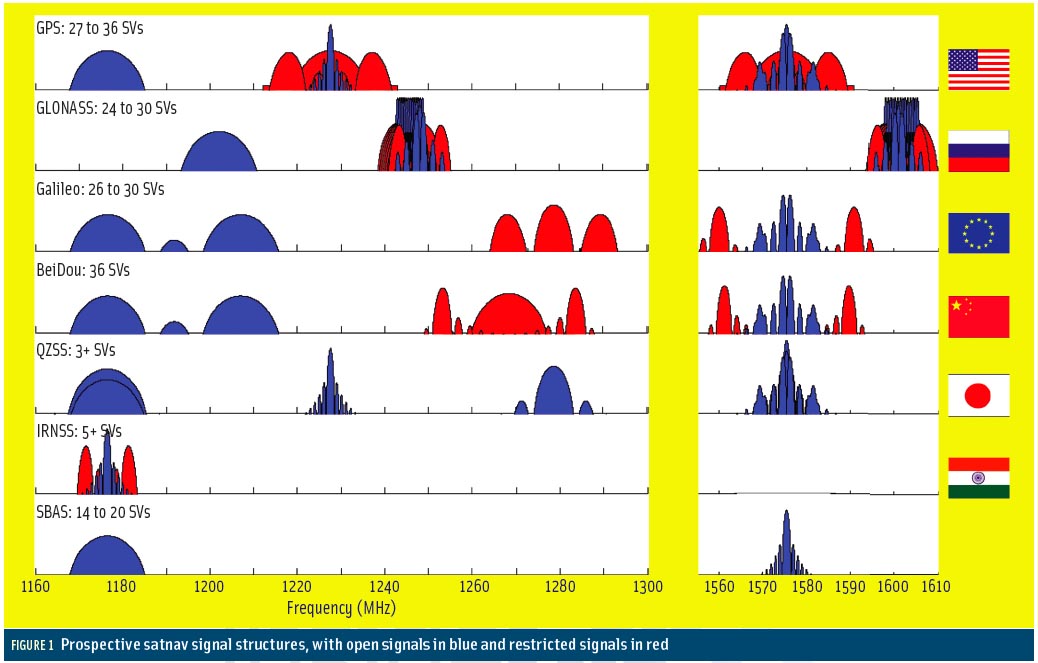
A: To set the scene, we need to define our terms of reference. By multi-frequency we mean receivers that operate with navigation signals in more than just the standard upper L-band from about 1560–1610 MHz where we find GPS L1, Galileo E1, Compass B1, and GLONASS L1. The obvious additional frequency is the lower L-band, from about 1170 to 1300 MHz, where again the same four constellations have signals.

Read More >

By Inside GNSS

The GNSS Merry Go Round

The whole GNSS world should have a warm spot in its heart for centripetal forces.

After all, a centripetal force — in this case, gravity — is what keeps planets in rotation around our Sun and satellites, around the Earth.

Centrifugal force, of course, is what throws us off a merry-go-round or carousel. Centripetal force is what keeps us on board.

For those on a merry-go-round, the centripetal force is not gravity, but rather the tensile strength of our arms pulling us toward the center of rotation, at right angles to the motion of our seats.

Read More >

By Inside GNSS

Developing a GNSS Position and Timing Authentication Testbed

FIGURE 1: Characterization of interference from the user perspective

Increasing demand for ensuring the authenticity of satellite signals and position/velocity/time (PVT) calculations raises the need for tools capable of assessing and testing innovative solutions for verifying GNSS signals and PVT. Today’s civilian systems do not provide authentication at the system level, and a number of mitigation strategies have been developed in the last 10 years at user segment in order to protect receivers from interference and deception.

Read More >

By Inside GNSS
January 22, 2013

AFRL Selects Surrey Satellite US to Evaluate Small Satellite Approach to GPS

The Air Force Research Laboratory (AFRL) has selected Surrey Satellite Technology US LLC (SST-US), of Englewood, Colorado, to investigate cost reduction and augmentation of the current GPS constellation through the application of a small satellite approach.

AFRL has contracted with SST-US to identify and analyze how small satellites can improve aspects of GPS system performance, such as accuracy, coverage, and robustness at costs far below those of past procurements.

Read More >

By Inside GNSS
IGM_e-news_subscribe