B: Applications

September 6, 2019

Deep-Space Clock Could Blaze Trail to Improved GNSS Accuracy

The U.S. National Aeronautic and Space Administration (NASA) has activated an orbiting ultra-precise atomic clock orbiting aboard a spacecraft provided by General Atomics Electromagnetic Systems. If the clock performs as well in space as it has in the lab, losing only one second every 10 million years, the technology could enable far-reaching deep space missions—and improve the accuracy of GNSS timing and positioning.

Read More >

By Inside GNSS
[uam_ad id="183541"]
[uam_ad id="183541"]
August 5, 2019

European-Chinese Satellite to Study Interaction Between the Solar Wind and Earth’s Magnetosphere

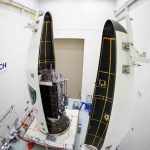
Airbus has been selected by the European Space Agency (ESA) to build the European component of the SMILE satellite (Solar wind Magnetosphere Ionosphere Link Explorer). SMILE will be the first joint satellite mission between ESA and the Chinese Academy of Sciences (CAS), following on from the success of the Double Star / Tan Ce mission which flew between 2003 and 2008.

Read More >

By Inside GNSS

EGNSS, ERTMS Impacting Both Rail and Space

Two years ago, Inside GNSS published a feature article describing some exciting new capabilities and business models making GNSS use a key contributor to deploying European Rail Traffic Management System (ERTMS) on local and regional lines. Today, the train control segment remains one of the most important components of the railway market. In the railway domain, this control segment also is one of the most important in terms of industrial and technological innovation, in particular in Europe with the development and the continuous improvement of the European Rail Traffic Management System/European Train Control System (ERTMS/ETCS) standards.

Read More >

By Stan Goff
August 1, 2019

Microchip’s Carrier-Grade Time, Synchronization Portfolio Expansion Improves Network Deployment, Reliability and Scalability

One of the biggest 5G network deployment challenges is synchronizing higher volumes of more densely packed base stations. Another is keeping services operating through GNSS lapses due to vulnerabilities such as jamming, spoofing or loss of signal. Microchip Technology Inc., via its Microsemi subsidiary, is solving these and other challenges for networks with additions to its Precision Time Protocol (PTP) PackeTime® portfolio including the TimeProvider 4100 Release 2.0. The TimeProvider release adds 10 Gigabit Ethernet (GE) support, a Boundary Clock operation mode that lowers operational costs, and other enhancements to improve how timing flows are distributed from multiple sources to a network’s base stations and other endpoints.

Read More >

By Inside GNSS
1 79 80 81 82 83 179
IGM_e-news_subscribe