
GLONASS: Picking Up the Pace
Russian officials are working to develop a plan that will meet Russian President Vladimir Putin’s directive to have the full GLONASS constellation in place by 2009 instead of 2011.
By Inside GNSS
Global Navigation Satellite Systems Engineering, Policy, and Design
Russian officials are working to develop a plan that will meet Russian President Vladimir Putin’s directive to have the full GLONASS constellation in place by 2009 instead of 2011.
By Inside GNSS
Risk allocation, avoidance, and management are the watchwords of the day as the contract negotiation for the Galileo concession moves into its endgame.
By Inside GNSS
The Bush Administration’s Fiscal Year 2007 (FY07) budget proposal for the Department of Defense (DoD), announced in February, allocates $315,314,000 in advanced technology development for GPS, including work on the GPS III program. If approved by Congress, that would represent a sizable increase from the FY06 expenditures of more than $85 million and $33 million in FY05.
By Inside GNSS
The Russian Space Forces are continuing efforts to bring the final two GLONASS spacecraft launched December 25 into operation.
One of the trio of satellites (SV798 in slot 19) went on the air in late January. Reports from the Russian news agency RIA Novosti, quoting Russian space officials, subsequently attributed the delay to frozen fuel lines in the satellites.
By Inside GNSS
Japan launched its second Multi-Functional Transport Satellite (MTSAT-2) on February 18, opening a new phase of precision air navigation and air traffic control (ATC) over the western Pacific Ocean.
By Inside GNSS
Russia gave a Christmas gift to the GNSS world with its launch of three GLONASS satellites, including two modernized GLONASS-M spacecraft, on December 25 2005.
By Inside GNSS
Matthias Ruete has been named as director-general of the European Commission’s Directorate- General for Energy and Transport (EC DG-TREN), which has overall responsibility for implementation of the Galileo program on behalf of the European Union (EU). He replaces François Lamoreaux.
By Inside GNSS
Civil GPS users now have a second full signal available to them — albeit on only one satellite and “at the user’s own risk” — courtesy of the first modernized Block IIR (IIR- 14M) spacecraft launched last September. And the world’s geodetic community is already moving to take advantage of it with announcement of an addendum to the receiver autonomous exchange (RINEX) format used to combine high-precision position data from different types of GPS receivers.
By Inside GNSS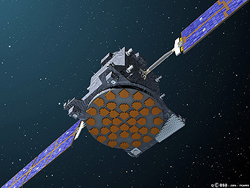
European Space Agency (ESA) and Surrey Satellite Technology Ltd.(SSTL) operators have completed the on-orbit preparations and activated the navigation payload for GIOVE-A, the first Galileo satellite launched December 28.
By Inside GNSS