A: System Categories

March 18, 2015

GAO Report: More Delays, Cost Increases for OCX, GPS III

New delays and higher costs should be expected for both the GPS III satellite program and GPS-OCX, the new GPS ground system, federal watchdogs warned in a new report.

The Government Accountability Office (GAO) said both programs are in the process of rebaselining, that is, resetting their estimated schedules and costs. In the case of the Next Generation Operational Control System (GPS OCX), which is essential for full operation of the new GPS III satellites, the changes could be significant.

Read More >

By Inside GNSS
March 16, 2015

DHS, NIST Make Progress on Protecting GPS

A roof antenna for a GPS timing system. Photo by David Monniaux, Wikimedia Commons

Two agencies charged with helping protect America’s critical infrastructure are working on ways to safeguard GPS receivers, particularly those used to tap the signal for essential timing data.

The Department of Homeland Security (DHS) is building on its more recent, technically focused research to identify and mitigate risks.

Read More >

By Inside GNSS
March 14, 2015

Renewed Spectrum Fight Emerges between GPS, LightSquared at ABC Workshop

Spectrum-related tensions reemerged during a workshop on Thursday (March 12, 2015) organized to gather feedback on a testing plan to help protect GPS receivers.

The plan is part of the GPS Adjacent-Band Compatibility (ABC) assessment — a wide-ranging effort to determine the power levels at which services operating in frequencies next those used by GPS and other GNSS systems can broadcast signals without causing interference to GPS signals.

Read More >

By Inside GNSS
[uam_ad id="183541"]

GNSS Hotspots | March 2015

One of 12 magnetograms recorded at Greenwich Observatory during the Great Geomagnetic Storm of 1859
1996 soccer game in the Midwest, (Rick Dikeman image)
Nouméa ground station after the flood
A pencil and a coffee cup show the size of NASA’s teeny tiny PhoneSat
Bonus Hotspot: Naro Tartaruga AUV
Pacific lamprey spawning (photo by Jeremy Monroe, Fresh Waters Illustrated)
“Return of the Bucentaurn to the Molo on Ascension Day”, by (Giovanni Antonio Canal) Canaletto
The U.S. Naval Observatory Alternate Master Clock at 2nd Space Operations Squadron, Schriever AFB in Colorado. This photo was taken in January, 2006 during the addition of a leap second. The USNO master clocks control GPS timing. They are accurate to within one second every 20 million years (Satellites are so picky! Humans, on the other hand, just want to know if we’re too late for lunch) USAF photo by A1C Jason Ridder.
Detail of Compass/ BeiDou2 system diagram
Hotspot 6: Beluga A300 600ST

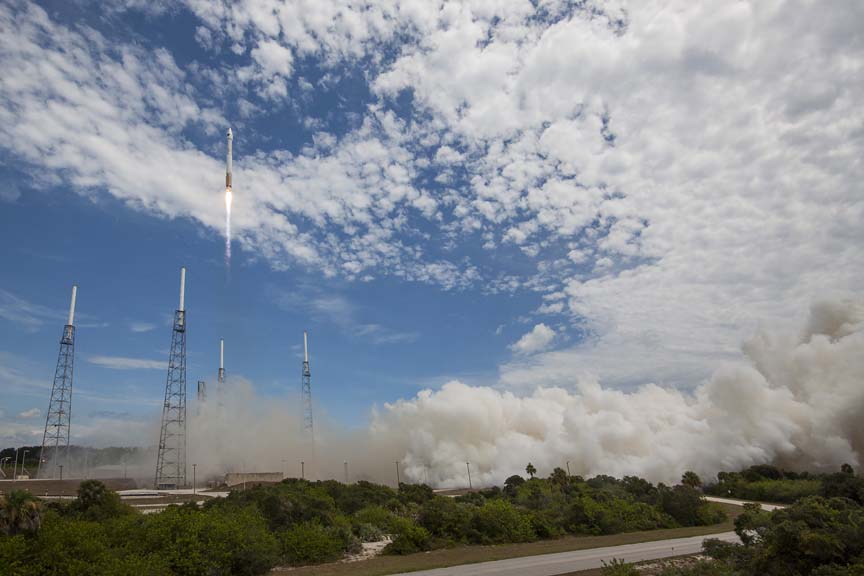
1. NAVSTAR GETS THE AX
Seal Beach, California

Read More >

By Inside GNSS

GNSS and Precision Farming

Dr. John Fulton, Ohio State University

Nowhere has the fact that GNSS can guide things besides military weapons and transport manifested itself more profoundly than in agriculture.

While Google and automotive manufacturers struggle to figure out how to put autonomous vehicles on the highway, farmers have been using GNSS for well over a decade to guide equipment through their fields — along with a host of other ag-related, site-specific applications.

Indeed, GNSS — along with an array of other high-tech resources — is transforming agriculture at an accelerating rate.

Read More >

By Inside GNSS

How does a GNSS receiver estimate velocity?

Equations 1 – 11

Q: How does a GNSS receiver estimate velocity?

A: Stand-alone single-frequency GNSS receivers represent the largest slice of the commercial positioning market. Such receivers operate mainly in single point position (SPP) mode and estimate velocity either by differencing two consecutive positions (i.e., approximating the derivative of user position) or by using Doppler measurements related to user-satellite motion.

Read More >

By Inside GNSS
[uam_ad id="183541"]

Seriously Seeking a Galileo Service Operator

Carlo des Dorides, El?bieta Bie?kowska

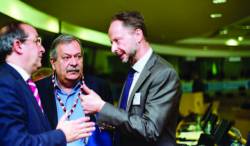
Last January, the European GNSS Agency (GSA) announced a new invitation to tender for the role of Galileo service operator (GSOp). Speaking at the recent EU Space Policy Conference in Brussels, GSA Executive Director Carlo des Dorides called it the largest contract ever to be awarded under the Galileo program.

“It will shape the future of Galileo,” he said.

Read More >

By Peter Gutierrez

Expanding EGNOS Horizons

GPS+EGNOS tracking device able to use EGNOS OS and EDAS mounted on a container

The European Geostationary Navigation Overlay Service (EGNOS) has a European regional coverage that could be extended quite easily to areas adjacent to the European Union. Backed by the European Commission, a public/private consortium is operating programs of technical assistance to prepare nations in the Mediterranean region to adopt and exploit European GNSS services in their priority market segments, namely aviation and road freight transport/logistics.

Read More >

By Inside GNSS
IGM_e-news_subscribe