
A: System Categories

July 17, 2016

Air Force Backs GPS OCX as Temporary Shutdown Looms

The Air Force is defending the new GPS ground system, taking a stand against naysayers in Congress and declaring through its actions an intent to stick with the Next Generation Operational Control System program (OCX) — at least for now.

The most public of these actions occurred June 30 when Secretary of the Air Force Deborah Lee James announced OCX would surpass by at least 25 percent the program’s estimated cost. She declared a critical Nunn-McCurdy breach, putting the program on a path to automatic cancellation.

Read More >

By Dee Ann Divis
July 15, 2016

Pursued by GPS-Aided Advertisers? Check the Small Print

When we’re using a mobile location-based application such as getting driving directions from Google Maps, it’s not surprising to see advertisements from local businesses showing up in our browsers. Customized advertising, after all, is Google’s bread and butter.

But as owners of GNSS-enabled mobile devices move around through the world, they are often followed by similar unsolicited offers and advertising from apparently random sources.

What’s that all about?

Read More >

By Inside GNSS
[uam_ad id="183541"]
July 6, 2016

Parkinson’s GPS Role Earns Marconi Prize

Brad Parkinson, recipient of 2016 Marconi Prize

Bradford Parkinson, the original manager of the NAVSTAR GPS development program and a Stanford professor emeritus of aeronautics and astronautics, will receive the 2016 Marconi Prize at a November 2 banquet and award ceremony during the Stanford PNT Symposium. The $100,000 prize, given annually, recognizes major advances in the field that benefit humanity.

Read More >

By Inside GNSS

Interference Mitigation in the E5a Galileo Band Using an Open-Source Simulator

Four global navigation satellite systems are scheduled to be fully operational orbiting Earth in the coming years: the NAVSTAR Global Positioning System (GPS) from the United States, the GLObal NAvigation Satellite System (GLONASS) from Russia, the Compass/BeiDou-2 System (BDS) from China, and Galileo from Europe. A considerably high number of signals, coming from the satellites of those constellations, will share the radio electric spectrum.

Read More >

By Inside GNSS

The Emerging Legal Debate Around Japan’s QZSS

Japan’s regional and augmentation positioning system, the Quasi-Zenith Satellite System (QZSS), is a project yet to be developed. While it will become a constellation of seven satellites covering the western Pacific area, only “Michibiki,” the first satellite launched in 2010 for technological validation , is now in orbit.

Read More >

By Ingo Baumann
[uam_ad id="183541"]

First Results

In February 2011, Russia launched the first satellite of the GLONASS-K1 series, i.e., SVN (space vehicle number) 801 (R26), which in addition to the legacy frequency division multiple access (FDMA) signals, for the first time was enabled to transmit code division multiple access (CDMA) signals on the GLONASS L3 frequency (1202.025 MHz). Later in 2014, the GLONASS program added SVNs 802 (R17) of series K1 and 755 (R21) of series M, and in 2016, SVN 751 of series M, with the capability of transmitting CDMA L3 signals to the constellation.

Read More >

By Inside GNSS

Federal Agencies Plan Shutdown of 37 Differential GPS Stations

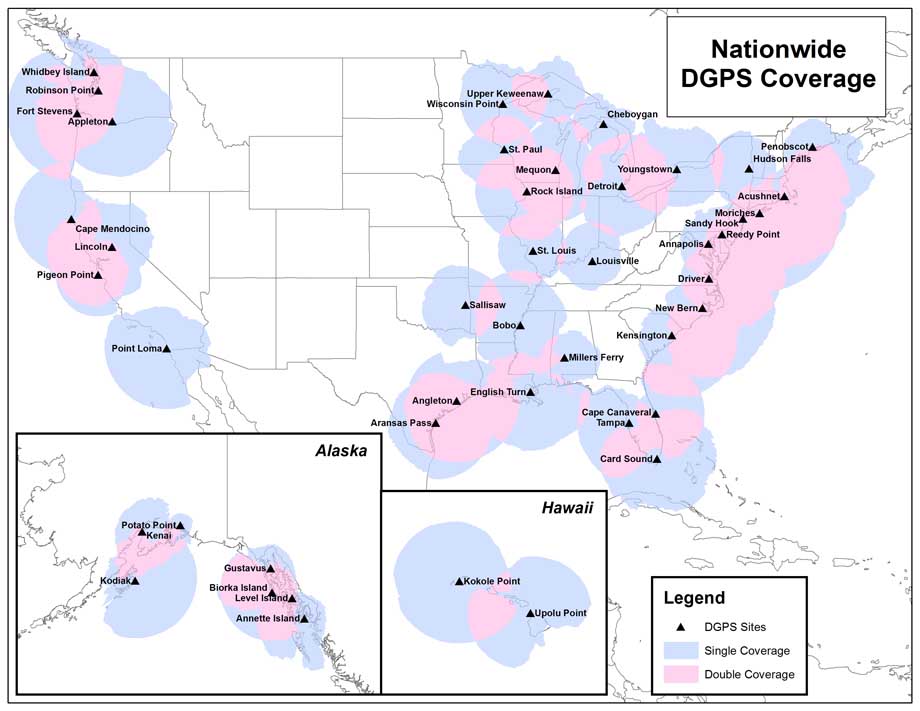
Graphic Depicting NDGPS Coverage After Site Reductions

The U.S. Coast Guard, the U.S. Army Corps of Engineers (USACE), and the Department of Transportation (DoT) released a Federal Register notice today (July 5, 2016) announcing a reduction of the Nationwide Differential Global Positioning System (NDGPS).

The planned reduction calls for the shutdown and decommissioning of 37 DGPS sites, leaving 46 operational sites available to users in coastal areas. Termination of the NDGPS broadcasts is scheduled to occur on August 5, 2016.

Read More >

By Inside GNSS
July 1, 2016

Army Plans Awards, Solicitations for Assured PNT with(out) GPS

The U.S. Army will soon release new contracts and a post-Milestone B solicitation as part of its shift to a system of systems approach for making sure warfighters have the position, navigation, and timing (PNT) information they need regardless of issues with getting the GPS signal.

The Assured PNT (APNT) approach incorporates multiple sensors and an open architecture into an integrated whole that is resilient and easy to update, explained Kevin Coggins, the direct reporting program manager for PNT.

Read More >

By Dee Ann Divis

Homeland Security, PNT ExCom Move on Backing Up GPS

Harold “Stormy” Martin, director NCO for Space-Based PNT

The Department of Homeland Security (DHS) is moving forward to establish a backup for the position, navigation, and timing (PNT) information provided by GPS. This month the agency assumed the lead in a yearlong effort to specifically define the requirements for an alternative source of timing information to and released a solicitation for research to help protect critical infrastructure from timing disruption or spoofing.

Read More >

By Inside GNSS
June 30, 2016

Air Force Declares Nunn-McCurdy Breach on the New GPS Operational Control System

Secretary of the Air Force Deborah Lee James declared a critical Nunn-McCurdy breach on the GPS Next-Generation Operational Control System (OCX) today (June 30, 2016).

After a December 2015 Program “Deep Dive,” Undersecretary of Defense for Acquisition, Technology and Logistics Frank Kendall placed the OCX program under significant Department of Defense (DoD) oversight with quarterly reviews.

Read More >

By Inside GNSS
IGM_e-news_subscribe