
Main Categories

Raytheon GPS Receiver Team Tracks M-Code Satellite Signal

The GPS Wing has announced that the Raytheon Modernized User Equipment (MUE) team has achieved live satellite M-code tracking with an MUE receiver.

The team has developed modernized versions of the Avionics GPS Receiver Application Module and Ground Based GPS Receiver Applications Module (GB-GRAM) receivers under MUE receiver development contracts awarded to three companies in June of 2006. M-code signals from Block IIR GPS satellites were acquired using a Raytheon GB-GRAM-M.

Read More >

By Inside GNSS

GPS Wing Seeks Manufacturer, User Feedback on SVN49 Signal Anomaly, Solution

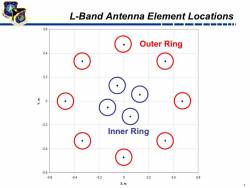
GPS satellite L-band antenna elements

The GPS Wing is reaching out to receiver manufacturers and the user community to gather comments on the SVN49 signal anomaly and the Air Force’s provisional solution to the problem.

Despite earlier news reports suggesting that the problem, which has kept the latest GPS satellite from being declared operational, was on its way to being solved, a GPS Wing spokesperson characterized the remedy of altering the satellite’s broadcast orbital position (ephemeris) and time as only a “partial fix.” Indeed, high-precision dual-frequency users, such as those in the International GNSS Service, may continue to encounter difficulties in handling the SVN49 signal.

Read More >

By Inside GNSS
[uam_ad id="183541"]
June 25, 2009

FAA Awards New WAAS Receiver Contract to NovAtel

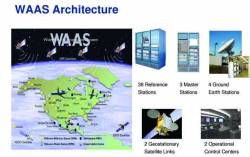
FAA graphic

GNSS manufacturer NovAtel Inc., of Calgary, Alberta, Canada, has received a new contract from the Federal Aviation Administration (FAA) to develop the next-generation GPS Wide Area Augmentation System (WAAS) reference receiver (the “GIII” receiver). The three-year contract is worth up to US$9.7million.

Read More >

By Inside GNSS

Saving GPS SVN49: Tweaking Satellite Ephemerides and Time

When GPS reference receivers at the European Space Operations Center (ESOC) detected a 150-meter error in the broadcast ephemerides (orbital position) for the latest GPS satellite — Space Vehicle Number 49 or SVN49 — scientists there assumed that a problem had arisen with the spacecraft’s navigation payload.

After all, coupled with an apparent 500-nanosecond clock error, the ephemerides could produce many kilometers of errors for navigation receivers.

Read More >

By Inside GNSS
June 16, 2009

Air Force May Be Able to Fix Problem with Latest GPS Satellite

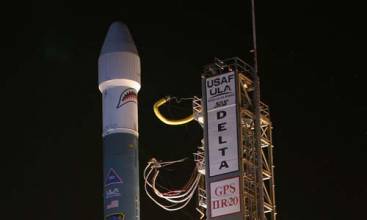
Members of the 45th Launch Support Squadron, along with the 45th Range Management Squadron’s GPS team, pause in front of the GPS IIR-20 satellite atop its Detla II booster prior to its launch March 24. (Lockheed Martin photo/Bruce Johnson)

U.S. Air Force officials have confirmed that signal anomalies on the latest GPS satellite — IIR-20(M), also identified as SVN49/PRN01 — are related to the interface to the new L5 payload also on board.

But the problem appears fixable.

The spacecraft has remained is still in early orbit checkout since its launch on March 24 and has not been introduced into the operational constellation.  

A dedicated response team of Air Force and contractor experts are wrapping up their investigation of the cause of the L1 signal anomalies, which were detected on April 9. The signal distortion was initially observed as an elevation-dependent bias in ranging measurements from GPS monitor stations.

Read More >

By Inside GNSS

ESA Signs Galileo IOV Launch, FOC Satellite Contracts

René Oosterlinck, ESA director of the Galileo Program and Navigation-related Activities (center), and Jean-Yves Le Gall, chairman and CEO Arianespace (left), sign the Galileo In-Orbit Validation Launch Services Contract in the ESA Pavilion at the Paris Air Show, Le Bourget. Paul Verhoef, programme manager of EU Satellite Navigation Programs at the European Commission. ESA photo — S. Corvaja, 2009

On June 15, the European Space Agency (ESA) signed contracts for launch services on the Galileo in-orbit validation (IOV) satellites as well as two additional contracts for “long lead items” needed to build the full operational capability (FOC) Galileo constellation of satellites.

The first contract, with Arianespace, will provide launch services for the four IOV Galileo satellites that will be placed in orbit by the end of 2010. Two Soyuz rockets, each carrying two Galileo spacecraft, will launch from Europe’s Spaceport in French Guiana.

Read More >

By Inside GNSS
[uam_ad id="183541"]
June 15, 2009

eLoran: The Never-Ending Story?

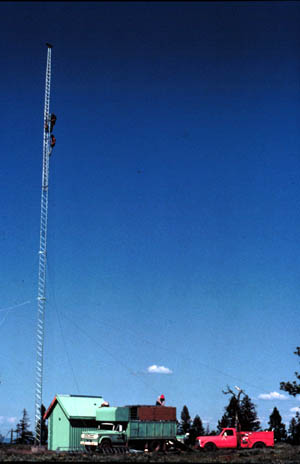
Loran tower – Starkey Loran research photos 2001

To say that enhanced Loran (eLoran) has been an on-again off-again program would give short shrift to multiple generations of official ambivalence about the proposed backup for GPS.

The latest chapter began on June 4 when Senator Maria Cantwell (D-Washington) introduced S. 1194, the Coast Guard Authorization Act for Fiscal Years 2010 and 2011 (FY2010/11).

Among other details, the measure directs the Secretary of Transportation to continue the Loran system until a plan has been drawn up and implemented to transition the program to eLoran.

Read More >

By Inside GNSS
June 4, 2009

Applanix Introduces New Aerial Digital Photogrammetric System

Applanix
has introduced the POSTrack 410 flight management and direct
georeferencing system designed for use with the latest generation of
medium-format airborne digital photogrammetric camera.

The POSTrack 410 incorporates Applanix’s POS AV GNSS-inertial navigation
system (INS) and POSPac Mobile Mapping Suite (MMS) office software,
featuring the IN-Fusion technology and SmartBase module. This system
can process both GPS and GLONASS signals as well as those from
satellite-based augmentation systems.

Read More >

By Inside GNSS

Changes in Store for U.S. Military GPS Equipment Development and Acquisition

DAGR 2008. Rockwell Collins image

Development and acquisition of military GPS user equipment (MGUE) are taking on new dimensions across the board — institutionally, procedurally, and technologically.

Along the way, the changes could redefine relationships within the Department of Defense (DoD) and between the agency and industry.

At the agency level, a proposal is forthcoming to “stand up” a positioning, navigation, and timing (PNT) user equipment joint program office (JPO) that would incorporate UE responsibilities (and budgets) now exercised by the GPS Wing (GPSW).

Read More >

By Inside GNSS
June 3, 2009

Pacific Crest Picks GNSS Industry Veteran to Head OEM Effort

Pacific Crest Corporation has  appointed GPS/GNSS industry veteran Don Speedy to head business development and sales for North America. With more than nine years of successful experience in business development and OEM GNSS, geographic information systems (GIS) and survey sales, Speedy will be responsible for driving strategic partnerships in OEM GNSS and data link communications while maintaining regional relationships.

Read More >

By Inside GNSS
May 25, 2009

GAO Report on GPS Satellite Constellation Status: The Pushback

Two weeks after a Government Accountability Office (GAO) report warned of potential gaps in the GPS satellite constellation, reassurances from Department of Defense (DoD), U.S. Air Force, GPS program officials, and industry are slowly restoring calm to an anxious public.

Coupled with a May 7 congressional hearing (and subsequent media coverage) that fanned the flames, the report described scenarios — for instance a two-year setback in launching the first GPS III spacecraft — that could lead to deterioration in the quality of GPS service due to delays in building new generations of satellites and past program management problems. The news coverage drew primarily on the GAO report and prepared statements presented at the hearing and not on the much more interesting dialog with subcommittee members captured on video or on the assumptions and methodology underlying the constellation analysis.

Read More >

By Inside GNSS
May 22, 2009

First Look: Initial Observations of the GPS L5 Broadcast and L1 Signal Anomaly

(Updated May 22, 2009) Leading researchers from Ohio University, Stanford, and the University of Colorado have released their initial observations of the GPS L5 signal broadcast, including an anomaly in SVN49’s L1 signal reported by the GPS Wing’s chief engineer on May 4.

The U.S. Air Force switched on the eagerly awaited, modernized L5 signal on April 10 after the successful launch of the newest GPS Block IIR-M satellite – SVN49 – in March. This was the first broadcast of a GPS signal in a frequency band dedicated solely for civilian use.

Read More >

By Inside GNSS
IGM_e-news_subscribe