GPS

April 20, 2009

Septentrio Receivers Track L5, Other SVN49 Signals

SVN49 L1 C/A (red) and L5 Signals. Septentrio image.

Septentrio reports success in tracking five signals being transmitted from the modernized GPS Block IIR satellite with the L5 demonstration payload launched on March 24.

Now designated space vehicle number 49 (SVN49), the satellite began broadcasting in the L1 and L2 band on March 28, shortly after the spacecraft reached its quasi-circular middle earth sorbit.

Read More >

By Inside GNSS
[uam_ad id="183541"]
April 10, 2009

Air Force Secures ITU Filing with GPS L5 Signal Transmission

Time Series and Power Spectrum of the L5 Demonstration Signal

The GPS IIR-20(M) satellite successfully transmitted for the first time a GPS signal in the L5 frequency band today (April 10), according to the U.S. Air Force operators of the Global Positioning System. L5, the third civil GPS signal, will eventually support safety-of-life applications for aviation and provide improved availability and accuracy to users.

Read More >

By Inside GNSS
April 9, 2009

GPS L5 Signal Goes on the Air April 10

Stanford “Big Dish” Antenna

U.S. Air Force officials are moving quickly to turn on the new civil GPS L5 signal after lengthy delays due to technical problems had brought the program close to an International Telecommunications Union (ITU) deadline for transmitting on the frequency.

The Air Force plans to begin transmitting the signal at 5 a.m. (PDT) on April 10 using the Block II R-20(M) satellite launched March 24. An L5 signal demonstration is planned the same day, organized by the GPS Wing and SRI International. The L5 spectrum will be received and plotted at the SRI’s 150-foot “big dish” antenna facility in the hills over looking Stanford University, California.

Read More >

By Inside GNSS

earthmine Launches 3D Mapping System Driven by GPS, Inertial

John Ristevski

Privacy rebellions such as recently drove a Google Street View crew from Broughton, England, or security-oriented legislation that would require blurred features or position accuracy in commercial imagery is just part of the market environment for 3-D mapping company earthmine, Inc., which is moving out of beta mode into full-fledged operations.

Read More >

By Inside GNSS
[uam_ad id="183541"]

An Expanding CAST Navigation Moves to New Facilities

CAST Navigation LLC is relocating to expanded facilities as a result of increased demand for the company’s GPS simulators, GPS/INS navigation test equipment, and embedded GPS/inertial (EGI) integration tools.

Effective April 20, the new physical location for the CAST Navigation team will be: One Highwood Drive, Suite 100, Tewksbury, MA 01876. Phone contact is 978-858-0130. Faxes may be sent to 978-858-0170; website, <www.castnav.com>.

Read More >

By Inside GNSS
March 30, 2009

Geotagging: u-blox Buys Geotate

Typical implementation of geotagging in camera. Source: Geotate

In a €5.5-million cash deal, u-blox AG, of Thalwil, Switzerland, has acquired Geotate B.V. and its patented technology and products in the area of software GPS and geotagging GPS.

The acquisition will enable u-blox to expand its position in consumer markets with geotagging solutions for digital camera manufacturers and other portable device manufacturers.

Read More >

By Inside GNSS
March 24, 2009

SSTL Leads Team Developing GNSS-Based Remote Sensing of Sea State

Sea State Monitoring

Surrey Satellite Technology Limited (SSTL) will lead a British project to exploit signals from GPS and other GNSS satellites that are reflected from the Earth for remote sensing purposes.

The project will investigate a prototype instrument capable of measuring the roughness of the sea and soil moisture content, providing data for atmospheric science and for operational ocean and weather forecasting.

Read More >

By Inside GNSS

OnPOZ Offers Free ArcPad GNSS Driver Extension

Montreal, Quebec, Canada–based OnPOZ Precision Positioning has released, GNSS Driver for ArcPad, a new extension to the ESRI product that allows GNSS post-processing using different GNSS receiver brands.

The receiver-independent extension can significantly improve GNSS/GIS data accuracy and reliability, logging real-time positions, metadata, and all GNSS observations in order to increase the reliability and accuracy of GNSS positions by post-processing ESRI Shapefiles.

Read More >

By Inside GNSS

GPS Satellite with L5 Payload Launches Successfully

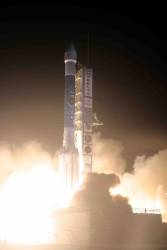
Block IIR-20(M) launch from Cape Canaveral. Photo by Carleton Bailie, United Launch Alliance.

GPS program managers and users — especially the U.S. civil aviation community — can breathe a sign of relief following the successful launch Tuesday (March 24) of a satellite carrying a demonstration payload of the new L5 signal.

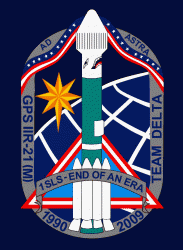
Built by the Lockheed Martin Company, the modernized Block II replenishment spacecraft, GPS IIR-20(M), is moving toward plane B, slot 2 to replace space vehicle number (SVN) 30. If all goes well, U.S. Air Force controllers expect to set the satellite healthy for navigation users worldwide next month.

Among other signals and capabilities, the IIR-20(M) will be the first to transmit the new GPS civil signal centered on 1176.45MHz (±12 MHz) within the protected aeronautical radionavigation service (ARNS) band. This so-called L5 signal will provide a second safety-of-life signal that meets the technical requirements for enabling aircraft to make precision landings in high multipath environments.

Read More >

By Inside GNSS
IGM_e-news_subscribe