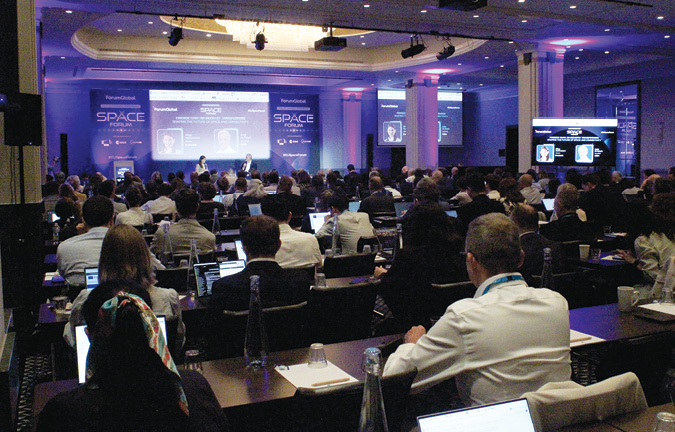
The European Space Forum held annually in Brussels reflects Europe’s high-level priorities in space. This year’s edition revealed how fundamentally those priorities have changed in the face of evolving geopolitical realities.
In 2026, the key topics for the European space community remain: Galileo, IRIS², launch capabilities, Earth observation, connectivity and industrial competitiveness. But the old continent is not discussing these old familiar themes in the same old familiar ways. No longer are these matters purely economic or technological. Instead, many at this year’s European Space Forum were asking how Europe can build space capabilities that are capable of surviving conflict.
The question was broached repeatedly, and the addition of a dedicated European Space Security and Defense Forum on day three confirmed the new fixation. Security is no longer a parallel discussion. It is one of the main organizing principles around which Europe’s future space architecture will be designed.
Russia’s invasion of Ukraine formed the dark backdrop to the conference. Speakers repeatedly pointed to the war as the clearest demonstration yet that modern military operations depend on space-based services. Satellite communications, positioning, navigation and timing (PNT), Earth observation and space domain awareness have become operational necessities and, increasingly, strategic vulnerabilities.

“Today, we operate in Europe in a fragmented and hyper-competitive environment where non-European LEO constellations have reshaped global markets, innovation cycles outpace procurement cycles.”
Aarti Holla-Maini, Director, United Nations Office for Outer Space Affairs (UNOOSA)
Straight Talk
Belgian Defense Minister Theo Francken offered a stark assessment of Europe’s current position. “The Ukraine war has taught us many lessons,” he said. “One of them is that all our radio communication has become increasingly vulnerable due to intensive jamming and other interference. Satellite communication has come to the rescue, to an extent. Starlink now provides the backbone of Ukrainian military connectivity, enabling command and control and deep strike missions.”
But Francken cautioned against drawing the wrong conclusion. “The success of Starlink in Ukraine is indeed spectacular,” he said, “but it should not blind us to its weaknesses.” Russia, he noted, rapidly adapted, first by exploiting Starlink before access controls were tightened, then by accelerating development of its own large satellite communications constellation.
“Just last month,” Francken said, “researchers from the University of Texas published compelling evidence that Russian military satellites have been transmitting GPS interference from orbit. If these findings are confirmed, they mark a profound shift in electronic warfare. A space-based jammer can project interference across vast areas while remaining safely in orbit, making it far more difficult to detect, attribute and counter.
“It is fair to say that the United States took space security matters far more seriously than Europe did,” Francken said. “Over the past two decades, the U.S. has spent more than $25 billion on a comprehensive ecosystem of three military satellite communications constellations. Together, they provide resilience and global military communications to the United States and its closest allies. We don’t have that. Yes, Europe also invested heavily in satellites, but our priorities lay elsewhere. To monitor climate change, ESA, the European Space Agency, spent close to €10 billion on the Copernicus system alone.”
Across Europe, governments are reassessing decades of assumptions that collective security could continue to rely principally on American capabilities. No one at the Space Forum advocated strategic separation from the United States. Rather, the prevailing view was that stronger European capabilities would strengthen the Alliance.

“We are under attack in Europe, and monitoring and alerting governmental services to jamming and spoofing is becoming part of our responsibility.”
Eric Guyader, Engineer, Galileo Program, European Commission DG DEFIS
Germany’s State Secretary Jens Plötner argued that Europe’s objective should not be independence for its own sake, but a more balanced partnership. “We need to be realistic,” he said. “Europe should not seek to replace the U.S. Even if we could, this should not be our goal. But Europe must develop capabilities that complement American strengths, fill gaps where they exist or grow, and provide resilience to American assets when they are stretched.
“Galileo provides this capability,” Plötner said, “but only if we invest in military receivers, integrate Galileo into our defense system, and exercise with it on a regular basis. The same logic applies across the board, in reconnaissance, communication and early warning. Not to decouple, but to build a partnership with greater balance and strength should be our goal.”
Rules of the Road, in Competition and Cooperation
Regulation emerged as the other key theme at this year’s Space Forum. Europe has propounded of late the need for greater strategic autonomy, but speakers repeatedly stressed that autonomy cannot come at the expense of openness, innovation or international cooperation.
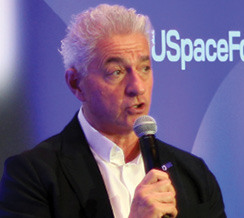


Aarti Holla-Maini, Director of the United Nations Office for Outer Space Affairs (UNOOSA), reflected on how dramatically Europe’s priorities have shifted since the Forum first convened. “Since the first edition five years ago, the world has completely changed,” she said. “Today, we operate in Europe in a fragmented and hyper-competitive environment where non-European LEO constellations have reshaped global markets, innovation cycles outpace procurement cycles, Europe’s strategic dependencies have been fully exposed, and space security risks have multiplied.”
Europe has proven that it can build world-class public infrastructure, Holla-Maini argued: “Copernicus is the world’s most comprehensive civilian Earth observation program. Galileo is the world’s first major civilian-controlled GNSS system. Both are used every day by billions of people.”
The proposed EU Space Act, she said, is the logical next step. “The Act provides a single, predictable regulatory environment for all operators, ensuring that European values of safety, sustainability and responsible behavior are not just words, but principles required of all players wishing to operate in the European market.”

“Autonomy does not mean acting alone. Space has always been built on partnerships.”
Laurent Jaffart, Director of Connectivity and Secure Communications, European Space Agency (ESA)
The proposed legislation, unveiled by the European Commission in June 2025, would replace today’s patchwork of national rules with a common framework covering safety, cyber resilience and sustainability. Just as significantly, its provisions would apply to all operators serving the European market, making it an instrument of international standard-setting as well as internal regulation.
Industry broadly welcomed that ambition, while warning against unnecessary complexity. Adel Al-Saleh, Group CEO of SES and Vice-Chair of the Global Satellite Operators Association (GSOA), described regulation as one of the industry’s biggest concerns. “Europe has a unique opportunity with the European Space Act and the new Digital Networks Act to do something very special,” he said. “However, there are also concerns. Investors want predictability. They want something they can count on and understand. And these regulations have got to be non-discriminatory. Innovation is global in nature.”
Through Thick and Thin
Those concerns were echoed, in measured terms, from Washington. Caitlin Poling, Foreign Affairs Officer at the U.S. Department of State, made clear that the United States recognizes Europe’s desire to strengthen its own capabilities. “When we discuss European strategic autonomy, just like when we say ‘America first’, it doesn’t mean ‘America alone.’ European nations and organizations, as well as the United States, are smart to ensure that we all have the capabilities we need. Strategic redundancies are vital. If we think about them in that context, the conversation about strategic autonomy moves away from exclusion and toward cooperation.”
Poling’s concern, she said, is not the objective of the Space Act, but its implementation. “We’ve consulted with more than 100 U.S. and international space companies over the past year and a half,” she said. “We support the goal of a coherent framework to simplify civil, commercial and security cooperation. We just don’t want to see regulatory barriers erected to keep out existing and longstanding partners.”
The United States, Poling said, hopes the legislation will preserve a six decades-long history of transatlantic cooperation while avoiding unintended consequences that make it harder for governments and companies on either side of the Atlantic to work together.
Galileo’s Next Chapter
While the wider conference established Europe’s strategic direction, the dedicated Galileo session examined what it all means for Europe’s flagship PNT program. Galileo is clearly a major success, but how does it need to evolve to remain resilient in a contested operational environment?
Ennio Guarino, Head of the Galileo and EGNOS Program Department at ESA, argued that evolution is already underway. “Galileo is one of the most accurate and reliable GNSS systems in the world,” he said. “Galileo Second Generation, which we are now working on, will provide even more flexibility, additional levels of resilience and secure solutions, together with additional functionalities and services.”
But, Guarino said, “In the last decades there was an assumption that resilience meant additional redundancy, either in space or on the ground. Today, for ESA it means something more. It’s a matter of diversification. I believe Europe is now in the right position to evolve toward a multi-layer ecosystem.

“There is no more room for static systems. We are subject to jamming and spoofing every single day.”
Ennio Guarino, Head of the Galileo and EGNOS Program Department, European Space Agency (ESA)
“EGNOS V3 will provide secure-by-design services and process both GPS and Galileo. And since the 2022 ESA Ministerial Council, the Agency has been moving forward with its LEO PNT initiative, with the in-orbit demonstration satellite already flying. The latest Ministerial Council approved substantial further funding to move toward the initial operational phase. So, we are working hand in hand with the Commission on what will become the future EU PNT architecture. It’s a matter of aggregating and finding the complementarity among all these layers to provide resilient services for European citizens.”
Marco Caparrini, Galileo Open Service Manager at EUSPA, argued that resilience extends beyond satellites and ground infrastructure to the user segment itself. “One additional layer we should consider is the user segment. Galileo was created to give Europe autonomy, and it has done that. We own the system. But in reality, you can exploit that autonomy only as long as the user is able to use the service, even when somebody is trying to deny the service, disrupt operations or even attack the system.”
Caparrini pointed to Open Service Navigation Message Authentication (OSNMA) as a practical example. “Galileo is delivering OSNMA, a new layer of security that we provide to users, but only to users who are able to exploit it. The key point is translating those capabilities into receivers across all markets. Otherwise, we don’t get the benefit of what the system is providing.” For Caparrini, the accuracy of the service is no longer the sole issue. “The question now is how trustworthy it is, how available, how robust it is.”
The Best Bettered
Eric Guyader, Engineer, Galileo Program at European Commission DG DEFIS, turned to what many regard as Galileo’s most strategically significant capability: the Public Regulated Service (PRS). “PRS is the most robust service we are delivering in Galileo. It exists today and we are developing a new version of PRS within Galileo Second Generation with unprecedented capabilities. Of course, we cannot discuss those capabilities because they are classified, but from the point of view of resilience, I think we are in a very good position.”
The challenge, Guyader argued, is to get people using it. “What matters now is that our governments start implementing the service. If it is not used, if it is not fully integrated into national capabilities, then we are missing something and we are not resilient. That transition, he said, will take time. “We have depended on the Americans, once again, with military-grade GPS services, for decades. It takes time to change defense capabilities and operational procedures. But now that we have PRS, and now that we are looking toward the second generation of PRS, it’s high time governments started taking action.”
Looking further ahead, Guyader highlighted several priorities now being considered for the next European space program. “We are introducing new elements related to terrestrial PNT. It may sound strange when we’re talking about satellites, but in the next 10 to 20 years, we believe we will need terrestrial back-ups in carefully selected areas. We are also considering new capabilities to monitor interference. We are under attack in Europe, and monitoring and alerting governmental services to jamming and spoofing is becoming part of our responsibility.”
He also identified a less obvious vulnerability. “We need new engineers to develop, manufacture and operate these systems. If we lack knowledge or have to rely on industries outside Europe, I think we have a problem. That’s part of our autonomy and resilience too.”
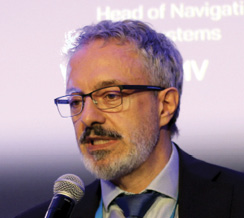
Representing industry, Miguel Romay, Head of Navigation Systems at GMV, argued that Europe’s greatest achievement is also its greatest responsibility. “Today we have excellent PNT systems in Europe,” he said. “Galileo and EGNOS are working very, very well and the user community is using them widely. What we have to do over the next 10 years is not lose what we have achieved. If we do nothing, if we keep the systems as they are, the risks keep increasing. That’s why we need continuous evolution of the system. That evolution has to be supported by the institutions and implemented by industry.”
Romay welcomed Galileo Second Generation and the emergence of LEO PNT, while stressing that resilience extends well beyond satellites. “Europe is moving in the right direction. But we also need complementary technologies: terrestrial positioning, inertial sensors, visual sensors and probably artificial intelligence at receiver level to discriminate good signals from jamming and spoofing. It’s like cybersecurity. You have to keep improving all the time.”
Guarino agreed: “There is no more room for static systems. We are subject to jamming and spoofing every single day. We need to design Galileo, EGNOS and future LEO PNT with the capability to evolve progressively and continuously. Continuous improvement is no longer optional. It is one of the main system requirements.”

“Europe’s space infrastructure has become critical infrastructure, and we have to protect it as such.”
Christophe Morand, Director for Space, Connectivity and Secure Communications, European Commission DG DEFIS
Make it Last
No one should underestimate the potential long-term impact of what’s playing out today on the European Union’s eastern border. But looking beyond the immediate geopolitical moment, can Europe build a space sector capable of sustaining real strategic autonomy over decades rather than across a few political cycles? For Christophe Morand, Director for Space, Connectivity and Secure Communications at the European Commission’s DG DEFIS, that means thinking about Europe’s space programs as a single strategic ecosystem rather than a collection of individual projects.
“Europe has built exceptional assets,” Morand said, citing Galileo, Copernicus, GOVSATCOM and IRIS². “The question now is how we ensure they work together and into the future to provide the resilience Europe needs. For that, the next Multiannual Financial Framework will be a key moment. We need continuity. Space programs cannot stop and start every seven years. Industry needs predictability. Innovation needs predictability. Our strategic autonomy depends on predictability.”
Morand said resilience must be designed into every program. “Security is not something you bolt on at the end of a program. It has to be designed in from the beginning. Cyber resilience, physical resilience, supply-chain resilience, operational resilience, they all have to be considered together. Europe’s space infrastructure has become critical infrastructure, and we have to protect it as such.”
Laurent Jaffart, Director of Connectivity and Secure Communications at ESA, argued Europe already possesses the required technologies. “What we need now is speed,” he said. “We need to move faster from demonstration to operational systems. We need to shorten development cycles while maintaining the quality and reliability that Europe is known for.”
Jaffart cautioned against equating strategic autonomy with isolation. “Autonomy does not mean acting alone. Space has always been built on partnerships. We will continue working with international partners wherever it serves our mutual interests. But Europe must be able to act whenever necessary using its own capabilities.”
So, Europe is not retreating from international cooperation. Rather, it is redefining its role within it, seeking to become a stronger and more capable partner while reducing the strategic dependencies exposed by recent crises.
Francken returned to that theme. “For decades, we treated space as an enabler. Today, it has become an operational domain in its own right. Europe cannot afford to be dependent where space is concerned. We need our own capabilities, we need trusted partners and we need the political will to invest in both.”