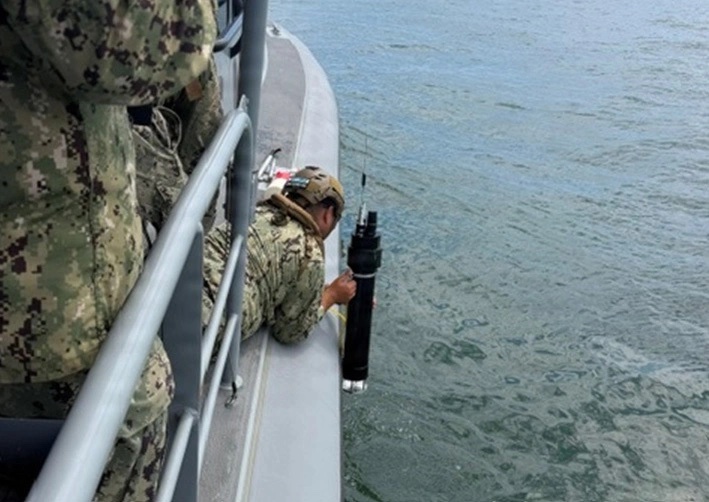
The U.S. Army, Navy and Space Force put a maritime version of an electronic warfare system called Hammer of the Gods to sea for the first time in mid-July 2026, during Project Convergence Capstone 6 (PC-C6), the Army’s large-scale joint experimentation event.
Hammer of the Gods is a deployable emitter designed to provide command-and-control and electronic warfare capabilities with a low electromagnetic signature. Land-based versions have appeared in exercises over the past two years, but PC-C6 marked the system’s maritime debut, with U.S. Space Forces Pacific and Naval Base San Diego supporting the integration.
PNT resilience was the central objective
The test centered on countering Positioning, Navigation and Timing (PNT) disruption — the GPS-dependent functions underpinning navigation, communications, precision-guided weapons and uncrewed systems. According to the Army, the exercise demonstrated that counter-PNT capabilities could be deployed, controlled and recovered during real-world maritime operations while extending reach through mesh networking.
Lt. Col. Darrin Hall, chief of Modeling, Simulation and Integration (S7/8) for U.S. Space Forces Pacific, said the test was meant to validate joint operation across services in contested electromagnetic environments, and that PNT disruption directly affects the precision of long-range artillery, guided missiles and cruise munitions.
Project Convergence is the Army’s recurring venue for testing emerging technology under joint and multinational conditions; PC-C6 ran on the West Coast in July 2026 and was hosted out of Fort Irwin, California, with the maritime Hammer of the Gods work specifically supported out of Naval Base San Diego. The event also included other counter-PNT and joint C2 experimentation feeding into the Army’s Next Generation Command and Control (NGC2) effort.


_web.jpg "Canadian Army to Test NovAtel’s GAJT GPS Anti-Jam Antenna")