
Oscilloquartz brings telecom-scale timing expertise to defense networks.
For decades, timing has been the least visible element of positioning, navigation and timing. Positioning and navigation tend to draw the operational attention. Timing sits deeper in the architecture, synchronizing networks, aligning systems and enabling the data flows modern missions require. But in contested environments, where GNSS signals can be jammed, spoofed or lost, timing is no longer a background utility. It becomes a measure of resilience.
That is the market Oscilloquartz is addressing. The company has more than 75 years of timing heritage and a long record in telecom synchronization, but its current strategy is aimed at a defense market that is beginning to treat trusted time as a core requirement for resilient PNT.
Gil Biran, who leads Oscilloquartz, describes the company’s position directly. “We are the timing enabler for any PNT mission-critical defense network,” he said. That statement reflects both technical confidence and strategic ambition. Oscilloquartz wants to be understood not simply as a supplier of clocks, but as a provider of timing architectures for defense users operating in degraded and contested environments, including mobile deployments.”
The shift builds on the company’s experience in mobile networks. When Biran took over the business after its acquisition from the Swatch Group, Oscilloquartz had lost ground in what had become one of the most demanding timing markets. The company refocused on systems rather than components and built an NTP and PTP portfolio around the synchronization needs of mobile operators. Oscilloquartz, Biran said, moved from roughly 20% share in mobile operators globally to about 80%.
That experience matters because telecom forced the company to solve timing as a network problem with accuracy that was measured in nanoseconds. Mobile operators needed synchronization at scale, across large distributed networks, with high availability, resiliency and standards-based performance. Defense users need many of the same fundamentals, but under more severe conditions.
FROM TELECOM SYNCHRONIZATION TO DEFENSE TIMING
“The foundational requirements for PNT are the same across mission-critical networks, whether it’s a mobile operator, power utility or defense organization,” Biran said. “Now, we have to focus on the differences.”
Those differences are significant. In telecom, timing equipment is generally installed in fixed sites. In defense, timing has to operate across ground, airborne, maritime and mobile applications. Systems may be mounted in vehicles, deployed in command centers, integrated into shelters, placed on platforms or connected to legacy infrastructure.
Biran identifies two immediate translation points from telecom to defense: physical interfaces and ruggedization. Defense networks retain large amounts of legacy infrastructure, and timing systems must connect to what is already fielded. “Defense is all about legacy,” he said. “It’s all about equipment that is sitting there for tens of years, and nobody’s going to touch.” To participate in those architectures, Oscilloquartz has had to support specialized physical interfaces that are uncommon in commercial telecom networks.
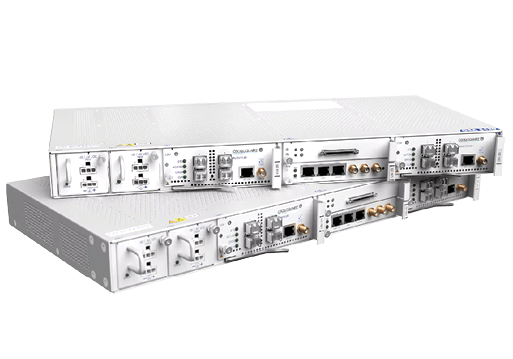
The second requirement is ruggedization. “In the telecom space everything is on the ground, everything is in a fixed location,” Biran said. “When you move to defense, you have ground applications, you have airborne applications, you have maritime applications, and now in most of these applications you are on the move.” That reality is behind the launch of the ruggedSync™ Series OSA 5510, which Biran describes as a rugged clock unit designed to bring Oscilloquartz’s timing capabilities into defense environments without rebuilding the entire product concept.
The deeper defense requirement is not only rugged hardware. It is trust.
For years, many timing architectures treated GNSS as the primary source and internal oscillators or network references as backups. Biran argues that this model no longer fits the threat environment. “The primary is GNSS,” he said. “Why set the least reliable source as the primary? That was good for the old days, not today.”

ZERO-TRUST TIMING IN A GNSS-DENIED WORLD
That observation leads directly to Oscilloquartz’s view of zero-trust timing. In practical terms, zero trust means no single timing source is accepted without evaluation. A defense node should be able to compare multiple timing inputs, assign different levels of confidence to each source depending on its reliability, detect anomalies and continue distributing trusted time. The issue is not whether GNSS remains useful. It does. The issue is whether the architecture depends on GNSS as an unquestioned authority.
“Every node in the network should have as many as possible sources, and the focus should be on diversified sources,” Biran said. In that model, GNSS may be one input, but it is not the only one. Other sources may include LEO-based timing, terrestrial RF sources, NIST references, PTP, White Rabbit and local atomic clocks. Biran compares the architecture to a recipe in which different sources receive different weights according to their reliability. Cesium, because it does not depend on an external signal, carries a different weight than a satellite signal that can be denied or manipulated.
This is where Oscilloquartz sees cesium and optical pumping as central to defense timing resilience. Holdover is often discussed as a clock specification, but in defense it is better understood as the last line of defense. If a system can maintain trusted time after GNSS is lost, it can continue operating. If it cannot, the network and the mission begin to degrade.
Biran points to submarines as a clear example. “Why do submarines need the cesium clock? Because if you’re underwater for two months, you will not know where you are unless you have a reliable, accurate clock source,” he said. The same principle extends beyond the undersea domain. As defense systems become more mobile and as GNSS denial becomes more common, the ability to maintain time without external reference becomes a strategic capability.
Oscilloquartz has invested in optical pumping technology for cesium clocks for much more than a decade, work Biran links to both performance and size. He said the company can hold 100 nanoseconds for up to 150 days, a figure he contrasts with rubidium-class holdover at far shorter durations. “Even if GNSS will disappear for six months, we can still maintain the mission critical network with this level of accuracy,” he said. He also makes clear that this is not only about duration. Airborne and mobile systems impose constraints on size, weight and stability under vibration. “You have lasers inside the box,” Biran said. “How do you make sure that the laser is stable enough when the unit is moving, is under vibration? This is not a simple challenge.”

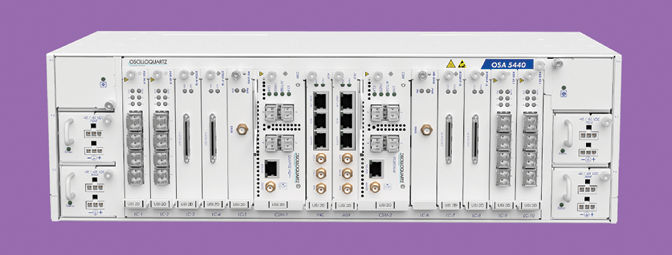
The larger point is that defense organizations should not think about timing as a collection of individual devices. They need to think about time as a distributed system-level resource. A high-stability core clock is important, but it is not enough. Trusted time has to move across networks, reach edge nodes, be monitored, compared, managed and protected.
“Our solution is not just a box,” Biran said. “It’s a networking solution.” He points to White Rabbit technology as one path for distributing high-accuracy timing over fiber, and to management systems that allow operators to see and control timing across the network. In a contested environment, that visibility matters. Operators need to know which sources are available, which nodes are degraded, where timing quality is changing and when the system has shifted into holdover.
ASSURED TIME AS A NETWORK ARCHITECTURE
The company is also watching a broader shift toward distributed timescale solutions. Historically, national timing could be delivered from a small number of sites. That model becomes harder as users need tighter timing closer to the mission. “You need to bring the time scale source close to the customer,” Biran said. He sees defense organizations moving toward more localized time sources, including service-level or agency-level timescales that can support operational networks without depending entirely on distant infrastructure.
For Oscilloquartz, the technical strategy is now being matched by a go-to-market shift. Biran is direct about the distinction: selling into defense is not the same as selling into telecom. The company has added sales talent with defense-sector experience, expanded its U.S. channel through representation firms focused on defense markets, and is building out value-added reseller relationships with defense expertise in EMEA and APAC. The customer path is different as well.
“We are not selling the full defense solution,” Biran said. “We are providing the timing that enables these vendors and system integrators to provide a full end-to-end defense solution.”
That distinction is important for the U.S. DoD market. Timing is rarely purchased in isolation. It is specified into systems, integrated into platforms and evaluated as part of larger mission
architectures. Oscilloquartz’s near-term task is therefore as much educational as commercial. It must show defense users that the “T” in PNT is not a supporting detail. It is a foundation for network resilience, autonomy and operational continuity.
How will Oscilloquartz know it has succeeded? Biran points to revenue mix, defense leads, pipeline growth and program wins. The company, he said, has already won major defense projects, including in the United States, though he does not name them, due to the confidential nature of the business. The broader milestone will be market recognition: when Oscilloquartz is seen not only as a telecom synchronization company, but as a global defense timing provider.
For defense users, the underlying issue is clear. GNSS will remain essential, but it cannot be the only trusted source of time. The next phase of PNT will depend on architectures that can evaluate, preserve and distribute time even when the external environment is compromised. Oscilloquartz is betting that its telecom-scale experience, rugged timing portfolio, cesium technology and zero-trust approach position it for that shift.
In Biran’s words, “The baseline is to have the right solution.” In defense timing, that baseline is moving quickly from accurate clocks to assured and resilient time.